Volume 32, Number 7—July 2026
Research
Adeno-Associated Virus Type 2 and Human Adenovirus Species F Type 41 Co-infection Associated with Acute Severe Hepatitis in Children, California, USA
Ran Zhuo1, Colette J. Matysiak Match1, Sanchi Malhotra, Huan Vinh Dong, Kristina Adachi, Robert S. Venick, Grace Aldrovandi, and Shangxin Yang
Figure
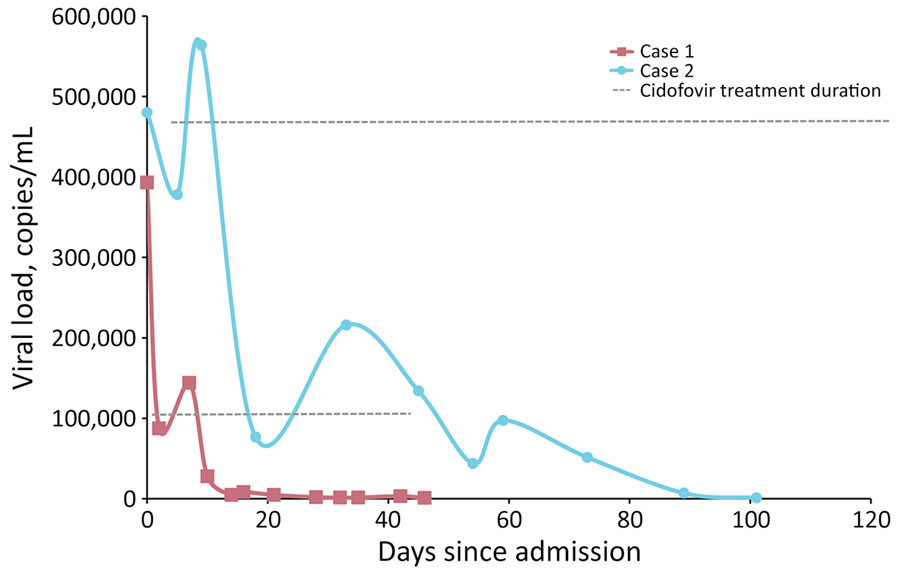
Figure. Longitudinal human adenovirus species F type 41 viral loads measured by quantitative PCR in whole-blood specimens from 2 pediatric cases of acute severe hepatitis of unknown etiology associated with adeno-associated virus type 2 and human adenovirus species F type 41 co-infection, California, USA. Viral loads are plotted against hospital day, illustrating high viremia preceding antiviral therapy and liver transplantation in case 1, the subsequent decline during cidofovir treatment, and persistent low-level detection despite clinical improvement in case 2.
1These authors contributed equally to this article.
Page created: May 06, 2026
Page updated: June 26, 2026
Page reviewed: June 26, 2026
The conclusions, findings, and opinions expressed by authors contributing to this journal do not necessarily reflect the official position of the U.S. Department of Health and Human Services, the Public Health Service, the Centers for Disease Control and Prevention, or the authors' affiliated institutions. Use of trade names is for identification only and does not imply endorsement by any of the groups named above.