Volume 32, Number 7—July 2026
Research Letter
Dracunculus sp. PantanalBr Infection in Florida Panthers and Bobcat, Florida, USA

 , Alexander Perez, Kayla B. Garrett, Christopher A. Cleveland, Mark Cunningham, Peter Sebastian, Bambi Clemons, Jeff M. Gruntmeir, and Heather D.S. Walden
Cite This Article
Citation for Media
Abstract
We used morphologic and genetic methods to analyze subcutaneous worms removed from endangered Florida panthers and a bobcat in Florida, USA, identifying Dracunculus sp. PantanalBr and several Dirofilaria spp. worms. Dracunculus sp. PantanalBr had been previously reported in a domestic dog and a jaguar in Brazil.
Dracunculus (Spirurida:Dracunculoidea) are large subcutaneous nematodes that can be found in mammals and reptiles (1). The life cycle of the parasites involves ingestion of infected cyclopoid copepods via drinking water, although consumption of paratenic or transport hosts (amphibians, fish) may also be involved (1,2). Female Dracunculus nematodes are morphologically indistinguishable by species and more commonly detected than the much smaller male nematodes, so sequence analysis is necessary for species identification (1).
Six of 15 Dracunculus species infect mammals, and most studies focus on the human Guinea worm, Dracunculus medinensis, in Africa (1). In North America, studies have reported 4 mammalian Dracunculus spp. nematodes: D. insignis (in various wild carnivores, dogs, cats), D. lutrae and an undescribed species (in river otters [Lontra canadensis]), and another undescribed species (in a Virginia opossum [Didephis virginianus], a river otter [USA], and a dog [Spain]) (1,3–5). Researchers have reported 3 Dracunculus nematode species in South America: D. jaguape (in a neotropical otter [Lontra longicaudis]), D. fuelleborni (in a big-eared opossum [Didelphis aurita]), and an undescribed species (Dracunculus sp. PantanalBr) (in dogs and a jaguar [Panthera onca] in Brazil) (6,7).
The Florida panther (Puma concolor coryi) is an endangered North American puma (P. c. couguar) subspecies restricted to South Florida. As part of mortality investigations, Florida Fish and Wildlife Conservation Commission veterinarians perform necropsies on panthers and bobcats (Lynx rufus). This study reports the findings related to worms collected from anthers and a bobcat, including detection of Dracunculus sp. PantanalBr.
Figure 1
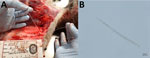
Figure 1. Dracunculus sp. PantanalBR nematode samples collected in investigation of Dracunculus sp. PantanalBr infection in Florida panthers and a bobcat, Florida, USA. A) Female Dracunculussp. PantanalBR...
We removed subcutaneous or internal parasites from 12 Florida panthers and 1 bobcat collected in Florida during 2002–2025, preserving the samples in formalin or 70% ethanol (Figure 1, panel A; Appendix 1 Table). We morphologically identified and genetically characterized all worms collected (Appendix 1).
Most worms were fragments, so we based identification on a combination of sequence analysis and morphology (characteristic first-stage larvae) (Figure 1, panel B). We noted 5 panthers and the bobcat to be infected with Dracunculus sp. nematodes, subsequently identifying parasites from 2 of those panthers and the bobcat as Dracunculus sp. PantanalBR. We identified Dirofilaria spp. nematodes in 7 panthers (Appendix 1).
Figure 2
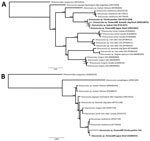
Figure 2. Phylogenetic tree of Dracunculus sp. PantanalBr nematodes collected from Florida panthers and a bobcat, Florida, USA. A) Genetic relationships of Dracunculussp. PantanalBR from a Florida panther...
We obtained partial Dracunculus cytochrome oxidase subunit I (COI) and 18S rRNA sequences from 2 Florida panthers and the bobcat. The two 657-bp COI sequences from Florida panthers were identical and were 99.7% similar to Dracunculus sp. PantanalBR identified in a jaguar and 98.8% similar to Dracunculus sp. PantanalBR detected in a dog (Appendix 2 Table 1). The bobcat worm sequence was 99.5% (654/657 bp) similar to the Florida panther sequences. Phylogenetically, the Florida panther and bobcat worm sequences grouped with the 2 Dracunculus sp. PantanalBR sequences (Figure 2, panel A). The 18S rRNA sequences (956 base pair) from the 2 Florida panthers and bobcat were identical and 99.9% similar to Dracunculus sp. PantanalBR (806/807 bp) (Appendix 2 Table 2). Phylogenetic analysis produced a similar tree to the COI gene (Figure 2, panel B). Larvae from Dracunculus sp. PantanalBR from 1 panther measured 601.67 µm long and 25.56 µm wide.
Our data confirm Dracunculus sp. PantanalBR nematodes in North America. A prior report of female Dracunculus nematodes in Florida panthers was reported as D. insignis in 2 Florida panthers from Monroe County in 1989–1990; however, that investigation included no genetic analysis to confirm species (8). Thus, it is unknown if Florida panthers are hosts for Dracunculus sp. PantanalBR and D. insignis nematodes, although D. insignis nematode infects domestic cats (5). Before our report, researchers reported 3 Dracunculus nematode species in Florida, including 2 undescribed Dracunculus clades in 2 river otters and unspeciated female Dracunculus nematodes in a domestic dog and raccoons (1,3,4). However, because Dracunculus sp. PantanalBR infects dogs and D. insignis nematode is only presumed to occur in Florida, worms from dogs and cats should be genetically characterized to determine species.
The Dracunculus sp. PantanalBR life cycle is unknown, but Dracunculus nematode species use copepods as intermediate hosts, and some species may use aquatic paratenic hosts (1,2). Further studies are needed to determine if this parasitic species is transmitted through ingestion of copepods or through a paratenic host. We discovered the subcutaneous parasites in the animals we studied during routine necropsy, and no lesions were noted, but researchers have observed ulceration and edema in other Dracunculus-infected hosts (1,3–7). Dracunculus infections can cause lameness in some hosts, but observation of clinical signs in free-ranging wildlife might be difficult.
The Florida panther is restricted to southern Florida, and the source of Dracunculus nematodes in the population is unknown. Genetic testing of panthers in Florida identified a unique lineage in the Everglades National Park that appeared to be of South American origin (9,10). Researchers presumed the origin of this unique genotype was the introduction of 7 captive pumas in the 1950–1960s to the park, all of which were brought from Central America (9,10). Although that history suggests a possible introduction route for Dracunculus sp. PantanalBR nematodes, additional surveillance of canids and felids in the Americas is needed to further clarify distribution and risk for infection.
Dr. Yabsley is the Mace Distinguished Professor of wildlife disease ecology, University of Georgia, Athens, Georgia. His research interests include vectorborne, parasitic, and zoonotic pathogens of wildlife and domestic animals.
Acknowledgment
Support was provided by the wildlife management agencies of the Southeastern Cooperative Wildlife Disease Study member states through the Federal Aid to Wildlife Restoration Act (50 Stat. 917) and by a U.S. Department of the Interior Cooperative Agreement. Florida Fish and Wildlife Conservation Commission veterinarians collected Florida panther samples using funding from the Florida Panther Research and Management Trust Fund.
References
- Cleveland CA, Garrett KB, Cozad RA, Williams BM, Murray MH, Yabsley MJ. The wild world of Guinea worms: a review of the genus Dracunculus in wildlife. Int J Parasitol Parasites Wildl. 2018;7:289–300. DOIPubMedGoogle Scholar
- Box EK, Yabsley MJ, Garrett KB, Thompson AT, Wyckoff ST, Cleveland CA. Susceptibility of anurans, lizards, and fish to infection with Dracunculus species larvae and implications for their roles as paratenic hosts. Sci Rep. 2021;11:11802. DOIPubMedGoogle Scholar
- Williams BM, Cleveland CA, Verocai GG, Swanepoel L, Niedringhaus KD, Paras KL, et al. Dracunculus infections in domestic dogs and cats in North America; an under-recognized parasite? Vet Parasitol Reg Stud Reports. 2018;13:148–55. DOIPubMedGoogle Scholar
- Yabsley MJ, Garrett KB, Thompson AT, Box EK, Giner MR, Haynes E, et al. Otterly diverse—a high diversity of Dracunculus species (Spirurida: Dracunculoidea) in North American river otters (Lontra canadensis). Int J Parasitol Parasites Wildl. 2024;23:
100922 . DOIPubMedGoogle Scholar - Cleveland CA, Eberhard ML, Garrett KB, Thompson AT, Swanepoel L, Miller EA, et al. Dracunculus species in meso-mammals from Georgia, United States, and implications for the Guinea Worm Eradication Program in Chad, Africa. J Parasitol. 2020;106:616–22. DOIPubMedGoogle Scholar
- Fagundes-Moreira R, Bezerra-Santos MA, May-Junior JA, Baggio-Souza V, Rampim LE, Sartorello LR, et al. The jaguar (Panthera onca) as a potential new host of Dracunculus sp. Parasitol Res. 2023;122:2951–6. DOIPubMedGoogle Scholar
- Paiva F, de Souza Piazzalunga P, Pereira FB, Borghesan TC, Soares P, Tavares LER. Dracunculiasis in a domestic dog in Brazil. Parasitol Res. 2021;120:1371–7. DOIPubMedGoogle Scholar
- Forrester DJ. Parasites and diseases of wild mammals in Florida. Gainesville (FL): University Press of Florida; 1992.
- US Fish & Wildlife Service. Species status assessment for the Florida panther. 2020, version 1.0. September 2020. Vero Beach, Florida [cited 2026 June 12] https://www.researchgate.net/publication/355077988_Species_Status_Assessment_for_the_Florida_Panther
- Saremi NF, Supple MA, Byrne A, Cahill JA, Coutinho LL, Dalén L, et al. Puma genomes from North and South America provide insights into the genomic consequences of inbreeding. Nat Commun. 2019;10:4769. DOIPubMedGoogle Scholar
Figures
Cite This ArticleOriginal Publication Date: June 23, 2026
Table of Contents – Volume 32, Number 7—July 2026
| EID Search Options |
|---|
 Advanced Article Search – Search articles by author and/or keyword.
|
 Articles by Country Search – Search articles by the topic country.
|
 Article Type Search – Search articles by article type and issue.
|
Please use the form below to submit correspondence to the authors or contact them at the following address:
Michael Yabsley, Southeastern Cooperative Wildlife Disease Study, College of Veterinary Medicine, University of Georgia Wildlife Disease Building, Athens, GA 30605, USA
Top