Volume 32, Number 7—July 2026
Research Letter
Ophthalmomyiasis Outbreak Caused by Oestrus ovis Infection, Algeria, 2025

Figure 2
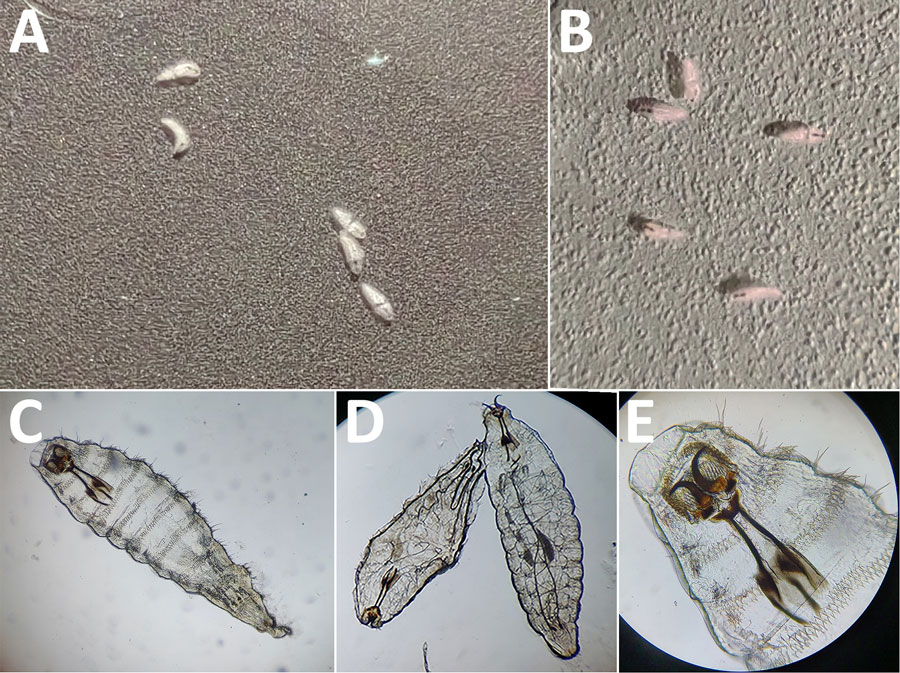
Figure 2. Morphologic identification of Oestrus ovis larvae extracted from patients with acute external ophthalmomyiasis after sheep exposure during Eid al-Adha, Algeria, 2025. A, B) Extracted first-instar larva from the ocular surface is shown grossly. C–E) Microscopic examination demonstrates characteristic features of O. ovis, including prominent oral hooks connected to the internal cephalopharyngeal skeleton and multiple rows of spiny projections. Original magnification ×40 (panel C), ×10 (panel D), and ×100 (panel E).
1These first authors contributed equally to this article.
Page created: May 28, 2026
Page updated: June 26, 2026
Page reviewed: June 26, 2026
The conclusions, findings, and opinions expressed by authors contributing to this journal do not necessarily reflect the official position of the U.S. Department of Health and Human Services, the Public Health Service, the Centers for Disease Control and Prevention, or the authors' affiliated institutions. Use of trade names is for identification only and does not imply endorsement by any of the groups named above.