Volume 32, Number 8—August 2026
Research Letter
Surveillance of Ticks and Tickborne Borrelia, Ehrlichia, and Rickettsia spp., Texas, USA, 2014–2021
Yan Zhang, Elizabeth A. Mitchell, Rebecca J. Kilgore, and Michael S. Allen
Figure 2
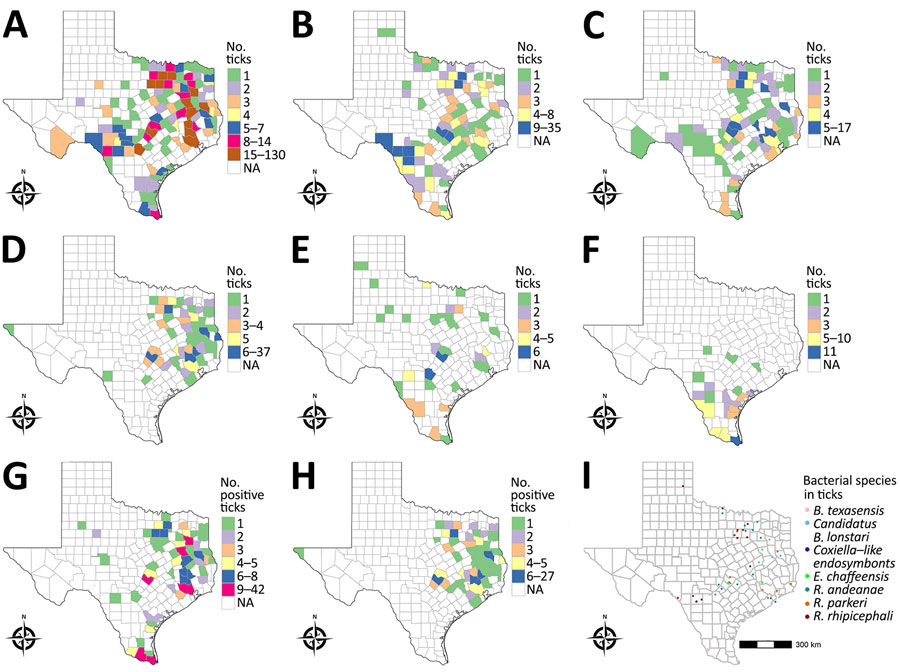
Figure 2. Geographic distribution of tick submissions and bacteria-positive ticks in Texas, USA, 2014–2021. A) Amblyomma americanum ticks. B) Dermacentor variabilis ticks. C) A. maculatum ticks. D) Ixodes scapularis ticks. E) Rhipicephalus sanguineus ticks. F) A. mixtum ticks. G) R. amblyommatis ticks. H) R. tamurae subspecies buchneri ticks. I) Bacterial species recovered from submitted ticks.
Page created: June 28, 2026
Page updated: July 27, 2026
Page reviewed: July 27, 2026
The conclusions, findings, and opinions expressed by authors contributing to this journal do not necessarily reflect the official position of the U.S. Department of Health and Human Services, the Public Health Service, the Centers for Disease Control and Prevention, or the authors' affiliated institutions. Use of trade names is for identification only and does not imply endorsement by any of the groups named above.