Volume 32, Number 8—August 2026
Research Letter
Surveillance of Ticks and Tickborne Borrelia, Ehrlichia, and Rickettsia spp., Texas, USA, 2014–2021


Cite This Article
Citation for Media
Abstract
We report the temporal and geographic distribution of ticks and tickborne Borrelia, Ehrlichia, and Rickettsia spp. bacteria in Texas, USA, 2014–2021, updating the previous 2008–2014 passive surveillance report. We identified 9 tick species and an overall prevalence of tested bacterial species of 26.0%, predominantly Rickettsia amblyommatis.
Texas, USA, is home to several human-biting tick species that carry and transmit bacterial pathogens, including Rickettsia, Borrelia, and Ehrlichia spp. (1–3). Since 2004, the University of North Texas Health Tick-Borne Disease Laboratory (Fort Worth, TX, USA) has performed pathogen testing of ticks removed from humans and submitted to the Texas Department of State Health Services (1,4,5). Building on previous surveillance efforts, we further analyzed the temporal and geographic distributions of tick species and tickborne bacteria in Texas. The data reflected human–tick interactions rather than natural tick activities and distributions and could be useful in informing public health risk in Texas.
Entomologists at the Texas Department of State Health Services identified tick species morphologically. Unidentified specimens were classified by tick mitochondrial 16S rRNA gene analysis at University of North Texas Health. They used PCRs and Sanger sequencing (1) to determine the presence of bacteria: Borrelia by using the flaB gene target, Ehrlichia by using the dsb gene target, and Rickettsia by using the rompA gene target. We excluded 2020 data from the temporal analysis because of testing delays caused by the COVID-19 pandemic.
A total of 1,625 ticks (9 species) from Texas were tested from October 1, 2014, through September 30, 2021. The most frequently submitted tick species was Amblyomma americanum (48.9%), followed by Dermacentor variabilis (21.2%), A. maculatum (11.9%), Ixodes scapularis (10.0%), Rhipicephalus sanguineus (3.8%), and A. mixtum (3.4%) (Appendix Table 1). Nymphs represented a substantial proportion of A. americanum (42.8%) and A. mixtum submissions (60.0%), and larvae were 2.1% (A. americanum) and 3.6% (A. mixtum) of submissions. By contrast, the other submitted species were mostly adults. The female-to-male ratio was close to 1 (0.87–1.2) for most species, except for I. scapularis (90.7%) and D. variabilis (62.3%) tick submissions, which were mostly female.
Figure 1
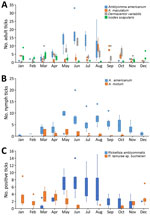
Figure 1. Box plot graph displaying temporal patterns of ticks submitted in Texas, USA, 2014–2021. A) Adult ticks; B) nymphs; C) Rickettsia amblyommatis and R. tamurae subspecies ...
Adult A. americanum, A. maculatum, D. variabilis, and I. scapularis tick submissions demonstrated clear temporal patterns (Figure 1, panel A; Appendix Table 2). Adult A. americanum submissions were much higher in May–July. We observed the highest adult A. maculatum tick submissions in August. Submission of adult I. scapularis ticks peaked in March, and D. variabilis ticks peaked in June. We observed no obvious temporal patterns in nymphal A. americanum or A. mixtum submissions (Figure 1, panel B).
We identified 9 bacterial species from ticks and an overall prevalence rate of 26.0%, largely comprising spotted fever group rickettsiae. Rickettsia amblyommatis was the most common bacterium, with the following prevalence rates in each tick species: A. mixtum, 34.6%; A. americanum, 26.8%; R. sanguineus, 1.6%; D. variabilis, 0.58%; and A. maculatum, 0.5% (Appendix Table 1). R. tamurae subspecies buchneri, the second most frequent bacterial species, was detected only in I. scapularis ticks (85.2% positive rate, 90% in females, whereas all male ticks tested negative). R. amblyommatis and R. tamurae subsp. buchneri–positive ticks demonstrated temporal patterns similar to the overall submission patterns of A. americanum and I. scapularis ticks; peaks occurred from May–July for R. amblyommatis and in March for R. tamurae subsp. buchneri (Figures 1, panel C; Appendix Table 2). Lacking clinical evidence, the pathogenicity of R. amblyommatis is unclear. R. tamurae subsp. buchneri is thought to be a nonpathogenic endosymbiont of I. scapularis ticks, providing essential nutrients for tick survival (6). The presence of those 2 organisms might reduce the transmission of other pathogenic Rickettsia spp. in ticks (6,7).
Figure 2
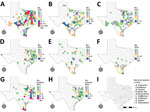
Figure 2. Geographic distribution of tick submissions and bacteria-positive ticks in Texas, USA, 2014–2021. A) Amblyomma americanum ticks. B) Dermacentor variabilis ticks. C) A. maculatum ticks. D) ...
Tick submissions primarily originated from eastern, central, and southern Texas, with a few from the panhandle and far western counties (Figure 2, panels A–F). The most tick submissions were from Travis County (n = 199), followed by Anderson County (n = 134). The most A. americanum tick submissions were from Anderson County (n = 130), and the most D. variabilis tick submissions were from Uvalde County (n = 35). The most A. maculatum (17), I. scapularis (n = 37), and R. sanguineus (n = 6) tick submissions were from Travis County. Nearly all (97.5%) I. scapularis submissions were from eastern Texas (east of 98°W longitude). All A. mixtum submissions originated from the southeastern area of the state, below 31°N latitude and east of 100°W longitude, with the most from Cameron County. The most R. amblyommatis ticks were from Anderson County and the most R. tamurae subsp. buchneri positive ticks were from Travis County (Figure 2, panels G–H). Ticks carrying Candidatus B. lonestari, E. chaffeensis, and R. parkeri were mainly from eastern and central Texas (Figure 2, panel I). Similar to our previous report, the prevalence of Candidatus B. lonestari (0.5%) and E. chaffeensis (0.4%) n A. americanum ticks and R. parkeri (5.2%) in A. maculatum ticks remained low and were found primarily in eastern and central Texas (1,4,5).
In conclusion, the temporal and geographic patterns of human–tick encounters and tickborne pathogens provide valuable guidance for outdoor activities and public health planning. The overall bacterial prevalence rate (26%) in ticks was slightly higher than our previous report (23%), highlighting the need for continued tick pathogen surveillance in this region.
Dr. Zhang is a research assistant professor at the University of North Texas Health Science Center Tick-Borne Disease Research Laboratory in the Department of Microbiology, Immunology and Genetics. Her current research focuses on tickborne pathogen detection, microbiome, and pathogenesis of Lyme disease.
Acknowledgments
We thank staff members at Texas Department of State Health Services Zoonosis Control for collecting, handling, and taxonomically identifying ticks.
This project was supported by funding from the State of Texas to the University of North Texas Health Science Center.
References
- Mitchell EA, Williamson PC, Billingsley PM, Seals JP, Ferguson EE, Allen MS. Frequency and distribution of Rickettsiae, Borreliae, and Ehrlichiae detected in human-parasitizing ticks, Texas, USA. Emerg Infect Dis. 2016;22:312–5. DOIPubMedGoogle Scholar
- Centers for Disease Control and Prevention. National Center for Emerging and Zoonotic Infectious Diseases DoV-BD. Where ticks live, 2025 [cited 2025 Jul 20]. https://www.cdc.gov/ticks/about/where-ticks-live.html
- Erickson TA, Mayes B, Murray KO, Gunter SM. The epidemiology of human ehrlichiosis in Texas, 2008–2017. Ticks Tick Borne Dis. 2021;12:
101788 . DOIPubMedGoogle Scholar - Williamson PC, Billingsley PM, Teltow GJ, Seals JP, Turnbough MA, Atkinson SF. Borrelia, Ehrlichia, and Rickettsia spp. in ticks removed from persons, Texas, USA. Emerg Infect Dis. 2010;16:441–6. DOIPubMedGoogle Scholar
- Allen MS, Kilgore RJ, Zhang Y, Williams MT, White SN, Teel PD. Evidence for the long-distance transport of ticks and tick-borne pathogens by human travellers to Texas, USA. J Travel Med. 2025;32:
taaf032 . DOIPubMedGoogle Scholar - Cull B, Burkhardt NY, Wang X-R, Thorpe CJ, Oliver JD, Kurtti TJ, et al. The Ixodes scapularis symbiont Rickettsia buchneri inhibits growth of pathogenic rickettsiaceae in tick cells: implications for vector competence. Front Vet Sci. 2022;8:
748427 . DOIPubMedGoogle Scholar - Levin ML, Schumacher LBM, Snellgrove A. Effects of Rickettsia amblyommatis infection on the vector competence of Amblyomma americanum ticks for Rickettsia rickettsii. Vector Borne Zoonotic Dis. 2018;18:579–87. DOIPubMedGoogle Scholar
Figures
Cite This ArticleOriginal Publication Date: July 17, 2026
Table of Contents – Volume 32, Number 8—August 2026
| EID Search Options |
|---|
 Advanced Article Search – Search articles by author and/or keyword.
|
 Articles by Country Search – Search articles by the topic country.
|
 Article Type Search – Search articles by article type and issue.
|
Please use the form below to submit correspondence to the authors or contact them at the following address:
Michael S. Allen, University of North Texas Health Science Center, 3500 Camp Bowie Blvd, Fort Worth, TX 76107, USA
Top