Skip directly to site content Skip directly to page options Skip directly to A-Z link Skip directly to A-Z link Skip directly to A-Z link

Disclaimer: Early release articles are not considered as final versions. Any changes will be reflected in the online version in the month the article is officially released.

Volume 32, Number 8—August 2026

Research

Qualitative Risk Assessment of Infectious Agents Associated with Canine Importation into Canada, 2023–2024

Vanessa May Leung, Jada Chiasson1, Victoria Patterson1, Anjali Narasimhan, Maureen E.C. Anderson2, Tasha Epp2, Christopher Fernandez-Prada2, Emelia Wong Gordon2, Jean-Philippe Rocheleau2, Jason W. Stull2, Margo Vachon2, Scott Weese2, and Katie M. ClowComments to Author 
Author affiliation: University of Guelph, Guelph, Ontario, Canada (V.M. Leung, J. Chiasson, V. Patterson, A. Narasimhan, S. Weese, K.M. Clow); Ontario Ministry of Agriculture, Food and Agribusiness, Guelph (M.E.C. Anderson); University of Saskatchewan, Saskatoon, Saskatchewan, Canada (T. Epp); University of Montreal, Saint-Hyacinthe, Quebec, Canada (C. Fernandez-Prada, J.-P. Rocheleau); Haven Veterinary Services, Vancouver, British Columbia, Canada (E. Wong Gordon); University of Prince Edward Island, Charlottetown, Prince Edward Island, Canada (J.W. Stull); Canadian Food Inspection Agency, Ottawa, Ontario, Canada (M. Vachon)

Main Article

Figure 1

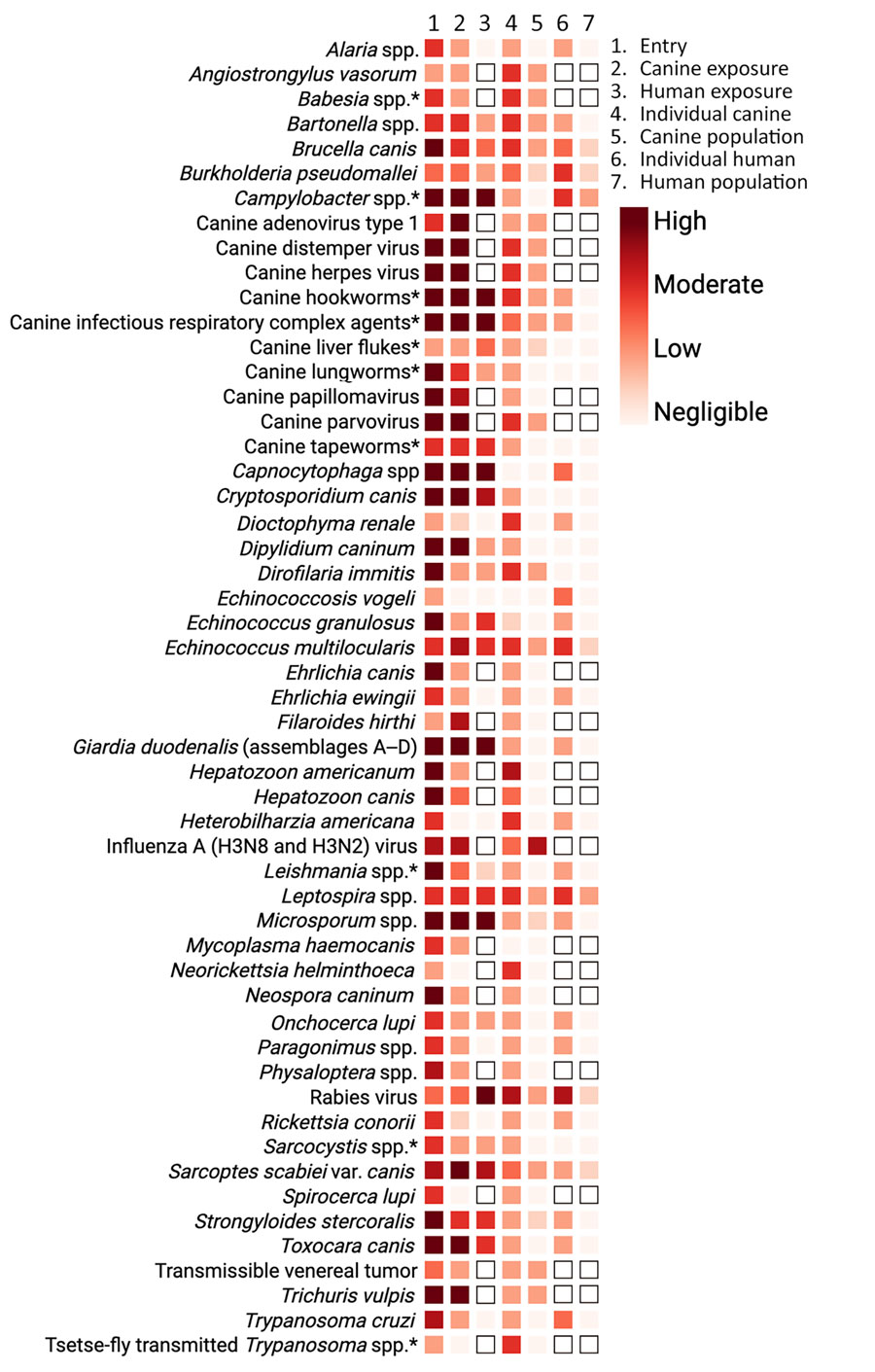
Heat map of qualitative estimates for all 53 hazards (arranged alphabetically) potentially associated with canine importation into Canada as determined through a qualitative risk assessment with expert consultation, 2023–2024. Estimates from left to right are likelihood of entry, likelihood of canine exposure, likelihood of human exposure, magnitude of impact of exposure for an individual canine, magnitude of impact of exposure for the canine population, magnitude of impact of exposure for an individual human, and magnitude of impact of exposure for the human population. For nonzoonotic hazards, estimates were not provided for human categories and are indicated by blank squares outlined in black. Hazards marked with an asterisk are groupings of agents. Full descriptions of those groups are available in Appendix 2 Table 1.

Figure 1. Heat map of qualitative estimates for all 53 hazards (arranged alphabetically) potentially associated with canine importation into Canada as determined through a qualitative risk assessment with expert consultation, 2023–2024. Estimates from left to right are likelihood of entry, likelihood of canine exposure, likelihood of human exposure, magnitude of impact of exposure for an individual canine, magnitude of impact of exposure for the canine population, magnitude of impact of exposure for an individual human, and magnitude of impact of exposure for the human population. For nonzoonotic hazards, estimates were not provided for human categories and are indicated by blank squares outlined in black. Hazards marked with an asterisk are groupings of agents. Full descriptions of those groups are available in Appendix 2 Table 1.

Main Article

1These authors contributed equally to this article.

2These authors are members of the expert consultation group and contributed equally to this article.

Page created: May 28, 2026
Page updated: July 09, 2026
Page reviewed: July 09, 2026
The conclusions, findings, and opinions expressed by authors contributing to this journal do not necessarily reflect the official position of the U.S. Department of Health and Human Services, the Public Health Service, the Centers for Disease Control and Prevention, or the authors' affiliated institutions. Use of trade names is for identification only and does not imply endorsement by any of the groups named above.
file_external