Volume 32, Number 8—August 2026
Research
Rapid Expansion of Highly Pathogenic Avian Influenza A(H5N1) Clade 2.3.4.4b Genotype D1.1 Virus across Flyway Regions, North America, Fall 2024
Matthew Scotch , Temitope O.C. Faleye, Angelica Urquidez-Negrete, Arvind Varsani, Ann Fan, and Anne Justice-Allen
, Temitope O.C. Faleye, Angelica Urquidez-Negrete, Arvind Varsani, Ann Fan, and Anne Justice-Allen
Figure 3
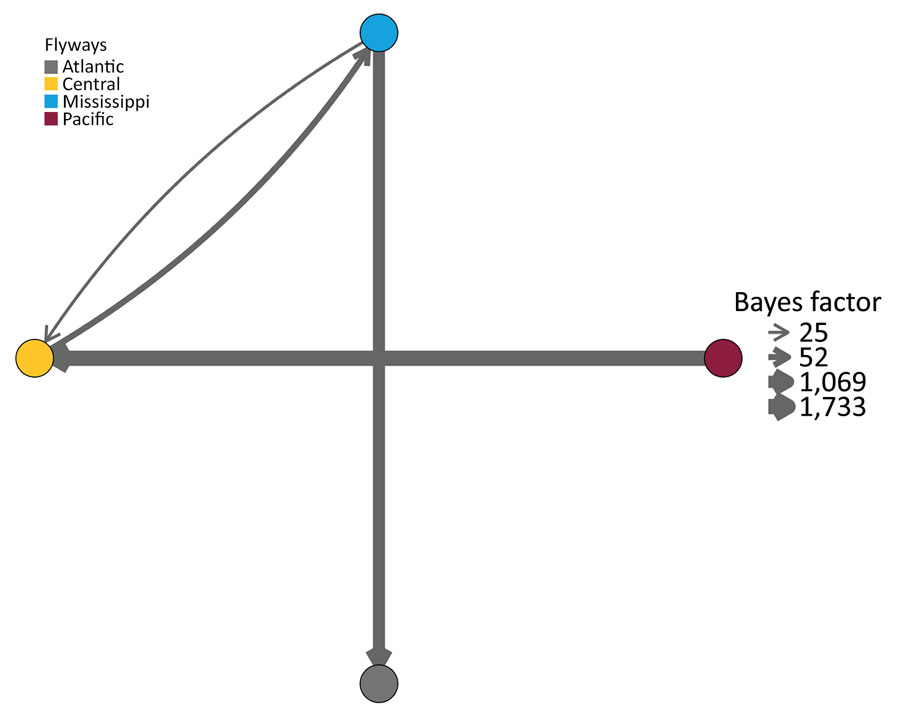
Figure 3. Most parsimonious pairwise transmission routes from a study of expansion of highly pathogenic avian influenza A(H5N1) clade 2.3.4.4b genotype D1.1 virus across flyway regions, North America, fall 2024. Pairs were indicated by Bayes factor results from SpreaD3 (27). Routes with a Bayes factor >3 and posterior probability >0.90 are shown. A thicker arrow indicates greater Bayes factor; node colors represent each discrete flyway. The analysis leveraged sequences from 300 taxa collected during October 2024–March 2025.
References
- Bevins SN, Shriner SA, Cumbee JC Jr, Dilione KE, Douglass KE, Ellis JW, et al. Intercontinental movement of highly pathogenic avian influenza A(H5N1) clade 2.3.4.4 virus to the United States, 2021. Emerg Infect Dis. 2022;28:1006–11. DOIPubMedGoogle Scholar
- Caliendo V, Lewis NS, Pohlmann A, Baillie SR, Banyard AC, Beer M, et al. Transatlantic spread of highly pathogenic avian influenza H5N1 by wild birds from Europe to North America in 2021. Sci Rep. 2022;12:11729. DOIPubMedGoogle Scholar
- US Department of Agriculture. Detections of highly pathogenic avian influenza in wild birds. 2025 Jun 22 [cited 2025 Jun 22]. https://www.aphis.usda.gov/livestock-poultry-disease/avian/avian-influenza/hpai-detections/wild-birds
- US Department of Agriculture. Confirmations of highly pathogenic avian influenza in commercial and backyard flocks. 2025 Jun 22 [cited 2025 Jun 22]. https://www.aphis.usda.gov/livestock-poultry-disease/avian/avian-influenza/hpai-detections/commercial-backyard-flocks
- US Department of Agriculture. HPAI confirmed cases in livestock. 2026 Mar 13 [cited 2026 Jul 7]. https://www.aphis.usda.gov/livestock-poultry-disease/avian/avian-influenza/hpai-detections/hpai-confirmed-cases-livestock
- US Department of Agriculture. Detections of highly pathogenic avian influenza in mammals. 2025 Jun 22 [cited 2025 Jun 22]. https://www.aphis.usda.gov/livestock-poultry-disease/avian/avian-influenza/hpai-detections/mammals
- Shu Y, McCauley J. GISAID: Global Initiative on Sharing All Influenza Data—from vision to reality. Euro Surveill. 2017;22:13. DOIPubMedGoogle Scholar
- Centers for Disease Control and Prevention. First H5 bird flu death reported in United States. 2024 Jun 23 [cited 2025 Jun 23]. https://www.cdc.gov/media/releases/2025/m0106-h5-birdflu-death.html
- Harrington WN, Signore A, Kercher L, Giacinti JA, Kandeil A, Ahlstrom CA, et al. Rapid expansion of genotype D1.1 A(H5N1) influenza viruses in wild birds across North America during the 2024 migratory season. Nat Med. 2026;32:1661–5. DOIPubMedGoogle Scholar
- Darriba D, Posada D, Kozlov AM, Stamatakis A, Morel B, Flouri T. ModelTest-NG: a new and scalable tool for the selection of DNA and protein evolutionary models. Mol Biol Evol. 2020;37:291–4. DOIPubMedGoogle Scholar
- Flouri T, Izquierdo-Carrasco F, Darriba D, Aberer AJ, Nguyen LT, Minh BQ, et al. The phylogenetic likelihood library. Syst Biol. 2015;64:356–62. DOIPubMedGoogle Scholar
- Tavaré S. Some probabilistic and statistical problems in the analysis of DNA sequences. In: Miura R, editor. Lectures on mathematics in the life sciences. Providence (RI): American Mathematical Society; 1985. p. 57–86.
- Rambaut A, Lam TT, Max Carvalho L, Pybus OG. Exploring the temporal structure of heterochronous sequences using TempEst (formerly Path-O-Gen). Virus Evol. 2016;2:
vew007 . DOIPubMedGoogle Scholar - Baele G, Ji X, Hassler GW, McCrone JT, Shao Y, Zhang Z, et al. BEAST X for Bayesian phylogenetic, phylogeographic and phylodynamic inference. Nat Methods. 2025;22:1653–6. DOIPubMedGoogle Scholar
- Rambaut A, Drummond AJ, Xie D, Baele G, Suchard MA. Posterior summarization in Bayesian phylogenetics using Tracer 1.7. Syst Biol. 2018;67:901–4. DOIPubMedGoogle Scholar
- Baele G, Lemey P, Bedford T, Rambaut A, Suchard MA, Alekseyenko AV. Improving the accuracy of demographic and molecular clock model comparison while accommodating phylogenetic uncertainty. Mol Biol Evol. 2012;29:2157–67. DOIPubMedGoogle Scholar
- Hadfield J, Megill C, Bell SM, Huddleston J, Potter B, Callender C, et al. Nextstrain: real-time tracking of pathogen evolution. Bioinformatics. 2018;34:4121–3. DOIPubMedGoogle Scholar
- Katoh K, Misawa K, Kuma K, Miyata T. MAFFT: a novel method for rapid multiple sequence alignment based on fast Fourier transform. Nucleic Acids Res. 2002;30:3059–66. DOIPubMedGoogle Scholar
- Minh BQ, Schmidt HA, Chernomor O, Schrempf D, Woodhams MD, von Haeseler A, et al. IQ-TREE 2: new models and efficient methods for phylogenetic inference in the genomic era. Mol Biol Evol. 2020;37:1530–4. DOIPubMedGoogle Scholar
- Huddleston J, Hadfield J, Sibley TR, Lee J, Fay K, Ilcisin M, et al. Augur: a bioinformatics toolkit for phylogenetic analyses of human pathogens. J Open Source Softw. 2021;6:2906. DOIPubMedGoogle Scholar
- Hasegawa M, Kishino H, Yano T. Dating of the human-ape splitting by a molecular clock of mitochondrial DNA. J Mol Evol. 1985;22:160–74. DOIPubMedGoogle Scholar
- Griffiths RC, Tavaré S. Sampling theory for neutral alleles in a varying environment. Philos Trans R Soc Lond B Biol Sci. 1994;344:403–10. DOIPubMedGoogle Scholar
- US Fish and Wildlife Service. Migratory Bird Program administrative flyways. 2026 [cited 2026 Jan 28]. https://www.fws.gov/partner/migratory-bird-program-administrative-flyways
- Lemey P, Rambaut A, Drummond AJ, Suchard MA. Bayesian phylogeography finds its roots. PLOS Comput Biol. 2009;5:
e1000520 . DOIPubMedGoogle Scholar - Minin VN, Suchard MA. Counting labeled transitions in continuous-time Markov models of evolution. J Math Biol. 2007;56:391–412. DOIPubMedGoogle Scholar
- Suchard MA, Lemey P, Baele G, Ayres DL, Drummond AJ, Rambaut A. Bayesian phylogenetic and phylodynamic data integration using BEAST 1.10. Virus Evol. 2018;4:
vey016 . DOIPubMedGoogle Scholar - Bielejec F, Baele G, Vrancken B, Suchard MA, Rambaut A, Lemey P. SpreaD3: interactive visualization of spatiotemporal history and trait evolutionary processes. Mol Biol Evol. 2016;33:2167–9. DOIPubMedGoogle Scholar
- Baele G, Ji X, Hassler GW, McCrone JT, Shao Y, Zhang Z, et al. BEAST X for Bayesian phylogenetic, phylogeographic and phylodynamic inference. Nat Methods. 2025;22:1653–6. DOIPubMedGoogle Scholar
- Lemey P, Ruktanonchai N, Hong SL, Colizza V, Poletto C, Van den Broeck F, et al. Untangling introductions and persistence in COVID-19 resurgence in Europe. Nature. 2021;595:713–7. DOIPubMedGoogle Scholar
- Parker J, Rambaut A, Pybus OG. Correlating viral phenotypes with phylogeny: accounting for phylogenetic uncertainty. Infect Genet Evol. 2008;8:239–46. DOIPubMedGoogle Scholar
- Ríos Carrasco M, Lin TH, Zhu X, Gabarroca García A, Uslu E, Liang R, et al. The Q226L mutation can convert a highly pathogenic H5 2.3.4.4e virus to bind human-type receptors. Proc Natl Acad Sci U S A. 2025;122:
e2419800122 . DOIPubMedGoogle Scholar - Lin TH, Zhu X, Wang S, Zhang D, McBride R, Yu W, et al. A single mutation in bovine influenza H5N1 hemagglutinin switches specificity to human receptors. Science. 2024;386:1128–34. DOIPubMedGoogle Scholar
- Himsworth CG, Caleta JM, Jassem AN, Yang KC, Zlosnik JEA, Tyson JR, et al. Highly pathogenic avian influenza A(H5N1) in wild birds and a human, British Columbia, Canada, 2024. Emerg Infect Dis. 2025;31:1216–21. DOIPubMedGoogle Scholar
- Giacinti JA, Signore AV, Jones MEB, Bourque L, Lair S, Jardine C, et al.; British Columbia Wildlife AIV Surveillance Program. (BC WASP). Avian influenza viruses in wild birds in Canada following incursions of highly pathogenic H5N1 virus from Eurasia in 2021–2022. MBio. 2024;15:
e0320323 . DOIPubMedGoogle Scholar - Fourment M, Darling AE, Holmes EC. The impact of migratory flyways on the spread of avian influenza virus in North America. BMC Evol Biol. 2017;17:118. DOIPubMedGoogle Scholar
- Bedford T, Greninger AL, Roychoudhury P, Starita LM, Famulare M, Huang ML, et al.; Seattle Flu Study Investigators. Cryptic transmission of SARS-CoV-2 in Washington state. Science. 2020;370:571–5. DOIPubMedGoogle Scholar
- Worobey M, Pekar J, Larsen BB, Nelson MI, Hill V, Joy JB, et al. The emergence of SARS-CoV-2 in Europe and North America. Science. 2020;370:564–70. DOIPubMedGoogle Scholar
- Aksamentov I, Roemer C, Hodcroft EB, Neher RA. Nextclade: clade assignment, mutation calling and quality control for viral genomes. J Open Source Softw. 2021;6:3773. DOIGoogle Scholar
- Andrew CL, Russell SL, Coombe M, Zlosnik JEA, Kuchinski KS, Caleta J, et al. Descriptive epidemiology and phylodynamics of the “first wave” of an outbreak of highly pathogenic avian influenza (H5N1 clade 2.3.4.4b) in British Columbia and the Yukon, Canada, April to September 2022. Transbound Emerg Dis. 2024;2024:
2327939 . DOIPubMedGoogle Scholar - Li B, Raghwani J, Hill SC, François S, Lefrancq N, Liang Y, et al. Association of poultry vaccination with interspecies transmission and molecular evolution of H5 subtype avian influenza virus. Sci Adv. 2025;11:
eado9140 . DOIPubMedGoogle Scholar - Šolaja S, Glišić D, Veljović L, Milošević I, Nićković E, Nišavić J, et al. Phylogeographic analysis of clade 2.3.4.4b H5N1 in Serbia reveals repeated introductions and spread across the Balkans. Pathogens. 2025;14:636. DOIPubMedGoogle Scholar
Page created: June 13, 2026
Page updated: July 26, 2026
Page reviewed: July 26, 2026
The conclusions, findings, and opinions expressed by authors contributing to this journal do not necessarily reflect the official position of the U.S. Department of Health and Human Services, the Public Health Service, the Centers for Disease Control and Prevention, or the authors' affiliated institutions. Use of trade names is for identification only and does not imply endorsement by any of the groups named above.