Volume 32, Number 8—August 2026
Research
Rapid Expansion of Highly Pathogenic Avian Influenza A(H5N1) Clade 2.3.4.4b Genotype D1.1 Virus across Flyway Regions, North America, Fall 2024
Matthew Scotch , Temitope O.C. Faleye, Angelica Urquidez-Negrete, Arvind Varsani, Ann Fan, and Anne Justice-Allen
, Temitope O.C. Faleye, Angelica Urquidez-Negrete, Arvind Varsani, Ann Fan, and Anne Justice-Allen
Figure 5
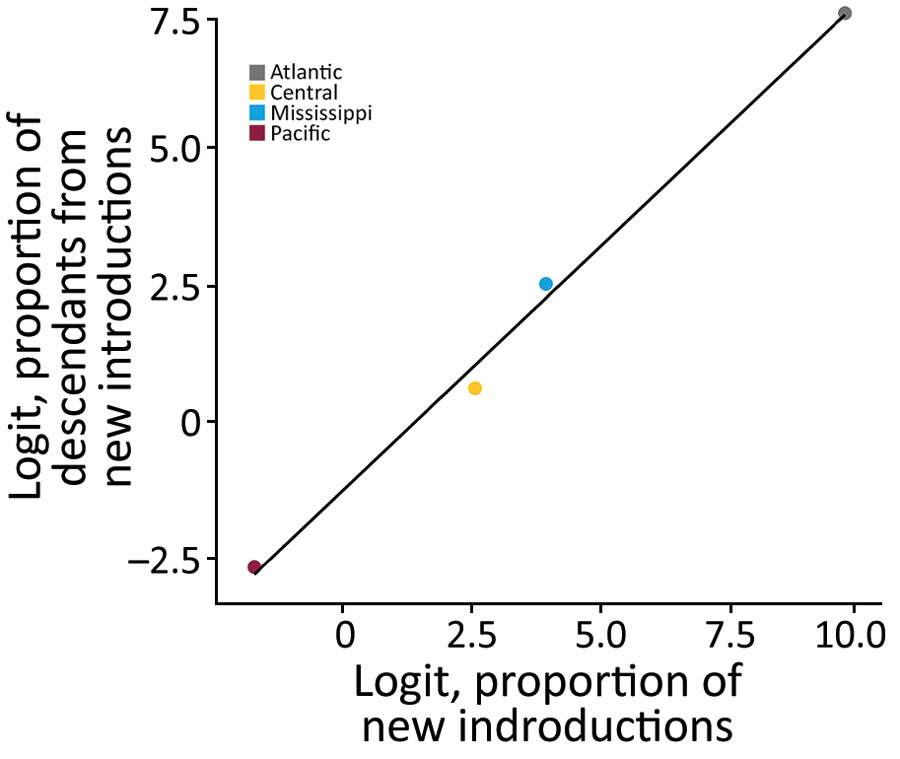
Figure 5. Logit-transformed proportion of new introductions from a study of expansion of highly pathogenic avian influenza A(H5N1) clade 2.3.4.4b genotype D1.1 virus across flyway regions, North America, fall 2024. Graph shows relationship between Ta (estimated D1.1 divergence; June 27, 2024) and Te (approximate date of first D1.1 detection; September 18, 2024) and the logit-transformed proportion of sampled descendant lineages arising from those introductions after Te. Points represent 4 flyway regions of North America. The analysis leveraged sequences from 300 taxa collected from October 2024–March 2025. Ta, ancestral time; Te, evaluation time.
Page created: June 13, 2026
Page updated: July 26, 2026
Page reviewed: July 26, 2026
The conclusions, findings, and opinions expressed by authors contributing to this journal do not necessarily reflect the official position of the U.S. Department of Health and Human Services, the Public Health Service, the Centers for Disease Control and Prevention, or the authors' affiliated institutions. Use of trade names is for identification only and does not imply endorsement by any of the groups named above.