Disclaimer: Early release articles are not considered as final versions. Any changes will be reflected in the online version in the month the article is officially released.
Volume 32, Number 8—August 2026
Emerging Infection Networks Letter
Detection of blaOXA-23–Positive Proteus mirabilis Isolate, United States, 2024
 , Porscha Bumpus-White, Alyssa G. Kent, Erin Breaker, Matthew Doucette, Caryn Ivanof, Esther Fortes, Sanjib Bhattacharyya, Nicolas Epie, Susannah L. McKay, Stephen P. LaVoie, and Sarah Sabour
Cite This Article
Citation for Media
Abstract
We report detection of a blaOXA-23-positive Proteus mirabilis clinical isolate through Antimicrobial Resistance Laboratory Network testing that is closely related to OXA-23 producers identified in Europe. Combined with similar reports internationally, this finding suggests that Enterobacterales might serve as a silent reservoir of carbapenemase genes commonly associated with Acinetobacter species.
The Ambler class D β-lactamase OXA-23–like subgroup is among the most common acquired mechanisms contributing to carbapenem resistance in Acinetobacter baumannii in the United States and globally (1). Detection of blaOXA-23 has been infrequently reported outside of the genus Acinetobacter; blaOXA-23–positive isolates of Proteus mirabilis are increasingly reported in Europe, particularly in France (2–7). Through routine testing conducted by the Centers for Disease Control and Prevention (CDC) Antimicrobial Resistance Laboratory Network (AR Lab Network), we detected a P. mirabilis clinical isolate from Massachusetts, USA, harboring blaOXA-23. This activity was reviewed and approved by CDC as exempt human subjects research (see 45 C.F.R. part 46.104).
P. mirabilis was isolated in May 2024 from a urine culture of a patient receiving outpatient care in Massachusetts. In the 12 months before specimen collection, the patient had no reported history of international travel, domestic inpatient healthcare stays, or invasive procedures. As part of the AR Lab Network, clinical laboratories submit clinical isolates of carbapenem-resistant Enterobacterales to public health laboratories for characterization, as previously described (1) (Appendix).
We performed supplementary antimicrobial susceptibility testing at CDC by reference broth microdilution according to Clinical Laboratory Standards Institute (CLSI) guidelines as previously described (8); we interpreted results using CLSI breakpoints (9). The isolate was susceptible to both ertapenem and meropenem by broth microdilution and disk diffusion (Table), consistent with the characteristically weak carbapenemase activity of OXA-23 (2). The isolate was susceptible to all other β-lactams except ampicillin and doripenem (and also imipenem, to which Proteus spp. commonly have reduced susceptibility) (9) and all tested cephalosporins apart from cefazolin (Table). Of note, the isolate showed susceptibility to piperacillin/tazobactam (Table), which is less frequently observed for blaOXA-23–positive isolates (6). The isolate was positive for carbapenemase production but PCR-negative for the 5 carbapenemase genes targeted by the AR Lab Network.
Figure
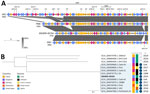
Figure. Genomic comparisons of blaOXA-23–positive Proteus mirabilis detected in Massachusetts, USA, in 2024 to clinical isolates identified in previous studies. A) Genomic context of bla...
We performed whole-genome sequencing (WGS) and data analysis; we submitted WGS data for the strain, 2024DK-00154, to the National Center for Biotechnology Information BioSample database (https://www.ncbi.nlm.nih.gov/biosample; accession no. SAMN41612253) (Appendix). We obtained a closed genome of 3.93 Mb that was not found to harbor any plasmids. The β-lactamase gene blaOXA-23 and 9 other AR genes were detected in this isolate (tetJ, aadA1, dfrA1, sat2, sul2, aph(6)-Id, aph(3”)-Ib, aac(3)-IIe, aph(3′)-Ia). The blaOXA-23 gene is located inside a Tn2008-like transposon (Tn6704) within a Tn6703-like genomic island, closely resembling the blaOXA-23 region of strains from Switzerland (Pm1 and Pm5) (7) and France (VAC) (4) (Figure, panel A).
We inferred a phylogenetic tree of 2024DK-00154 and 12 other blaOXA-23-positive P. mirabilis strains on the basis of the alignment of the core genome (≈3.23 Mb; 81% of the average genome size) (Figure, panel B). The 2024DK-00154 strain clustered with clinical isolates collected in Europe during 1996–2023, including an OXA-23–producing lineage circulating in France and Belgium since 1996 (2,4) and closely related strains detected in Germany (6) and Switzerland (7) (Figure, panel B). Within that cluster, all isolates belonged to sequence type (ST) 142 and differed by 4–200 core-genome single-nucleotide variants (SNVs); 2024DK-00154 is most similar to a strain isolated in Germany (Carb-21), differing by only 27 SNVs across ≈80% of the genome. In contrast, 2024DK-00154 differs from non-ST142 isolates from Singapore and France in which blaOXA-23 is plasmidborne (4,10) by 17,321–18,347 SNVs.
Those results suggest that the P. mirabilis isolate identified in Massachusetts is closely related to contemporary blaOXA-23–positive ST142 P. mirabilis strains circulating in Europe, consistent with international dissemination. In France, OXA-23–producing P. mirabilis strains (that cluster with the Massachusetts isolate) have been recovered from epidemiologically unrelated patients, suggesting community spread (3). Community spread has not been detected in the United States but is possible. Indeed, the Massachusetts case-patient had no reported international travel, suggesting a local infection source.
Testing for carbapenemase genes in the AR Lab Network is initiated on the basis of the detection of carbapenem resistance at the clinical laboratory. Thus, blaOXA-23–positive P. mirabilis isolates, which are characteristically carbapenem-susceptible, would not be targeted for mechanism testing, and the presence of blaOXA-23 would go undetected. Consequently, appropriate infection control measures that would be taken for patients identified as harboring carbapenemase-producing organisms would not necessarily be taken; P. mirabilis could serve as an unmonitored reservoir enabling ongoing transmission of blaOXA-23 to other species, including other Enterobacterales species. The inability to detect reservoirs of carbapenemase genes, including environmental sources, healthcare workers, or novel gene-organism combinations, could pose challenges for identifying and addressing sources of transmission.
In addition to displaying susceptibility to carbapenems, blaOXA-23–harboring P. mirabilis might also escape detection during routine laboratory testing for carbapenemases because of poor sensitivity of phenotypic carbapenemase production tests and the absence of that target from most commercial PCR and immunochromatographic tests (6). A diagnostic algorithm based on antimicrobial susceptibility profiles and phenotypic assays was recently developed to improve detection of OXA-23 and other carbapenemases whose frequency might be underestimated in Proteus spp. (3,4,6). Our findings suggest the need for continued vigilance in detecting blaOXA-23 in genera beyond Acinetobacter to prevent further spread between taxa.
Dr. Orazi is a microbiologist in the Division of Healthcare Quality Promotion, National Center for Emerging and Zoonotic Infectious Diseases, Centers for Disease Control and Prevention. Her work focuses on antimicrobial resistance and molecular epidemiology of healthcare-associated bacterial pathogens.
Acknowledgments
We thank Akita Joshi and Marcus Belger for their contributions to isolation and characterization of the organism, Brandon Sabina for contributions to sequencing and bioinformatic analyses, and Danielle Chaney for conducting epidemiological investigation of this case. We also thank Alison Laufer Halpin and Maria Karlsson for their scientific guidance on isolate laboratory testing and characterization (whole-genome sequencing and antimicrobial susceptibility testing, respectively).
This work was supported by the Centers for Disease Control and Prevention’s internal funding.
References
- Sabour S, Bantle K, Bhatnagar A, Huang JY, Biggs A, Bodnar J, et al. Descriptive analysis of targeted carbapenemase genes and antibiotic susceptibility profiles among carbapenem-resistant Acinetobacter baumannii tested in the Antimicrobial Resistance Laboratory Network—United States, 2017–2020. Microbiol Spectr. 2024;12:
e0282823 . DOIPubMedGoogle Scholar - Bonnet R, Marchandin H, Chanal C, Sirot D, Labia R, De Champs C, et al. Chromosome-encoded class D β-lactamase OXA-23 in Proteus mirabilis. Antimicrob Agents Chemother. 2002;46:2004–6. DOIPubMedGoogle Scholar
- Potron A, Hocquet D, Triponney P, Plésiat P, Bertrand X, Valot B. Carbapenem-susceptible OXA-23-producing Proteus mirabilis in the French community. Antimicrob Agents Chemother. 2019;63:e00191–19. DOIPubMedGoogle Scholar
- Bonnin RA, Girlich D, Jousset AB, Gauthier L, Cuzon G, Bogaerts P, et al. A single Proteus mirabilis lineage from human and animal sources: a hidden reservoir of OXA-23 or OXA-58 carbapenemases in Enterobacterales. Sci Rep. 2020;10:9160. DOIPubMedGoogle Scholar
- Lombes A, Bonnin RA, Laurent F, Guet-Revillet H, Bille E, Cattoir V, et al.; GMC Study Group. High prevalence of OXA-23 carbapenemase-producing Proteus mirabilis among amoxicillin-clavulanate–resistant isolates in France. Antimicrob Agents Chemother. 2022;66:
e0198321 . DOIPubMedGoogle Scholar - Hamprecht A, Sattler J, Noster J, Stelzer Y, Fuchs F, Dorth V, et al. Proteus mirabilis—analysis of a concealed source of carbapenemases and development of a diagnostic algorithm for detection. Clin Microbiol Infect. 2023;29:1198.e1–6. DOIPubMedGoogle Scholar
- Findlay J, Nordmann P, Stephan R, Poirel L. NARA Network. Detection of OXA-23-producing Proteus mirabilis in Switzerland. Eur J Clin Microbiol Infect Dis. 2025;44:759–62. DOIPubMedGoogle Scholar
- Lutgring JD, Balbuena R, Reese N, Gilbert SE, Ansari U, Bhatnagar A, et al. Antibiotic susceptibility of NDM-producing Enterobacterales collected in the United States in 2017 and 2018. Antimicrob Agents Chemother. 2020;64:e00499–20. DOIPubMedGoogle Scholar
- Clinical and Laboratory Standards Institute. Performance standards for antimicrobial susceptibility testing, 34th edition. Supplement M100. Wayne (PA): The Institute; 2024.
- Octavia S, Xu W, Ng OT, Marimuthu K, Venkatachalam I, Cheng B, et al. Identification of AbaR4 Acinetobacter baumannii resistance island in clinical isolates of blaOXA-23-positive Proteus mirabilis. J Antimicrob Chemother. 2020;75:521–5. DOIPubMedGoogle Scholar
Figures
Table
Cite This ArticleOriginal Publication Date: July 25, 2026
Table of Contents – Volume 32, Number 8—August 2026
| EID Search Options |
|---|
 Advanced Article Search – Search articles by author and/or keyword.
|
 Articles by Country Search – Search articles by the topic country.
|
 Article Type Search – Search articles by article type and issue.
|
Please use the form below to submit correspondence to the authors or contact them at the following address:
Giulia Orazi, Centers for Disease Control and Prevention, 1600 Clifton Rd NE, Mailstop H17-4, Atlanta, GA 30329-4018, USA
Top