Volume 32, Number 9—September 2026
Research Letter
Autochthonous Canine Pythiosis Linked with Freshwater Exposure, Italy, 2021–2024
Andrea Peano , Anna Rita Molinar Min, Patrizia Danesi, Francesco Albanese, Nicla Furiani, Moira Monaco, Fabiano Necci, Chiara Noli, Sofia Sgubin, Antonella Varina, and Mario Pasquetti
, Anna Rita Molinar Min, Patrizia Danesi, Francesco Albanese, Nicla Furiani, Moira Monaco, Fabiano Necci, Chiara Noli, Sofia Sgubin, Antonella Varina, and Mario Pasquetti
Figure 1
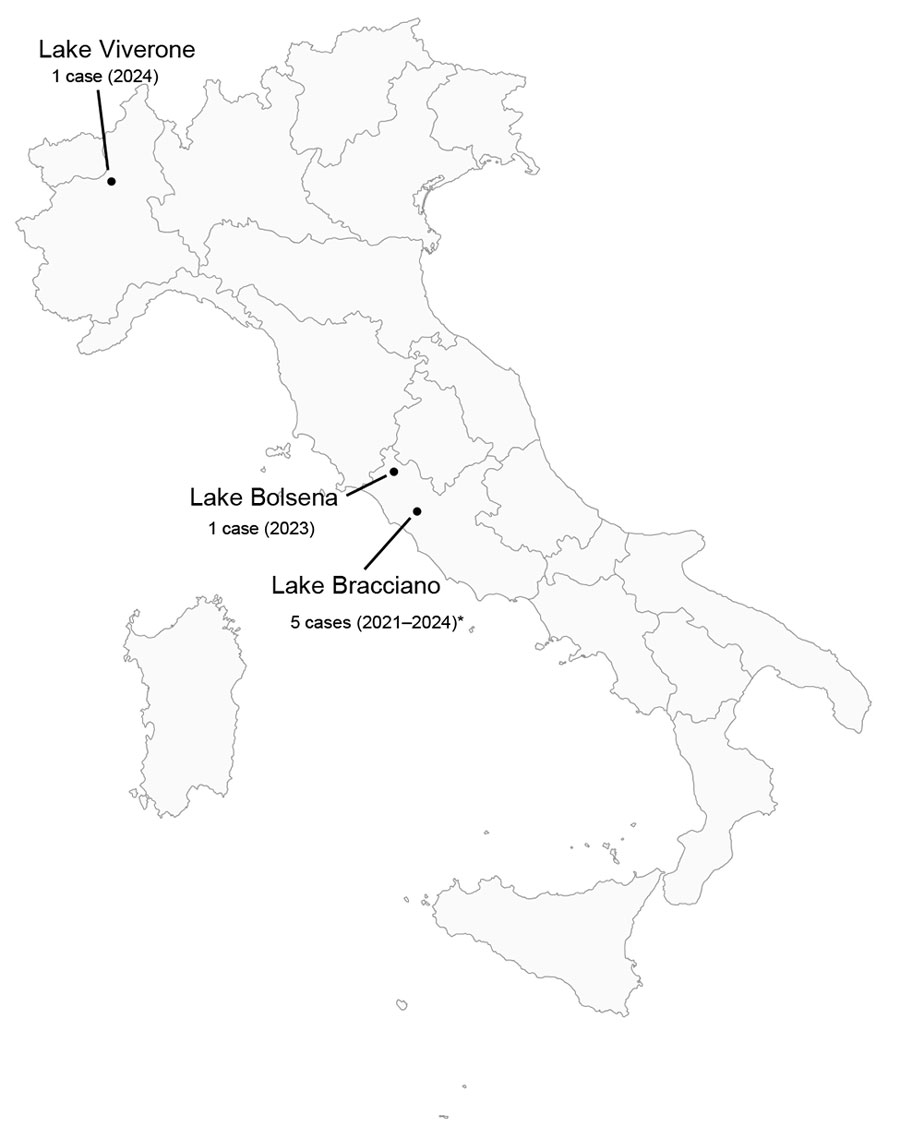
Figure 1. Freshwater sites associated with autochthonous canine pythiosis cases for a study of autochthonous canine pythiosis linked with freshwater exposure, Italy, 2021–2024. Dots indicate lakes linked to reported exposure histories. Labels summarize the number and year(s) of associated cases; asterisk indicates that 2 previously published cases (6) were included in the total count for that lake. Base map adapted from Wikimedia Commons (https://commons.wikimedia.org)
References
- Gaastra W, Lipman LJ, De Cock AW, Exel TK, Pegge RB, Scheurwater J, et al. Pythium insidiosum: an overview. Vet Microbiol. 2010;146:1–16. DOIPubMedGoogle Scholar
- Yolanda H, Krajaejun T. Global distribution and clinical features of pythiosis in humans and animals. J Fungi (Basel). 2022;8:182. DOIPubMedGoogle Scholar
- Calvano TP, Blatz PJ, Vento TJ, Wickes BL, Sutton DA, Thompson EH, et al. Pythium aphanidermatum infection following combat trauma. J Clin Microbiol. 2011;49:3710–3. DOIPubMedGoogle Scholar
- Farmer AR, Murray CK, Driscoll IR, Wickes BL, Wiederhold N, Sutton DA, et al. Combat-related Pythium aphanidermatum invasive wound infection: case report and discussion of utility of molecular diagnostics. J Clin Microbiol. 2015;53:1968–75. DOIPubMedGoogle Scholar
- Bernheim D, Dupont D, Aptel F, Dard C, Chiquet C, Normand AC, et al. Pythiosis: case report leading to new features in clinical and diagnostic management of this fungal-like infection. Int J Infect Dis. 2019;86:40–3. DOIPubMedGoogle Scholar
- Peano A, Min ARM, Fondati A, Romano E, Brachelente C, Porcellato I, et al. Cutaneous pythiosis in 2 dogs, Italy. Emerg Infect Dis. 2023;29:1447–50. DOIPubMedGoogle Scholar
- Oldenhoff W, Grooters A, Pinkerton ME, Knorr J, Trepanier L. Cutaneous pythiosis in two dogs from Wisconsin, USA. Vet Dermatol. 2014;25:52–e21. DOIPubMedGoogle Scholar
- Berryessa NA, Marks SL, Pesavento PA, Krasnansky T, Yoshimoto SK, Johnson EG, et al. Gastrointestinal pythiosis in 10 dogs from California. J Vet Intern Med. 2008;22:1065–9. DOIPubMedGoogle Scholar
- Billings P, Walton S, Shmalberg J, Santoro D. The use of mefenoxam to treat cutaneous and gastrointestinal pythiosis in dogs: a retrospective study. Microorganisms. 2023;11:1726. DOIPubMedGoogle Scholar
- Miraglia BM, Mendoza L, Rammohan R, Vilela L, Vilela C, Vilela G, et al. Pythium insidiosum complex hides a cryptic novel species: Pythium periculosum. Fungal Biol. 2022;126:366–74. DOIPubMedGoogle Scholar
Page created: July 16, 2026
Page updated: September 01, 2026
Page reviewed: September 01, 2026
The conclusions, findings, and opinions expressed by authors contributing to this journal do not necessarily reflect the official position of the U.S. Department of Health and Human Services, the Public Health Service, the Centers for Disease Control and Prevention, or the authors' affiliated institutions. Use of trade names is for identification only and does not imply endorsement by any of the groups named above.