Volume 32, Number 9—September 2026
Research Letter
Autochthonous Canine Pythiosis Linked with Freshwater Exposure, Italy, 2021–2024
Andrea Peano , Anna Rita Molinar Min, Patrizia Danesi, Francesco Albanese, Nicla Furiani, Moira Monaco, Fabiano Necci, Chiara Noli, Sofia Sgubin, Antonella Varina, and Mario Pasquetti
, Anna Rita Molinar Min, Patrizia Danesi, Francesco Albanese, Nicla Furiani, Moira Monaco, Fabiano Necci, Chiara Noli, Sofia Sgubin, Antonella Varina, and Mario Pasquetti
Figure 2
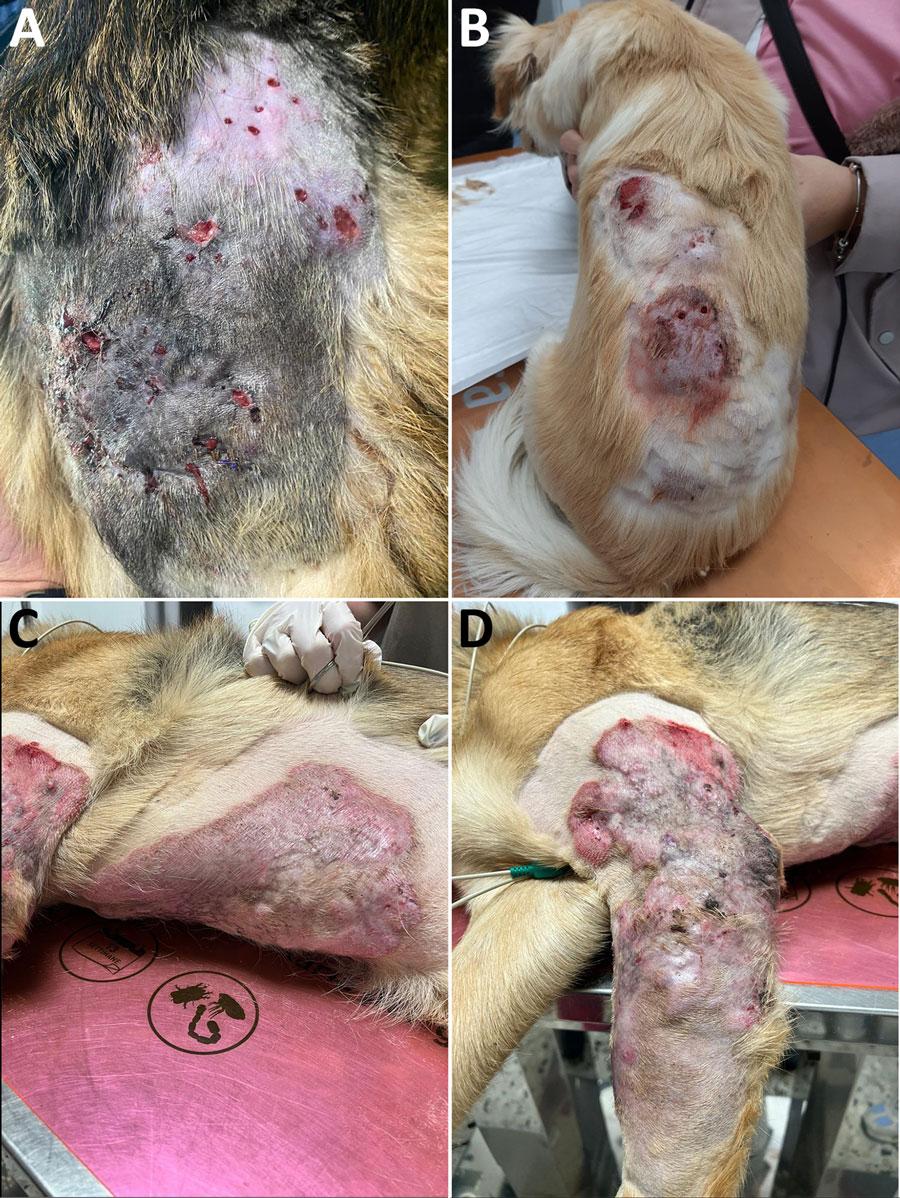
Figure 2. Representative cutaneous manifestations of canine pythiosis for a study of autochthonous canine pythiosis linked with freshwater exposure, Italy, 2021–2024. Lesions were characterized by chronic ulceration, nodules or plaques, draining tracts, and extensive proliferative to necrotizing cutaneous involvement. A) Extensive ulcerative and proliferative lesions involving the dorsal region. B) Ulcerative plaque affecting the dorsal thoracic region. C) Extensive ventral cutaneous involvement with ulcerative and proliferative lesions. D) Severe chronic ulcerative and exudative lesion affecting the left forelimb.
Page created: July 16, 2026
Page updated: September 01, 2026
Page reviewed: September 01, 2026
The conclusions, findings, and opinions expressed by authors contributing to this journal do not necessarily reflect the official position of the U.S. Department of Health and Human Services, the Public Health Service, the Centers for Disease Control and Prevention, or the authors' affiliated institutions. Use of trade names is for identification only and does not imply endorsement by any of the groups named above.