Skip directly to site content Skip directly to page options Skip directly to A-Z link Skip directly to A-Z link Skip directly to A-Z link

Disclaimer: Early release articles are not considered as final versions. Any changes will be reflected in the online version in the month the article is officially released.

Volume 32, Number 10—October 2026

Research

Isothermal Detection of Influenza D Virus using Reverse Transcription Loop-Mediated Isothermal Amplification

Carlos Abelardo dos Santos, Jialu Li, Pauline M. van Diemen, Andrew McMahon, Benjamin C. Mollett, Andrew M. Ramsay, Meshach M. Maina, Joe James, Helen E. Everett, Janet M. Daly, and Nicole C. RobbComments to Author 
Author affiliation: Warwick Medical School, University of Warwick, Coventry, UK (C.A. dos Santos, J. Li, N.C. Robb); Animal and Plant Health Agency Weybridge, Addlestone, UK (P.M. van Diemen, B.C. Mollett, A.M. Ramsay, J. James, H.E. Everett); School of Life Sciences, University of Warwick, Coventry (A. McMahon); One Virology, Wolfson Centre for Global Virus Research, University of Nottingham, Nottingham, UK (M.M. Maina, J.M. Daly)

Main Article

Figure 1

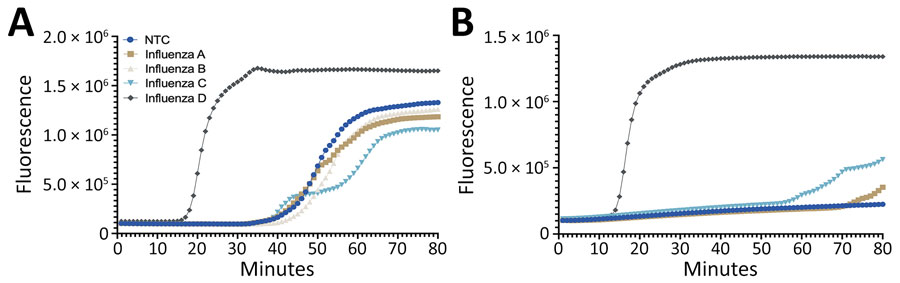
Mean amplification curves from reverse transcription loop-mediated isothermal amplification (RT-LAMP) reaction triplicates showing the onset of specific and nonspecific signal over time in study of isothermal detection of influenza D virus (IDV) using RT-LAMP. Graphs indicate results of RT-LAMP on gBlocks containing the influenza A, B, C, and D virus polymer basic protein 2 gene sequences. All gBlocks were tested at a concentration of 106 copies per µL of input. A) Reactions using the primers in IDV_set1. The amplification of the IDV gBlock positive control started within the first 20 minutes, whereas influenza A, influenza B, and influenza C gBlocks and the NTC (water) produced false-positive signals after only 35 minutes of incubation. B) Reactions using the primers in IDV_set2. The amplification of the IDV gBlock positive control started within the first 15 minutes, whereas influenza A, influenza B, and influenza C gBlocks and the NTC produced delayed false-positive signals after 65 minutes of incubation. NTC, nontemplate control.

Figure 1. Mean amplification curves from reverse transcription loop-mediated isothermal amplification (RT-LAMP) reaction triplicates showing the onset of specific and nonspecific signal over time in study of isothermal detection of influenza D virus (IDV) using RT-LAMP. Graphs indicate results of RT-LAMP on gBlocks containing the influenza A, B, C, and D virus polymer basic protein 2 gene sequences. All gBlocks were tested at a concentration of 106 copies per µL of input. A) Reactions using the primers in IDV_set1. The amplification of the IDV gBlock positive control started within the first 20 minutes, whereas influenza A, influenza B, and influenza C gBlocks and the NTC (water) produced false-positive signals after only 35 minutes of incubation. B) Reactions using the primers in IDV_set2. The amplification of the IDV gBlock positive control started within the first 15 minutes, whereas influenza A, influenza B, and influenza C gBlocks and the NTC produced delayed false-positive signals after 65 minutes of incubation. NTC, nontemplate control.

Main Article

Page created: August 13, 2026
Page updated: September 21, 2026
Page reviewed: September 21, 2026
The conclusions, findings, and opinions expressed by authors contributing to this journal do not necessarily reflect the official position of the U.S. Department of Health and Human Services, the Public Health Service, the Centers for Disease Control and Prevention, or the authors' affiliated institutions. Use of trade names is for identification only and does not imply endorsement by any of the groups named above.
file_external