Detection of Influenza D Virus using Reverse Transcription Loop-Mediated Isothermal Amplification
Carlos Abelardo dos Santos, Jialu Li, Pauline M. van Diemen, Andrew McMahon, Benjamin C. Mollett, Andrew M. Ramsay, Meshach M. Maina, Joe James, Helen E. Everett, Janet M. Daly, and Nicole C. Robb

Author affiliation: Warwick Medical School, University of Warwick, Coventry, UK (C.A. dos Santos, J. Li, N.C. Robb); Animal and Plant Health Agency Weybridge, Addlestone, UK (P.M. van Diemen, B.C. Mollett, A.M. Ramsay, J. James, H.E. Everett); School of Life Sciences, University of Warwick, Coventry (A. McMahon); One Virology, Wolfson Centre for Global Virus Research, University of Nottingham, Nottingham, UK (M.M. Maina, J.M. Daly)
Main Article
Figure 2
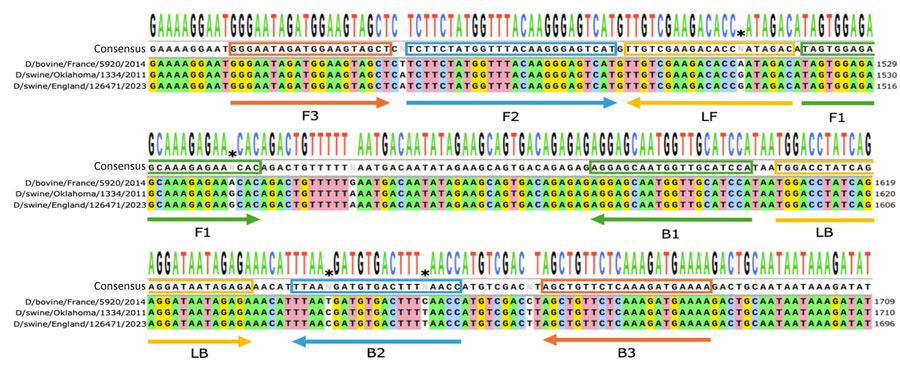
Figure 2. Reverse transcription loop-mediated isothermal amplification (RT-LAMP) primers targeting the influenza D virus polymer basic protein 2 gene in study of isothermal detection of influenza D virus. All available influenza D virus polymer basic protein 2 gene sequences in the National Center for Biotechnology Information Nucleotide database (https://www.ncbi.nlm.nih.gov/nucleotide) were aligned and mutations were annotated. To improve coverage, primers were synthesized with degenerate nucleotides in positions with heterogeneity in the sequences. The consensus sequence and sequences of the 3 isolates (D/bovine/France/5920/2014, D/swine/Oklahoma/1334/2011, and D/swine/England/126471/2023) are shown for comparison. Primer target sequences are presented within the boxes, and the direction of binding is represented by the arrows.
Main Article
Page created: August 13, 2026
Page updated: September 28, 2026
Page reviewed: September 28, 2026
The conclusions, findings, and opinions expressed by authors contributing to this journal do not necessarily reflect the official position of the U.S. Department of Health and Human Services, the Public Health Service, the Centers for Disease Control and Prevention, or the authors' affiliated institutions. Use of trade names is for identification only and does not imply endorsement by any of the groups named above.