Skip directly to site content Skip directly to page options Skip directly to A-Z link Skip directly to A-Z link Skip directly to A-Z link

Disclaimer: Early release articles are not considered as final versions. Any changes will be reflected in the online version in the month the article is officially released.

Volume 32, Number 3—March 2026

Research

Lymphocytic Choriomeningitis Virus Seroprevalence among Urban Pregnant Women and Newborns, Philadelphia, Pennsylvania, USA, 2021

Dustin D. Flannery1Comments to Author , Caitlin M. Cossaboom1, Timothy D. Flietstra, Alvaro Zevallos Barboza, Heather H. Burris, Karen M. Puopolo, Aridth Gibbons, Deborah L. Cannon, Inna Krapiunaya, Leanna Sayyad, Katrin S. Sadigh, Kami Smith, Joel M. Montgomery, Trevor Shoemaker, John D. Klena, and Scott M. Gordon
Author affiliation: Author affiliations: Children’s Hospital of Philadelphia, Philadelphia, Pennsylvania, USA (D.D. Flannery, A. Zevallos Barboza, H.H, Burris, K.M. Puopolo, S.M. Gordon); University of Pennsylvania Perelman School of Medicine, Philadelphia (D.D. Flannery, H.H. Burris, K.M. Puopolo, S.M. Gordon); Centers for Disease Control and Prevention, Atlanta, Georgia, USA (C.M. Cossaboom, T.D. Flietsra, A. Gibbons, D.L. Cannon, I. Krapiunaya, L. Sayyad, K.S. Sadigh, K. Smith, J.M. Montgomery, T. Shoemaker, J.D. Klena)

Main Article

Figure

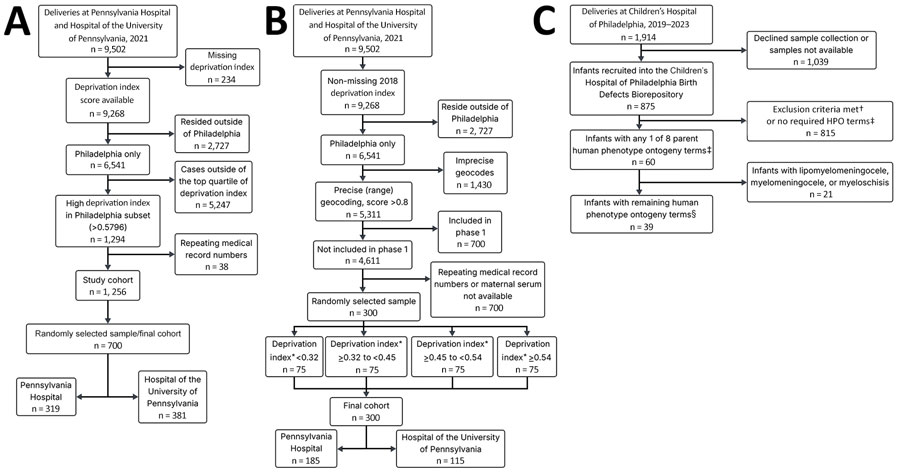
Flowchart of 3 phases of a study of lymphocytic choriomeningitis virus seroprevalence among urban pregnant women and newborns, Philadelphia, Pennsylvania, USA, 2021. A) Phase 1; B) phase 2; C) phase 3. Phases 1 and 2 used deliveries at Pennsylvania Hospital and the Hospital of the University of Pennsylvania in 2021 as the starting population. Repeated medical record numbers indicate parturient patients with multiple deliveries or >1 delivery during the study period, which would result in replicate maternal serum samples if retained. Phase 3’s starting population was the Children’s Hospital of Philadelphia Special Delivery Unit newborns delivered from the inception of the Birth Defects Biorepository during June 1, 2019–June 1, 2023. *Deprivation index ranges were determined using the Community Deprivation Index (https://github.com/geomarker-io/dep_index) on the basis of the geocoded address and quartile values were calculated on the full eligible cohort before phase-specific exclusions (n = 4,611). †Exclusion criteria included no cytomegalovirus testing on file, no placenta tissue available, and plasma not available for both maternal/infant matched samples even within the first few weeks after delivery. ‡The 8 overall HPO terms (https://hpo.jax.org) used encompassed 615 conditions. Those 8 HPO terms were abnormal choroid morphology, abnormal retinal morphology, cerebral calcification, intracranial cystic lesion, abnormality of neuronal migration, abnormal cerebral morphology, open neural tube defect, and abnormal cerebral ventricle morphology. §After excluding lipomyelomeningocele, myelomeningocele, and myeloschisis, 612 children’s HPO conditions remained. HPO, Human Phenotype Ontology.

Figure. Flowchart of 3 phases of a study of lymphocytic choriomeningitis virus seroprevalence among urban pregnant women and newborns, Philadelphia, Pennsylvania, USA, 2021. A) Phase 1; B) phase 2; C) phase 3. Phases 1 and 2 used deliveries at Pennsylvania Hospital and the Hospital of the University of Pennsylvania in 2021 as the starting population. Repeated medical record numbers indicate parturient patients with multiple deliveries or >1 delivery during the study period, which would result in replicate maternal serum samples if retained. Phase 3’s starting population was the Children’s Hospital of Philadelphia Special Delivery Unit newborns delivered from the inception of the Birth Defects Biorepository during June 1, 2019–June 1, 2023. *Deprivation index ranges were determined using the Community Deprivation Index (https://github.com/geomarker-io/dep_index) on the basis of the geocoded address and quartile values were calculated on the full eligible cohort before phase-specific exclusions (n = 4,611). †Exclusion criteria included no cytomegalovirus testing on file, no placenta tissue available, and plasma not available for both maternal/infant matched samples even within the first few weeks after delivery. ‡The 8 overall HPO terms (https://hpo.jax.org) used encompassed 615 conditions. Those 8 HPO terms were abnormal choroid morphology, abnormal retinal morphology, cerebral calcification, intracranial cystic lesion, abnormality of neuronal migration, abnormal cerebral morphology, open neural tube defect, and abnormal cerebral ventricle morphology. §After excluding lipomyelomeningocele, myelomeningocele, and myeloschisis, 612 children’s HPO conditions remained. HPO, Human Phenotype Ontology.

Main Article

1These first authors contributed equally to this article.

Page created: December 30, 2025
Page updated: February 25, 2026
Page reviewed: February 25, 2026
The conclusions, findings, and opinions expressed by authors contributing to this journal do not necessarily reflect the official position of the U.S. Department of Health and Human Services, the Public Health Service, the Centers for Disease Control and Prevention, or the authors' affiliated institutions. Use of trade names is for identification only and does not imply endorsement by any of the groups named above.
file_external