Volume 32, Number 3—March 2026
Research Letter
Mycobacterium riyadhense Pulmonary Disease after Relocation from Saudi Arabia, Japan
Takuya Ozawa, Takeshi Komine, Sohei Nakayama, Yusuke Suzuki, Naoki Hasegawa, Koichi Fukunaga, Ho Namkoong, Hanako Fukano, and Takanori Asakura
Figure 2
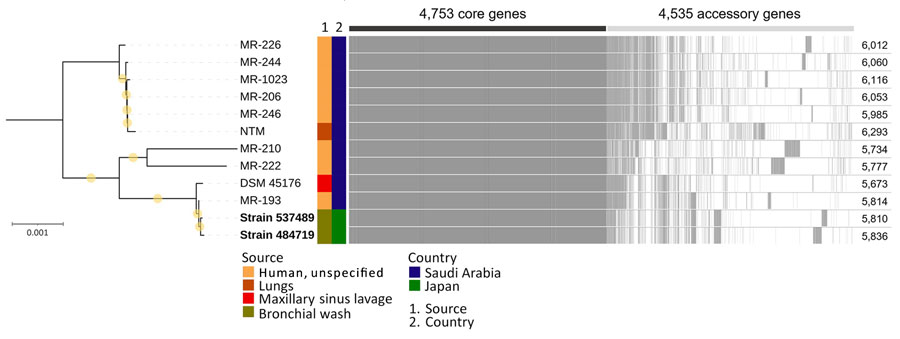
Figure 2. Midpoint-rooted maximum-likelihood tree based on 4,753 core genes of Mycobacterium riyadhense isolates from study of Mycobacterium riyadhense pulmonary disease after relocation from Saudi Arabia to Japan. Strains 484719 and 537489 (bold), obtained from clinical specimens in this study, were more closely related to strains MR-193 and DSM 45176 from Saudi Arabia. Yellow circles indicate ultrafast bootstrap values of 100%. Numbers at right indicate the number of coding sequences detected. Scale bar represents 0.001 substitutions per site.
Page created: February 20, 2026
Page updated: March 20, 2026
Page reviewed: March 20, 2026
The conclusions, findings, and opinions expressed by authors contributing to this journal do not necessarily reflect the official position of the U.S. Department of Health and Human Services, the Public Health Service, the Centers for Disease Control and Prevention, or the authors' affiliated institutions. Use of trade names is for identification only and does not imply endorsement by any of the groups named above.