Skip directly to site content Skip directly to page options Skip directly to A-Z link Skip directly to A-Z link Skip directly to A-Z link

Disclaimer: Early release articles are not considered as final versions. Any changes will be reflected in the online version in the month the article is officially released.

Volume 32, Number 5—May 2026

Synopsis

Three Fatal Gestational Psittacosis Cases Caused by Chlamydia psittaci Strains Belonging to Closely Related Lineages, Japan

Atsuko Nishino, Yukiko Nakura, Yukiko Sassa-O’Brien, Momoko Soeda, Hirokazu Sugii, Kanako Shimizu, Shiro Miura, Yumiko Sato, Michinobu Yoshimura1, Michiko Kodama, and Itaru YanagiharaComments to Author 
Author affiliation: Research Institute, Osaka Women’s and Children’s Hospital, Osaka, Japan (A. Nishino, Y. Nakura, M. Yoshimura, I. Yanagihara); The University of Osaka, Osaka, Japan (A. Nishino, M. Kodama, I. Yanagihara); Tokyo University of Agriculture and Technology, Tokyo, Japan (Y. Sassa-O’Brien); NHO Nagasaki Medical Center, Nagasaki, Japan (M. Soeda, S. Miura); NHO Iwakuni Clinical Center, Yamaguchi, Japan (H. Sugii, Y. Sato); Tannan Health Welfare Center, Fukui, Japan (K. Shimizu); Maizuru Kyosai Hospital, Kyoto, Japan (K. Shimizu)

Main Article

Figure 2

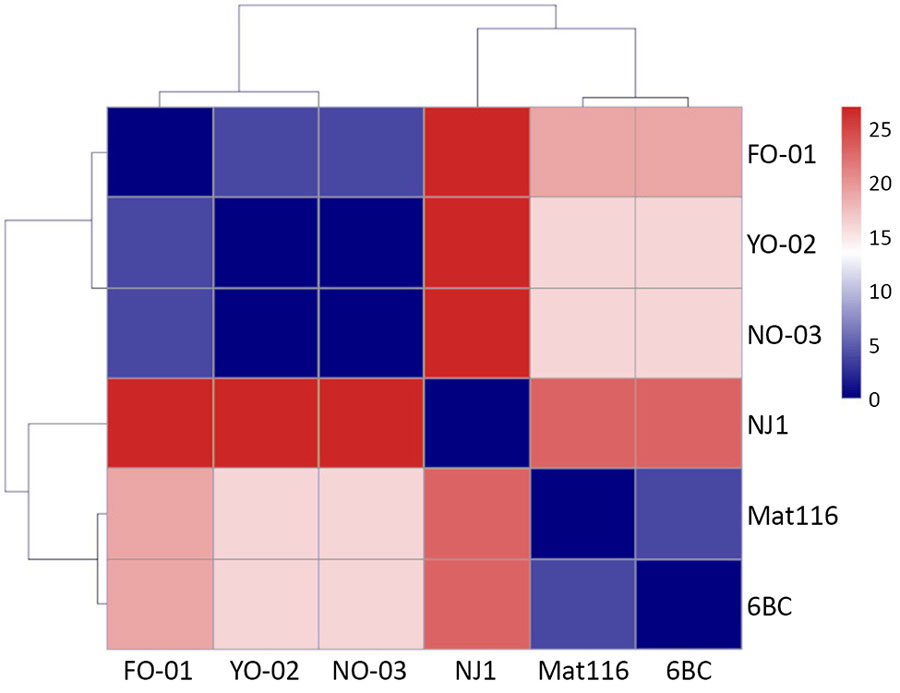
Heatmap of single-nucleotide polymorphism distances of housekeeping genes among 3 cases of gestational psittacosis (FO-01, YO-02, and NO-03) and other Chlamydia psittaci strains in study of fatal gestational psittacosis cases caused by C. psittaci strains belonging to closely related multilocus sequence typing lineages, Japan, 2017–2024.

Figure 2. Heatmap of single-nucleotide polymorphism distances of housekeeping genes among 3 cases of gestational psittacosis (FO-01, YO-02, and NO-03) and other Chlamydia psittaci strains in study of fatal gestational psittacosis cases caused by C. psittaci strains belonging to closely related multilocus sequence typing lineages, Japan, 2017–2024.

Main Article

1Current affiliation: Fukuoka University, Fukuoka, Japan.

Page created: April 01, 2026
Page updated: April 16, 2026
Page reviewed: April 16, 2026
The conclusions, findings, and opinions expressed by authors contributing to this journal do not necessarily reflect the official position of the U.S. Department of Health and Human Services, the Public Health Service, the Centers for Disease Control and Prevention, or the authors' affiliated institutions. Use of trade names is for identification only and does not imply endorsement by any of the groups named above.
file_external