Skip directly to site content Skip directly to page options Skip directly to A-Z link Skip directly to A-Z link Skip directly to A-Z link

Disclaimer: Early release articles are not considered as final versions. Any changes will be reflected in the online version in the month the article is officially released.

Volume 32, Number 7—July 2026

Research

National Surveillance of Enterovirus D68 Upsurge, France, 2024

Marion Jeannoël, Maxime Bisseux, Stéphanie Dan, Elisa Creuzet, Delphine Parraud, Jean-Luc Bailly, Jérémie Lebeurre, Amélie Brebion, Hélène Chabrolles, Laurence Josset, Cécile Henquell, Isabelle Schuffenecker, Audrey MirandComments to Author , and Enterovirus Surveillance Network1
Author affiliation: Hospices Civils de Lyon, Centre National de Référence des Entérovirus–Laboratoire Associé, Lyon, France (M. Jeannoël, S. Dan, D. Parraud, J. Lebeurre, L. Josset, I. Schuffenecker); Université Clermont Auvergne, Clermont-Ferrand (M. Bisseux, E. Creuzet, H. Chabrolles, C. Henquell, A. Mirand); Centre Hospitalier Universitaire de Clermont-Ferrand, Centre National de Référence des Entérovirus–Laboratoire Coordonnateur, Clermont-Ferrand, France (M. Bisseux, A. Brebion, H. Chabrolles, A. Mirand); Université Claude Bernard Lyon 1, Villeurbanne, France (S. Dan, D. Parraud, L. Josset); Université Clermont Auvergne, Clermont-Ferrand (J. Bailly)

Main Article

Figure 4

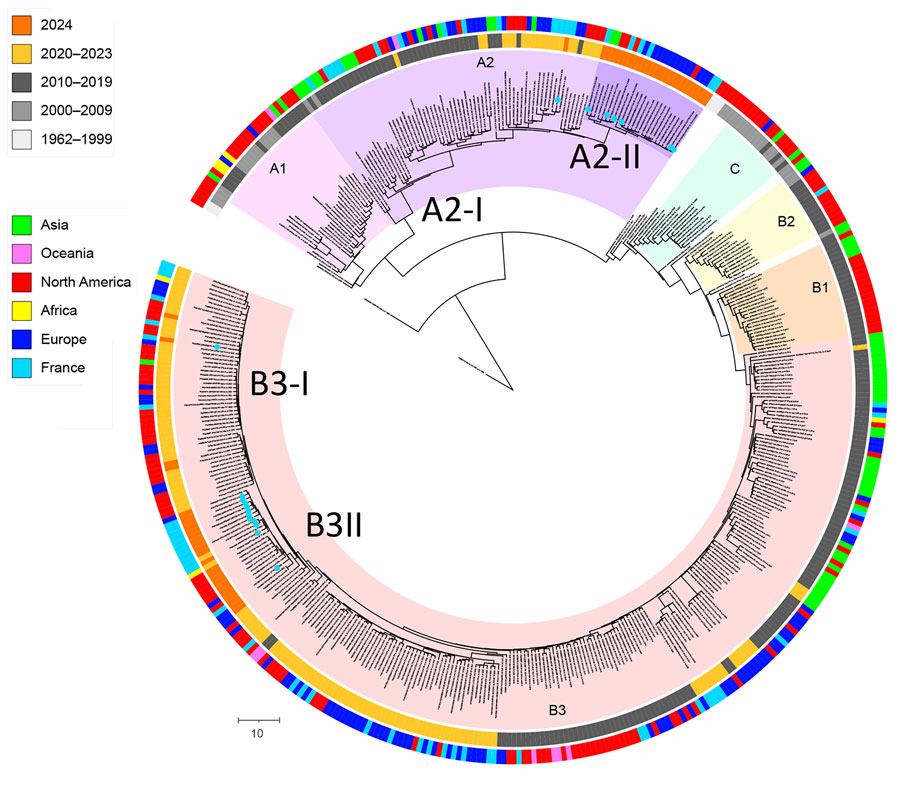
Time-scaled phylogeny of enterovirus D68 from report on national surveillance of enterovirus D68 upsurge, France, 2021–2024. We reconstructed a time-calibrated phylogenetic tree based on all available complete or near-complete (<6,495 nt) ORF sequences retrieved from GenBank, along with the sequences generated in this study. We subsampled and analyzed a total of 449 sequences using Bayesian inference with BEAST version 2.6.3 (https://beast.community), running a Markov chain of 500 million generations. We summarized the maximum clade credibility tree using TreeAnnotator (https://beast.community/treeannotator), and visualized with iTOL (https://itol.embl.de). We added 2 outer annotation rings, the outer ring for the continent or country of origin and the inner ring for the year of sampling. Previously defined clades (A1, A2, B1–B3, and C) are labeled and highlighted for branches and taxa: pink for clade A1, light purple for A2 and darker purple for sequences from the newly identified 2024 A2 subgroup A2-II, light orange for B1, yellow for B2, peach for B3, and light green for C. We identified the 2 groups of B3 sequences in this study as B3-I (ancestral) and B3-II. Blue dots indicated at the taxon names indicate sequences generated in this study in 2024. Scale bar represents the divergence in years relative to 2024.

Figure 4. Time-scaled phylogeny of enterovirus D68 from report on national surveillance of enterovirus D68 upsurge, France, 2021–2024. We reconstructed a time-calibrated phylogenetic tree based on all available complete or near-complete (<6,495 nt) ORF sequences retrieved from GenBank, along with the sequences generated in this study. We subsampled and analyzed a total of 449 sequences using Bayesian inference with BEAST version 2.6.3 (https://beast.community), running a Markov chain of 500 million generations. We summarized the maximum clade credibility tree using TreeAnnotator (https://beast.community/treeannotator), and visualized with iTOL (https://itol.embl.de). We added 2 outer annotation rings, the outer ring for the continent or country of origin and the inner ring for the year of sampling. Previously defined clades (A1, A2, B1–B3, and C) are labeled and highlighted for branches and taxa: pink for clade A1, light purple for A2 and darker purple for sequences from the newly identified 2024 A2 subgroup A2-II, light orange for B1, yellow for B2, peach for B3, and light green for C. We identified the 2 groups of B3 sequences in this study as B3-I (ancestral) and B3-II. Blue dots indicated at the taxon names indicate sequences generated in this study in 2024. Scale bar represents the divergence in years relative to 2024.

Main Article

1Additional members of Enterovirus Surveillance Network who contributed data are listed at the end of this article.

Page created: April 30, 2026
Page updated: June 04, 2026
Page reviewed: June 04, 2026
The conclusions, findings, and opinions expressed by authors contributing to this journal do not necessarily reflect the official position of the U.S. Department of Health and Human Services, the Public Health Service, the Centers for Disease Control and Prevention, or the authors' affiliated institutions. Use of trade names is for identification only and does not imply endorsement by any of the groups named above.
file_external