National Surveillance of Enterovirus D68 Upsurge, France, 2024
Marion Jeannoël, Maxime Bisseux, Stéphanie Dan, Elisa Creuzet, Delphine Parraud, Jean-Luc Bailly, Jérémie Lebeurre, Amélie Brebion, Hélène Chabrolles, Laurence Josset, Cécile Henquell, Isabelle Schuffenecker, Audrey Mirand

, and
Enterovirus Surveillance Network1
Author affiliation: Hospices Civils de Lyon, Centre National de Référence des Entérovirus–Laboratoire Associé, Lyon, France (M. Jeannoël, S. Dan, D. Parraud, J. Lebeurre, L. Josset, I. Schuffenecker); Université Clermont Auvergne, Clermont-Ferrand (M. Bisseux, E. Creuzet, H. Chabrolles, C. Henquell, A. Mirand); Centre Hospitalier Universitaire de Clermont-Ferrand, Centre National de Référence des Entérovirus–Laboratoire Coordonnateur, Clermont-Ferrand, France (M. Bisseux, E. Creuzet, A. Brebion, H. Chabrolles, C. Henquell, A. Mirand); Université Claude Bernard Lyon 1, Villeurbanne, France (S. Dan, D. Parraud, L. Josset); Université Clermont Auvergne, Clermont-Ferrand (J.-Lo Bailly)
Main Article
Figure 6
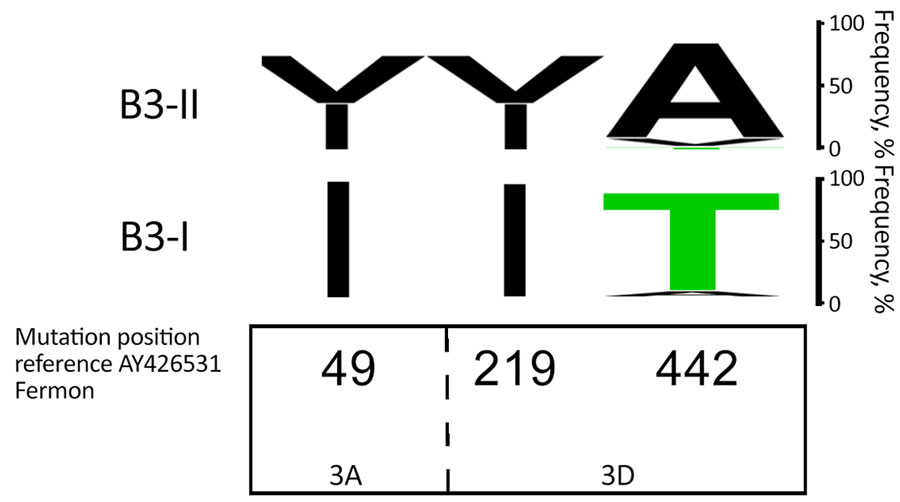
Figure 6. Amino acid change analysis of enterovirus D68, subgenotype B3, from report on national surveillance of enterovirus D68 upsurge, France, 2024. Amino acid substitutions leading to changes in the predominant residues between B3-II (n = 61 sequences) and the monophyletic clade corresponding to the nearest common ancestor B3-I (n = 106 sequences) are shown. Mutation positions are numbered according to the reference Fermon strain (GenBank accession no. AY426531) and annotated by the corresponding nonstructural viral proteins (3A and 3D). For each of the positions showing a mutation in the new group, the frequency of each amino acid was visualized using WebLogo (https://weblogo.threeplusone.com). A, alanine; I, isoleucine; T, threonine; Y, tyrosine; V, valine.
Main Article
Page created: April 30, 2026
Page updated: June 26, 2026
Page reviewed: June 26, 2026
The conclusions, findings, and opinions expressed by authors contributing to this journal do not necessarily reflect the official position of the U.S. Department of Health and Human Services, the Public Health Service, the Centers for Disease Control and Prevention, or the authors' affiliated institutions. Use of trade names is for identification only and does not imply endorsement by any of the groups named above.