Skip directly to site content Skip directly to page options Skip directly to A-Z link Skip directly to A-Z link Skip directly to A-Z link

Disclaimer: Early release articles are not considered as final versions. Any changes will be reflected in the online version in the month the article is officially released.

Volume 32, Number 7—July 2026

Synopsis

Neurosurgical Biopsy and Resection for Diagnosis and Treatment of Balamuthia mandrillaris Amebic Encephalitis, United States

Beenish Rubbab1, Ammar Adenwalla1, Natasha Spottiswoode, Julia C. Haston, Sarah Firmani, Sumit Singh, Veena Rajaram, Jay Ramos, Ibne Karim M. Ali, Brett Whittemore, and Natasha W. HannersComments to Author 
Author affiliation: University of Texas Southwestern Medical Center, Dallas, Texas, USA (B. Rubbab, A. Adenwalla, S. Singh, V. Rajaram, B. Whittemore, N.W. Hanners); University of California San Francisco, San Francisco, California, USA (N. Spottiswoode); Centers for Disease Control and Prevention, Atlanta, Georgia, USA (J.C. Haston, I.K.M. Ali); Children’s Health, Dallas (S. Firmani, J. Ramos)

Main Article

Figure 1

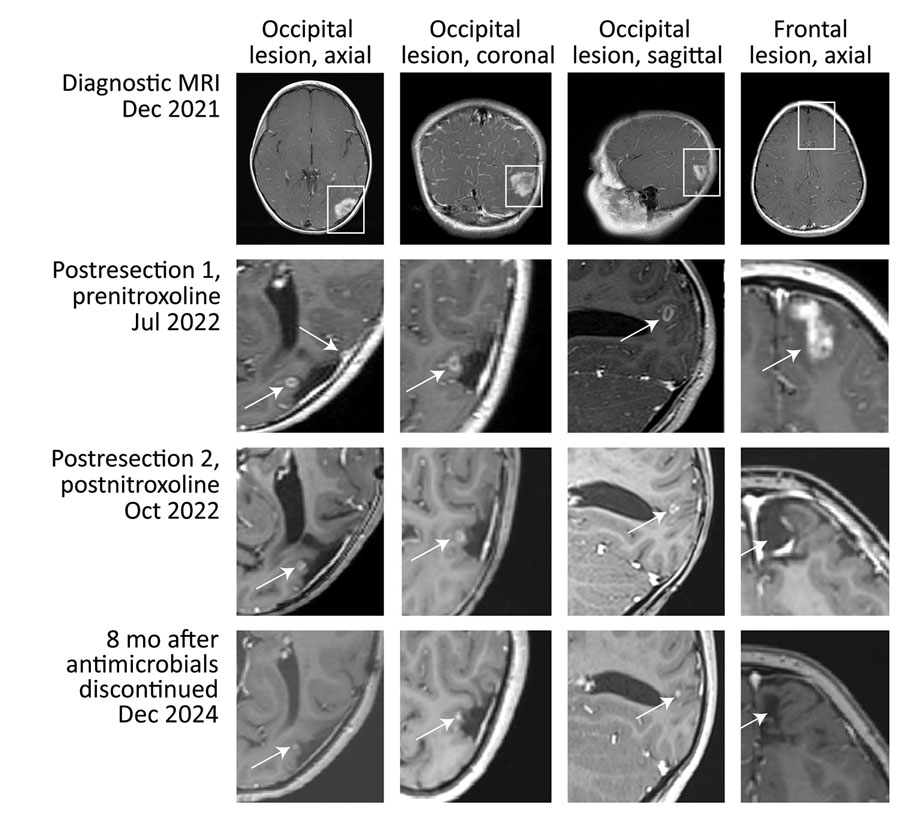
Axial, coronal, and sagittal postcontrast T1-weighted MRI images from study of neurosurgical biopsy and resection for diagnosis and treatment of Balamuthia mandrillaris amebic encephalitis, United States. Top row images show patient’s primary occipital and frontal lesions (boxes). Three weeks after resection of the first occipital lesion (second row), recurrent nodules (arrows) developed around the resection cavity. Before nitroxoline initiation, those nodules were enlarging. MRI in July 2022 (second row) showed a new, 7-mm diameter, indistinct, fluid attenuated inversion recovery–hyperintense, enhancing focus in the anterior aspect of the left superior frontal gyrus. After nitroxoline (third row), the occipital lesions retracted (arrows) and were no longer ring-enhancing. No recurrent lesions were noted at the resection site of the frontal lesion, which was resected while the patient was on multidrug therapy and 4 weeks before starting nitroxoline. Follow-up imaging 8 months after antimicrobial treatment was discontinued (fourth row), a stable, residual nodule (arrows) in the medial resection cavity remained, thought to represent gliosis. MRI, magnetic resonance imaging.

Figure 1. Axial, coronal, and sagittal postcontrast T1-weighted MRI images from study of neurosurgical biopsy and resection for diagnosis and treatment of Balamuthia mandrillaris amebic encephalitis, United States. Top row images show patient’s primary occipital and frontal lesions (boxes). Three weeks after resection of the first occipital lesion (second row), recurrent nodules (arrows) developed around the resection cavity. Before nitroxoline initiation, those nodules were enlarging. MRI in July 2022 (second row) showed a new, 7-mm diameter, indistinct, fluid attenuated inversion recovery–hyperintense, enhancing focus in the anterior aspect of the left superior frontal gyrus. After nitroxoline (third row), the occipital lesions retracted (arrows) and were no longer ring-enhancing. No recurrent lesions were noted at the resection site of the frontal lesion, which was resected while the patient was on multidrug therapy and 4 weeks before starting nitroxoline. Follow-up imaging 8 months after antimicrobial treatment was discontinued (fourth row), a stable, residual nodule (arrows) in the medial resection cavity remained, thought to represent gliosis. MRI, magnetic resonance imaging.

Main Article

1These authors contributed equally to this article.

Page created: June 10, 2026
Page updated: June 23, 2026
Page reviewed: June 23, 2026
The conclusions, findings, and opinions expressed by authors contributing to this journal do not necessarily reflect the official position of the U.S. Department of Health and Human Services, the Public Health Service, the Centers for Disease Control and Prevention, or the authors' affiliated institutions. Use of trade names is for identification only and does not imply endorsement by any of the groups named above.
file_external