Disclaimer: Early release articles are not considered as final versions. Any changes will be reflected in the online version in the month the article is officially released.
Volume 32, Number 9—September 2026
Research
Reemergence of Scrub Typhus Associated with Leptotrombidium akamushi Mites and Karp-Like Orientia tsutsugamushi Genotype Bacteria, Japan, 2024–2025
Motohiko Ogawa , Nobuhiro Takada, Takashi Katayama, Yuki Hashimoto, Kei Nagano, Hirotaka Komine, and Yukihiro Akeda
, Nobuhiro Takada, Takashi Katayama, Yuki Hashimoto, Kei Nagano, Hirotaka Komine, and Yukihiro Akeda
Figure 1
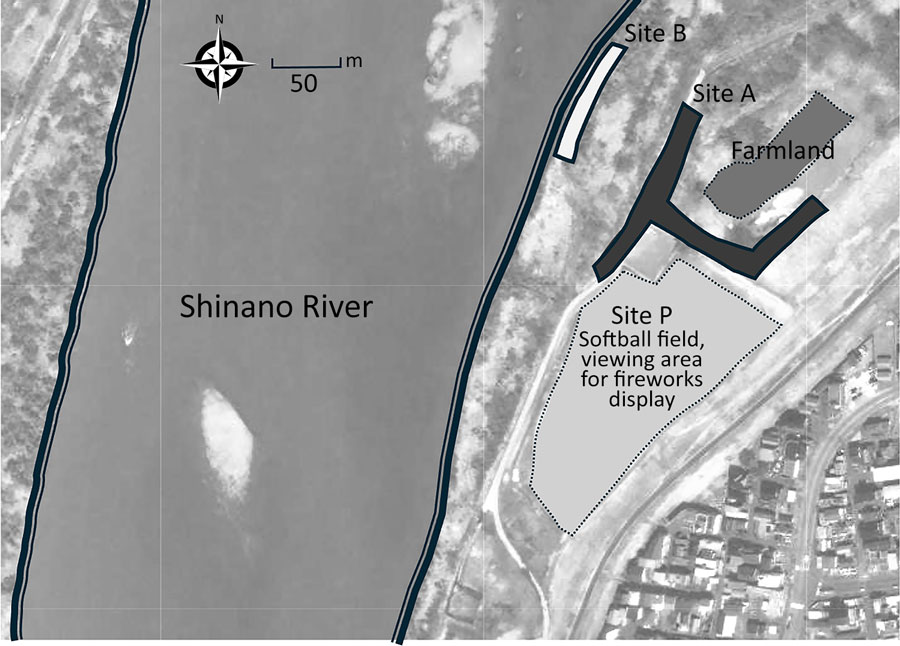
Figure 1. Study sites for investigation of reemergence of scrub typhus associated with Leptotrombidium akamushi mites and Karp-like Orientia tsutsugamushi genotype bacteria, Japan, 2024–2025. Map shows suspected exposure site along the Shinano River in Niigata Prefecture (P) and 2 sampling sites (A and B). Site A was located adjacent to farmland, and site B was located along the riverbank. Sites A and B are within 200 m of the patient’s suspected exposure site.
Page created: August 05, 2026
Page updated: August 18, 2026
Page reviewed: August 18, 2026
The conclusions, findings, and opinions expressed by authors contributing to this journal do not necessarily reflect the official position of the U.S. Department of Health and Human Services, the Public Health Service, the Centers for Disease Control and Prevention, or the authors' affiliated institutions. Use of trade names is for identification only and does not imply endorsement by any of the groups named above.