Disclaimer: Early release articles are not considered as final versions. Any changes will be reflected in the online version in the month the article is officially released.
Volume 32, Number 9—September 2026
Research
Reemergence of Scrub Typhus Associated with Leptotrombidium akamushi Mites and Karp-Like Orientia tsutsugamushi Genotype Bacteria, Japan, 2024–2025
 , Nobuhiro Takada, Takashi Katayama, Yuki Hashimoto, Kei Nagano, Hirotaka Komine, and Yukihiro Akeda
Figure 4
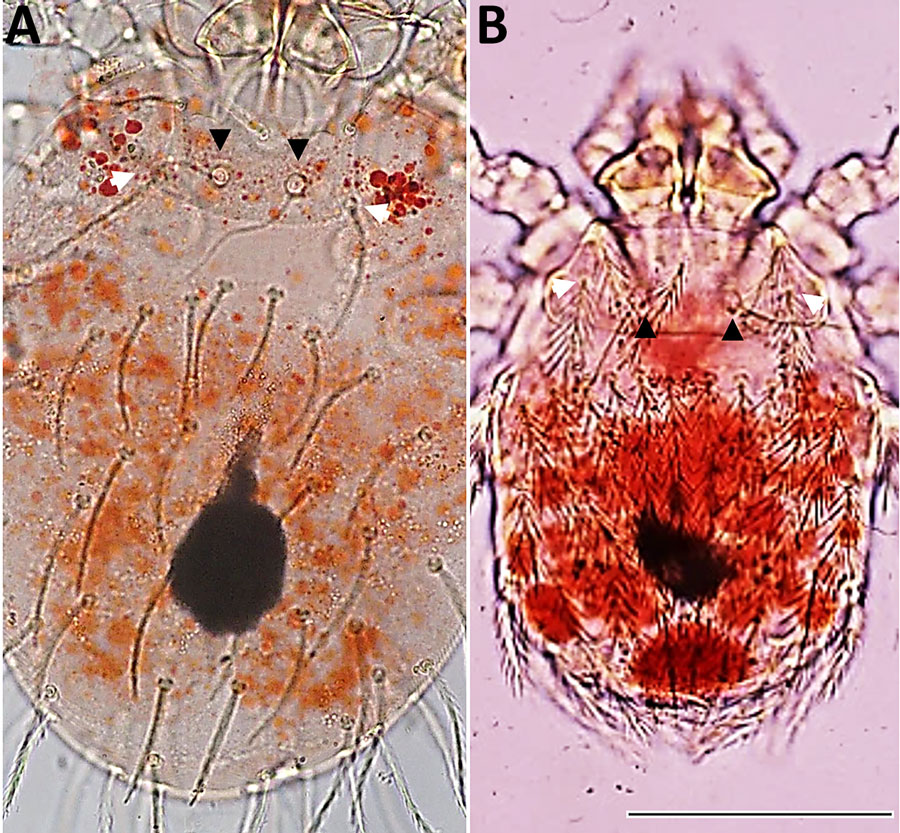
Figure 4. Comparison of engorged larval mites from a study of reemergence of scrub typhus associated with Leptotrombidium akamushi mites and Karp-like Orientia tsutsugamushi genotype bacteria, Japan, 2024–2025. A) L. akamushi larva; B) semi-engorged L. pallidum larva. Larvae were collected from field mice in Niigata Prefecture at the site of probable patient O. tsutsugamushi infection. L. akamushi can be distinguished from L. pallidum by the position of the sensillary setae (black arrows), which arise anterior to the posterolateral setae of the scutum, and by the presence of 8 dorsal idiosomal setae in a transverse row (white arrows). Those morphological characteristics were consistent with the molecular identification on the basis of COX1 sequence analysis. Scale bar indicates 100 μm; both images are at the same magnification.