Skip directly to site content Skip directly to page options Skip directly to A-Z link Skip directly to A-Z link Skip directly to A-Z link

Disclaimer: Early release articles are not considered as final versions. Any changes will be reflected in the online version in the month the article is officially released.

Volume 32, Number 9—September 2026

Research

Reemergence of Scrub Typhus Associated with Leptotrombidium akamushi Mites and Karp-Like Orientia tsutsugamushi Genotype Bacteria, Japan, 2024–2025

Motohiko OgawaComments to Author , Nobuhiro Takada, Takashi Katayama, Yuki Hashimoto, Kei Nagano, Hirotaka Komine, and Yukihiro Akeda
Author affiliation: National Institute of Infectious Diseases, Japan Institute for Health Security, Tokyo, Japan (M. Ogawa, Y. Hashimoto, Y. Akeda); University of Fukui, Fukui, Japan (N. Takada); Kanagawa Prefectural Institute of Public Health, Kanagawa, Japan (T. Katayama); Niigata City General Hospital, Niigata, Japan (K. Nagano); Yamagata University, Yamagata, Japan (H. Komine)

Main Article

Figure 5

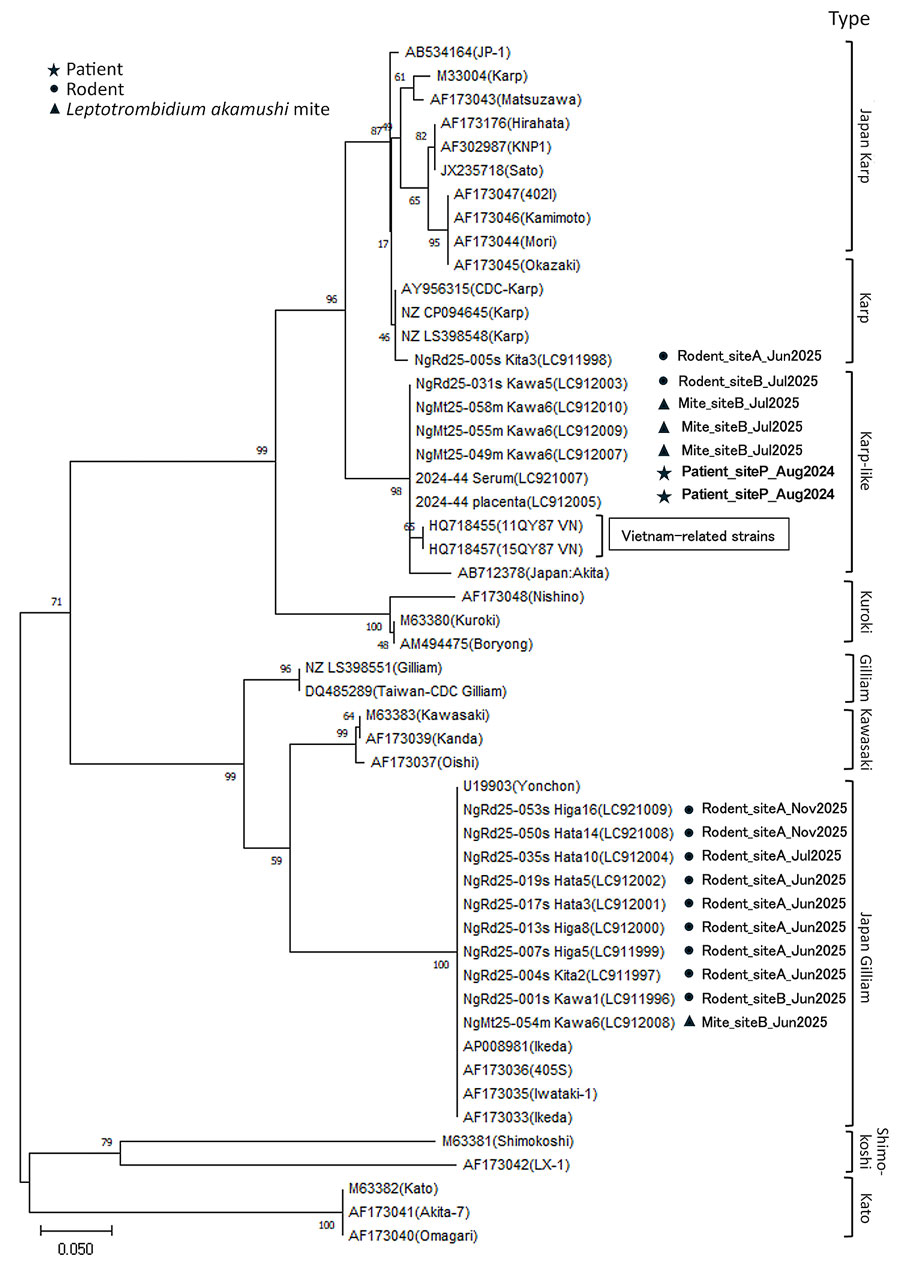
Phylogenetic relationships of Orientia tsutsugamushi strains detected in field mice, mites, and a human patient from a study of reemergence of scrub typhus associated with Leptotrombidium akamushi mites and Karp-like O. tsutsugamushi genotype bacteria, Japan, 2024–2025. Phylogenetic analysis was performed using the neighbor-joining method on the basis of an ≈420-bp region of the 56-kDa type–specific antigen gene. Sequences obtained from the placenta specimen, patient serum, 1 field mouse, and 3 L. akamushi mite larvae clustered together within the Karp-like lineage and were identical within the analyzed region. The placenta sequence (GenBank accession no. LC912005) was also identical over a 959-bp region to 2 L. akamushi mite–derived sequences (GenBank accession nos. LC912009 and LC912010). Reference strains representing major genotypes, including Kato and Karp-related strains, are included for comparison. O. tsutsugamushi bacterial sequences from rodents were all obtained from large Japanese field mice (Apodemus speciosus). Scale bar indicates nucleotide substitutions per site.

Figure 5. Phylogenetic relationships of Orientia tsutsugamushi strains detected in field mice, mites, and a human patient from a study of reemergence of scrub typhus associated with Leptotrombidium akamushi mites and Karp-like O. tsutsugamushi genotype bacteria, Japan, 2024–2025. Phylogenetic analysis was performed using the neighbor-joining method on the basis of an ≈420-bp region of the 56-kDa type–specific antigen gene. Sequences obtained from the placenta specimen, patient serum, 1 field mouse, and 3 L. akamushi mite larvae clustered together within the Karp-like lineage and were identical within the analyzed region. The placenta sequence (GenBank accession no. LC912005) was also identical over a 959-bp region to 2 L. akamushi mite–derived sequences (GenBank accession nos. LC912009 and LC912010). Reference strains representing major genotypes, including Kato and Karp-related strains, are included for comparison. O. tsutsugamushi bacterial sequences from rodents were all obtained from large Japanese field mice (Apodemus speciosus). Scale bar indicates nucleotide substitutions per site.

Main Article

Page created: August 05, 2026
Page updated: August 18, 2026
Page reviewed: August 18, 2026
The conclusions, findings, and opinions expressed by authors contributing to this journal do not necessarily reflect the official position of the U.S. Department of Health and Human Services, the Public Health Service, the Centers for Disease Control and Prevention, or the authors' affiliated institutions. Use of trade names is for identification only and does not imply endorsement by any of the groups named above.
file_external