Skip directly to site content Skip directly to page options Skip directly to A-Z link Skip directly to A-Z link Skip directly to A-Z link

Disclaimer: Early release articles are not considered as final versions. Any changes will be reflected in the online version in the month the article is officially released.

Volume 32, Number 9—September 2026

Research

Reemergence of Scrub Typhus Associated with Leptotrombidium akamushi Mites and Karp-Like Orientia tsutsugamushi Genotype Bacteria, Japan, 2024–2025

Motohiko OgawaComments to Author , Nobuhiro Takada, Takashi Katayama, Yuki Hashimoto, Kei Nagano, Hirotaka Komine, and Yukihiro Akeda
Author affiliation: National Institute of Infectious Diseases, Japan Institute for Health Security, Tokyo, Japan (M. Ogawa, Y. Hashimoto, Y. Akeda); University of Fukui, Fukui, Japan (N. Takada); Kanagawa Prefectural Institute of Public Health, Kanagawa, Japan (T. Katayama); Niigata City General Hospital, Niigata, Japan (K. Nagano); Yamagata University, Yamagata, Japan (H. Komine)

Main Article

Figure 3

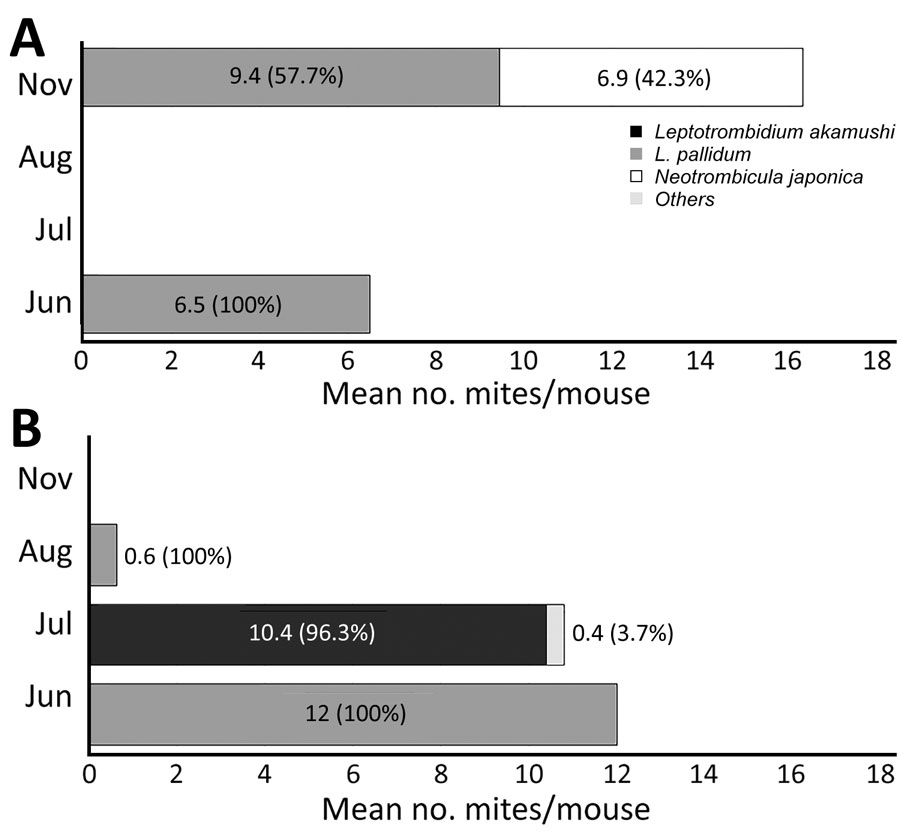
Seasonal abundance and species composition of trombiculid mites collected from field mice in a study of reemergence of scrub typhus associated with Leptotrombidium akamushi mites and Karp-like Orientia tsutsugamushi genotype bacteria, Japan, 2024–2025. A) Site A, near a tract of farmland; B) site B, near the riverbank. Graphs show mean numbers of mites per mouse and species composition for each sampling period. Mite species composition differed markedly between the sites: L. pallidum was predominant at site A in June (early summer) and November (autumn), whereas L. akamushi was predominant at site B in July (summer). Neotrombicula japonica and other mite species were also detected.

Figure 3. Seasonal abundance and species composition of trombiculid mites collected from field mice in a study of reemergence of scrub typhus associated with Leptotrombidium akamushi mites and Karp-like Orientia tsutsugamushi genotype bacteria, Japan, 2024–2025. A) Site A, near a tract of farmland; B) site B, near the riverbank. Graphs show mean numbers of mites per mouse and species composition for each sampling period. Mite species composition differed markedly between the sites: L. pallidum was predominant at site A in June (early summer) and November (autumn), whereas L. akamushi was predominant at site B in July (summer). Neotrombicula japonica and other mite species were also detected.

Main Article

Page created: August 05, 2026
Page updated: August 18, 2026
Page reviewed: August 18, 2026
The conclusions, findings, and opinions expressed by authors contributing to this journal do not necessarily reflect the official position of the U.S. Department of Health and Human Services, the Public Health Service, the Centers for Disease Control and Prevention, or the authors' affiliated institutions. Use of trade names is for identification only and does not imply endorsement by any of the groups named above.
file_external