Disclaimer: Early release articles are not considered as final versions. Any changes will be reflected in the online version in the month the article is officially released.
Volume 32, Number 11—November 2026
Research
Emergence of Novel Macrolide-Resistant Mycoplasma pneumoniae Sequence Type 3 Subclades in Children after COVID-19 Pandemic, Taiwan

Figure 3
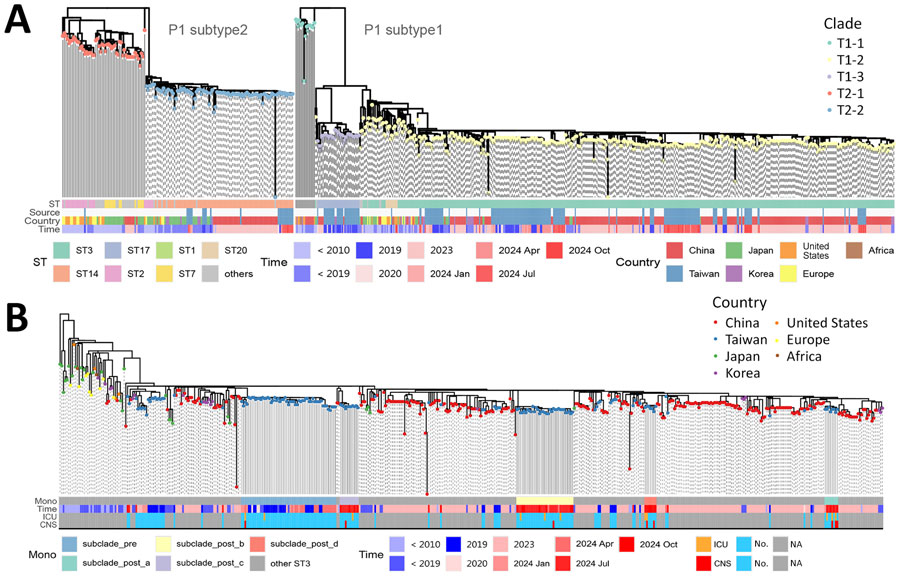
Figure 3. Phylogenomic evolution of Mycoplasma pneumoniae in study of emergence of novel macrolide-resistant M. pneumoniae ST3 subclades in children after COVID-19 pandemic, Taiwan, 2017–2024. A) Global phylogenetic tree showing evolutionary relationships among all sequenced strains. Nodes are colored by clade according to our previous study (12). Annotation bands indicate sequence type, data source, country, and sampling time. For 2024, isolates were grouped into quarterly intervals (January–March, April–June, July–September, and October–December) to provide greater temporal resolution during the outbreak. B) Phylogeny of ST3 strain. Nodes are colored by country, with annotation bands indicating monophyletic subclades (Mono), sampling time, ICU admission, and CNS complications. CNS, central nervous system; ICU, intensive care unit; ST, sequence type.
References
- Meyer Sauteur PM, Beeton ML, Pereyre S, Bébéar C, Gardette M, Hénin N, et al.; ESGMAC the ESGMAC MAPS study group. Mycoplasma pneumoniae: gone forever? Lancet Microbe. 2023;4:
e763 . DOIPubMedGoogle Scholar - Méndez-Echevarría A, Calle-Miguel L, Miralbés S, Barreiro-Pérez S, Afonso-Rodriguez O, Soler-Simón JA, et al.; Spanish Mycoplasma Study Group. Increased severity of Mycoplasma pneumoniae infections in Spanish children. Pediatr Infect Dis J. 2024;43:1113–9. DOIPubMedGoogle Scholar
- McCarthy KN, Hatcher J, Best T, Kaliakatsos M, Hassell J, Turnbull A, et al. Increasing number of clinically severe Mycoplasma pneumoniae infections in children after the COVID-19 pandemic: a single-center case series. J Pediatric Infect Dis Soc. 2025;14:14. DOIPubMedGoogle Scholar
- Danner MT, Binns HC, Nguyen K, Johnson C, Dunn J, Niles D, et al. Resurgence of pediatric Mycoplasma pneumoniae infections in southeast Texas, November 2023–June 2024. J Pediatric Infect Dis Soc. 2025;14:14. DOIPubMedGoogle Scholar
- Meyer Sauteur PM, Zhang XS, Emborg HD, Sidorov S, Pereyre S, Fischer A, et al.; ESGMAC MAPS study group. Global spatiotemporal dynamics of Mycoplasma pneumoniae re-emergence after COVID-19 pandemic restrictions: an epidemiological and transmission modelling study. Lancet Microbe. 2025;6:
101019 . DOIPubMedGoogle Scholar - Garzoni C, Bernasconi E, Zehnder C, Malossa SF, Merlani G, Bongiovanni M. Unexpected increase of severe Mycoplasma pneumoniae pneumonia in adults in southern Switzerland. Clin Microbiol Infect. 2024;30:953–4. DOIPubMedGoogle Scholar
- Gavaud A, Holub M, Asquier-Khati A, Faure K, Leautez-Nainville S, Le Moal G, et al.; MYCADO Study Group. Mycoplasma pneumoniae infection in adult inpatients during the 2023–24 outbreak in France (MYCADO): a national, retrospective, observational study. Lancet Infect Dis. 2025;25:801–12. DOIPubMedGoogle Scholar
- Li H, Li S, Yang H, Chen Z, Zhou Z. Resurgence of Mycoplasma pneumonia by macrolide-resistant epidemic clones in China. Lancet Microbe. 2024;5:
e515 . DOIPubMedGoogle Scholar - Kim K, Jung S, Kim M, Park S, Yang HJ, Lee E. Global trends in the proportion of macrolide-resistant Mycoplasma pneumoniae infections: a systematic review and meta-analysis. JAMA Netw Open. 2022;5:
e2220949 . DOIPubMedGoogle Scholar - Hung HM, Chuang CH, Chen YY, Liao WC, Li SW, Chang IY, et al. Clonal spread of macrolide-resistant Mycoplasma pneumoniae sequence type-3 and type-17 with recombination on non-P1 adhesin among children in Taiwan. Clin Microbiol Infect. 2021;27:1169e1–e6. PMID 33010445
- Al-Zaidy SA, MacGregor D, Mahant S, Richardson SE, Bitnun A. Neurological complications of PCR-proven M. pneumoniae infections in children: prodromal illness duration may reflect pathogenetic mechanism. Clin Infect Dis. 2015;61:1092–8. DOIPubMedGoogle Scholar
- Hsieh YC, Li SW, Chen YY, Kuo CC, Chen YC, Chang IY, et al. Global genome diversity and recombination in Mycoplasma pneumoniae. Emerg Infect Dis. 2022;28:111–7. DOIPubMedGoogle Scholar
- Clinical and Laboratory Standards Institute. Methods for antimicrobial susceptibility testing for human mycoplasmas. Supplement M43. Wayne (PA): The Institute; 2011.
- Dungu KHS, Holm M, Hartling U, Jensen LH, Nielsen AB, Schmidt LS, et al. Mycoplasma pneumoniae incidence, phenotype, and severity in children and adolescents in Denmark before, during, and after the COVID-19 pandemic: a nationwide multicentre population-based cohort study. Lancet Reg Health Eur. 2024;47:
101103 . DOIPubMedGoogle Scholar - Yu Y, Jin X, Zhang X, Shen Y. Pulmonary thrombotic complication of Mycoplasma pneumoniae pneumonia in Chinese children: clinical feature and risk factor analysis. Pediatr Infect Dis J. 2024;43:505–10. DOIPubMedGoogle Scholar
- Zhang XB, He W, Gui YH, Lu Q, Yin Y, Zhang JH, et al. Current Mycoplasma pneumoniae epidemic among children in Shanghai: unusual pneumonia caused by usual pathogen. World J Pediatr. 2024;20:5–10. DOIPubMedGoogle Scholar
- Jiao W, Wang J, Li C, Wang P, Xu S, Bi J, et al. Genetic factors driving the Mycoplasma pneumoniae outbreak among children post-COVID-19 in China: a whole genome analysis. Lancet Reg Health West Pac. 2025;59:
101578 . DOIPubMedGoogle Scholar - Lee JK, Lee JH, Lee H, Ahn YM, Eun BW, Cho EY, et al. Clonal expansion of macrolide-resistant sequence type 3 Mycoplasma pneumoniae, South Korea. Emerg Infect Dis. 2018;24:1465–71. DOIPubMedGoogle Scholar
- Ando M, Morozumi M, Adachi Y, Ubukata K, Iwata S. Multilocus sequence typing of Mycoplasma pneumoniae, Japan, 2002–2016. Emerg Infect Dis. 2018;24:1895–901. DOIPubMedGoogle Scholar
- Rubin R. From “immunity debt” to “immunity theft”—how COVID-19 might be tied to recent respiratory disease surges. JAMA. 2024;331:378–81. DOIPubMedGoogle Scholar
- Kannan TR, Baseman JB. ADP-ribosylating and vacuolating cytotoxin of Mycoplasma pneumoniae represents unique virulence determinant among bacterial pathogens. Proc Natl Acad Sci U S A. 2006;103:6724–9. DOIPubMedGoogle Scholar
- Meyer Sauteur PM, Jacobs BC, Spuesens EBM, Jacobs E, Nadal D, Vink C, et al. Antibody responses to Mycoplasma pneumoniae: role in pathogenesis and diagnosis of encephalitis? PLoS Pathog. 2014;10:
e1003983 . DOIPubMedGoogle Scholar - Bitnun A, Ford-Jones EL, Petric M, MacGregor D, Heurter H, Nelson S, et al. Acute childhood encephalitis and Mycoplasma pneumoniae. Clin Infect Dis. 2001;32:1674–84. DOIPubMedGoogle Scholar
- Fan G, Guo Y, Tang F, Chen M, Liao S, Wang J. Determining the clinical characteristics, treatment strategies, and prognostic factors for Mycoplasma pneumoniae encephalitis in children: a multicenter study in China. J Clin Neurol. 2023;19:402–9. DOIPubMedGoogle Scholar
- Ravindra D, Huang G, Hallett K, Burgner DP, Gwee A, Silva MJ. Antibiotic exposure and dental health: a systematic review. Pediatrics. 2023;152:
e2023061350 . DOIPubMedGoogle Scholar - Committee on Infectious Diseases. The use of systemic fluoroquinolones. Pediatrics. 2006;118:1287–92. DOIPubMedGoogle Scholar
- Vizarraga D, Kawamoto A, Matsumoto U, Illanes R, Pérez-Luque R, Martín J, et al. Immunodominant proteins P1 and P40/P90 from human pathogen Mycoplasma pneumoniae. Nat Commun. 2020;11:5188. DOIPubMedGoogle Scholar
1These senior authors contributed equally to this article.