Disclaimer: Early release articles are not considered as final versions. Any changes will be reflected in the online version in the month the article is officially released.
Emergence of Novel Macrolide-Resistant Mycoplasma pneumoniae Sequence Type 3 Subclades in Children after COVID-19 Pandemic, Taiwan
Yu-Chia Hsieh, Chen-Ching Lin, Jia-Wen Wu, Yi-Hsuan Liu, Yi-Jiun Pan, Tzu-Ya Lo, Shian-Sen Shie, Huey-Ling You, Chong-Wei Huang, Yi-Chuan Huang, Tzu-Ching Huang, Yu-Xin She, Yin-Cheng Chen
1, and Shiao-Wen Li
1
Author affiliation: Chang Gung Children’s Hospital, Chang Gung Memorial Hospital, Chang Gung University, College of Medicine, Taoyuan, Taiwan (Y.-C. Hsieh, J.-W. Wu, Y.-H. Liu, T.-Y. Lo); School of Medicine, National Yang Ming Chiao Tung University, Taipei, Taiwan (C.-C. Lin, Y.-C. Chen); School of Medicine, College of Medicine, People’s Republic of China Medical University, Taichung, Taiwan (Y.-J. Pan); Chang Gung Memorial Hospital, Taoyuan (S.-S. Shie); Kaohsiung Chang Gung Memorial Hospital, Kaohsiung, Taiwan (H.-L. You); Keelung Chang Gung Memorial Hospital, Keelung, Taiwan (C.-W. Huang, Y.-C. Huang); School of Medicine, College of Medicine, National Yang Ming Chiao Tung University, Taipei (T.-C. Huang); College of Science Department of Life Sciences, National University of Kaohsiung, Kaohsiung (Y.-X. She, S.-W. Li)
Main Article
Figure 4
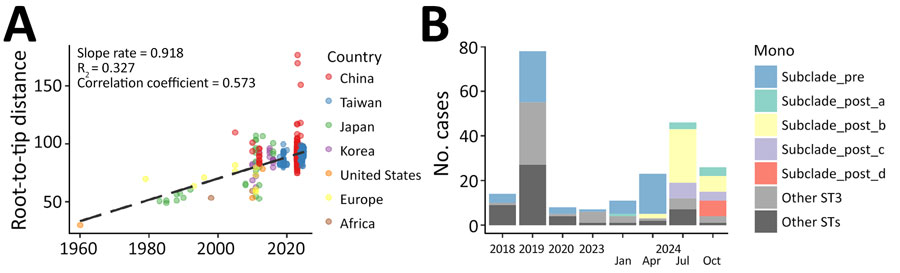
Figure 4. Temporal prevalence of Mycoplasma pneumoniae in study of emergence of novel macrolide-resistant M. pneumoniae sequence type 3 subclades in children after COVID-19 pandemic, Taiwan, 2017–2024. A) Temporal signal in ST3 genomes evaluated by linear regression of root-to-tip genetic distances against sampling year for global isolates collected during 1960–2024, indicating molecular clock consistency. B) Temporal prevalence of ST3 subclades among persons <18 years of age, Taiwan, 2018–2024. Isolates collected in 2024 are shown at quarterly intervals. ST, sequence type.
Main Article
Page created: September 05, 2026
Page updated: October 14, 2026
Page reviewed: October 14, 2026
The conclusions, findings, and opinions expressed by authors contributing to this journal do not necessarily reflect the official position of the U.S. Department of Health and Human Services, the Public Health Service, the Centers for Disease Control and Prevention, or the authors' affiliated institutions. Use of trade names is for identification only and does not imply endorsement by any of the groups named above.