Skip directly to site content Skip directly to page options Skip directly to A-Z link Skip directly to A-Z link Skip directly to A-Z link

Volume 32, Number 3—March 2026

Research

Environmental and Phylogenetic Investigations of Aspergillus flavus Outbreak Linked to Contaminated Building Materials, Denmark, 2025

Alexander Gewecke, Raphael Niklaus Sieber, Søren Hallstrøm, Marc Stegger, Barbara Kolarik, Jenny D. Knudsen, Birgitte Andersen, Astrid Hall, Nadja Hawwa Vissing, and Maiken Cavling ArendrupComments to Author 
Author affiliation: Statens Serum Institut, Copenhagen, Denmark (A. Gewecke, R.N. Sieber, S. Hallstrøm, M. Stegger, M.C. Arendrup); Harry Butler Institute, Murdoch University, Perth, Western Australia, Australia (M. Stegger); dansk MiljøAnalyse, Vedbæk, Denmark (B. Kolarik); Copenhagen University Hospital, Rigshospitalet, Copenhagen (J.D. Knudsen, A. Hall, N.H. Vissing, M.C. Arendrup); Aalborg University, Copenhagen (B. Andersen); University of Copenhagen, Copenhagen (M.C. Arendrup)

Main Article

Figure 3

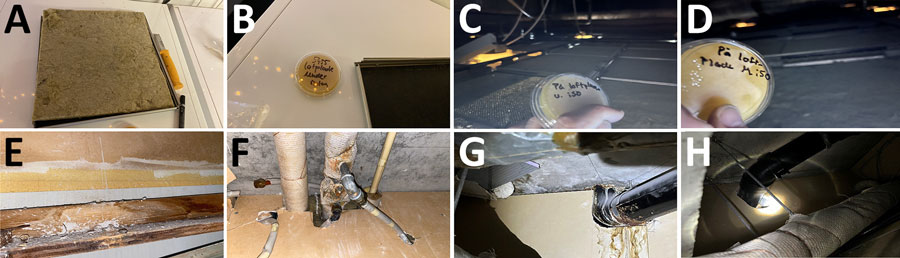
Examples of locations with dust accumulation above ceiling and large Aspergillus flavus contamination from hospital pediatric hemotology ward in study of environmental and phylogenetic investigations of A. flavus outbreak linked to contaminated building materials, Denmark, 2025. A) Ceiling tile from room A with 55 CFU/25 cm2 A. flavus detected on top (none detected underneath); B) the same ceiling tile (black item) from room A with the insulation sheet (yellow mat) removed, where the surface had been covered and thus tested negative for A. flavus; C) area above ceiling in room B, 24 CFU/25 cm2 (no rock wool); D) thick dust layer on inside of ceiling, room B; E) example of a water-damaged part of the wooden framing with mold-like growth above the suspended ceiling, 32 CFU/25 cm2; F) 40 CFU/25 cm2 on righthand pipe; G, H) pipes between rooms lacking sealing, which could possibly enable spore dispersal.

Figure 3. Examples of locations with dust accumulation above ceiling and large Aspergillus flavus contamination from hospital pediatric hemotology ward in study of environmental and phylogenetic investigations of A. flavus outbreak linked to contaminated building materials, Denmark, 2025. A) Ceiling tile from room A with 55 CFU/25 cm2 A. flavus detected on top (none detected underneath); B) the same ceiling tile (black item) from room A with the insulation sheet (yellow mat) removed, where the surface had been covered and thus tested negative for A. flavus; C) area above ceiling in room B, 24 CFU/25 cm2 (no rock wool); D) thick dust layer on inside of ceiling, room B; E) example of a water-damaged part of the wooden framing with mold-like growth above the suspended ceiling, 32 CFU/25 cm2; F) 40 CFU/25 cm2 on righthand pipe; G, H) pipes between rooms lacking sealing, which could possibly enable spore dispersal.

Main Article

Page created: January 21, 2026
Page updated: March 20, 2026
Page reviewed: March 20, 2026
The conclusions, findings, and opinions expressed by authors contributing to this journal do not necessarily reflect the official position of the U.S. Department of Health and Human Services, the Public Health Service, the Centers for Disease Control and Prevention, or the authors' affiliated institutions. Use of trade names is for identification only and does not imply endorsement by any of the groups named above.
file_external