Skip directly to site content Skip directly to page options Skip directly to A-Z link Skip directly to A-Z link Skip directly to A-Z link

Disclaimer: Early release articles are not considered as final versions. Any changes will be reflected in the online version in the month the article is officially released.

Volume 32, Number 5—May 2026

Synopsis

Borna Disease Virus 1 as Cause of Fatal Meningoencephalomyelitis in Wild Hedgehogs, Germany, 2022–2025

Effrosyni Michelakaki, Benjamin Schade, Brigitte Boehm, Eva Kappe, Marcel Suchowski, Anne Kupca, Magdalena Schumacher, Anna Maria Gager, Friederike Liesche-Starnecker, Sonja Fiedler, Eva Schwarz, Zoltan Bago, Andreas Blutke, Martin Beer, Dennis Rubbenstroth1Comments to Author , and Kaspar Matiasek1
Author affiliation: Centre for Clinical Veterinary Medicine, Ludwig Maximilians-Universität München, Munich, Germany (E. Michelakaki, S. Fiedler, E. Schwarz, A. Blutke, K. Matiasek); Bavarian Animal Health Service, Poing, Germany (B. Schade, B. Boehm, E. Kappe); Bavarian Health and Food Safety Authority, Oberschleißheim, Germany (M. Suchowski, A. Kupca, M. Schumacher, A.M. Gager); University Medical Center Ulm, Ulm University, Ulm, Germany (F. Liesche-Starnecker); Institute for Veterinary Disease Control, Mödling, Austria (Z. Bago); Institute of Diagnostic Virology, Friedrich-Loeffler-Institut, Greifswald-Insel Riems, Germany (M. Beer, D. Rubbenstroth)

Main Article

Figure 6

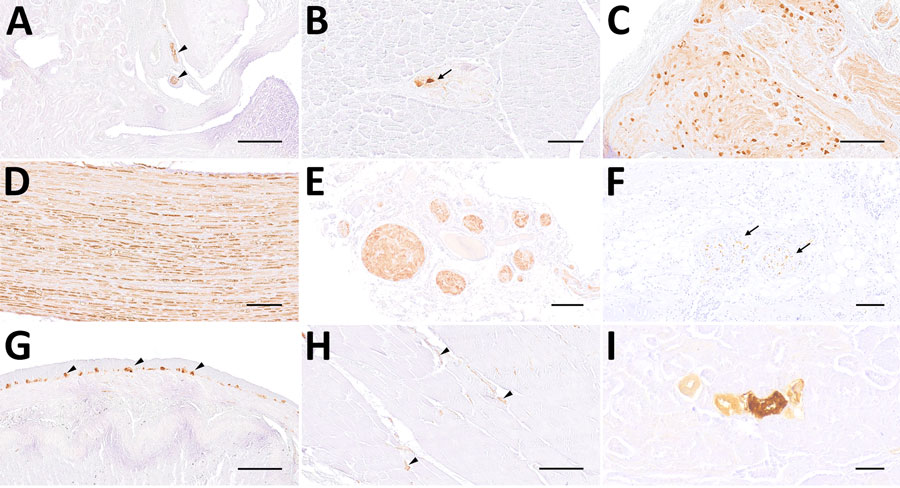
Distribution of virus antigen detected by immunohistochemistry using Bo18 antibody among peripheral organs and tissues of Borna disease virus 1–infected hedgehogs in study of the virus as cause of fatal meningoencephalomyelitis in wild hedgehogs, Germany, 2022–2025. A) Immunopositive nerve branches within the renal pelvis (arrowheads) from case 3. Scale bar represents 250 μm. B) Immunopositive ganglion neurons within salivary gland (arrow) from case 4. Scale bar represents 100 μm. C) Marked positivity within cranial mesenteric ganglion from case 3. Scale bar represents 250 μm. D) Diffusely immunopositive nerve fibers within a large fascicular nerve from case 1. Scale bar represents 100 μm. E) Large immunopositive visceral nerve branches within the mediastinum from case 2. Scale bar represents 200 μm. F) Pulmonary nerve branches with positive fibers (arrows) from case 7. Scale bar represents 100 μm. G) Widespread immunostaining of myenteric plexus (arrowheads) from case 4. Scale bar represents 250 μm. H) Immunopositive intramuscular nerve branches within the paravertebral musculature (arrowheads) from case 5. Scale bar represents 250 μm. I) A small group of immunopositive renal tubules from case 5. Scale bar represents 50 μm. All stains were 3,3′-diaminobenzidine stain with, hematoxylin counterstain.

Figure 6. Distribution of virus antigen detected by immunohistochemistry using Bo18 antibody among peripheral organs and tissues of Borna disease virus 1–infected hedgehogs in study of the virus as cause of fatal meningoencephalomyelitis in wild hedgehogs, Germany, 2022–2025. A) Immunopositive nerve branches within the renal pelvis (arrowheads) from case 3. Scale bar represents 250 μm. B) Immunopositive ganglion neurons within salivary gland (arrow) from case 4. Scale bar represents 100 μm. C) Marked positivity within cranial mesenteric ganglion from case 3. Scale bar represents 250 μm. D) Diffusely immunopositive nerve fibers within a large fascicular nerve from case 1. Scale bar represents 100 μm. E) Large immunopositive visceral nerve branches within the mediastinum from case 2. Scale bar represents 200 μm. F) Pulmonary nerve branches with positive fibers (arrows) from case 7. Scale bar represents 100 μm. G) Widespread immunostaining of myenteric plexus (arrowheads) from case 4. Scale bar represents 250 μm. H) Immunopositive intramuscular nerve branches within the paravertebral musculature (arrowheads) from case 5. Scale bar represents 250 μm. I) A small group of immunopositive renal tubules from case 5. Scale bar represents 50 μm. All stains were 3,3′-diaminobenzidine stain with, hematoxylin counterstain.

Main Article

1These senior authors contributed equally to this article.

Page created: April 02, 2026
Page updated: April 27, 2026
Page reviewed: April 27, 2026
The conclusions, findings, and opinions expressed by authors contributing to this journal do not necessarily reflect the official position of the U.S. Department of Health and Human Services, the Public Health Service, the Centers for Disease Control and Prevention, or the authors' affiliated institutions. Use of trade names is for identification only and does not imply endorsement by any of the groups named above.
file_external