Volume 32, Number 5—May 2026
Research
Zoonotic and Anthroponotic Plasmodium spp. Circulation between Wild Primates and Indigenous Community, Peruvian Amazon, 2007–2020
Gabriela M. Ulloa , Alex D. Greenwood, Omar E. Cornejo, Henar Alonso, Meddly L. Santolalla Robles, Stephanie Montero, Andres G. Lescano, and Pedro Mayor
, Alex D. Greenwood, Omar E. Cornejo, Henar Alonso, Meddly L. Santolalla Robles, Stephanie Montero, Andres G. Lescano, and Pedro Mayor
Figure 3
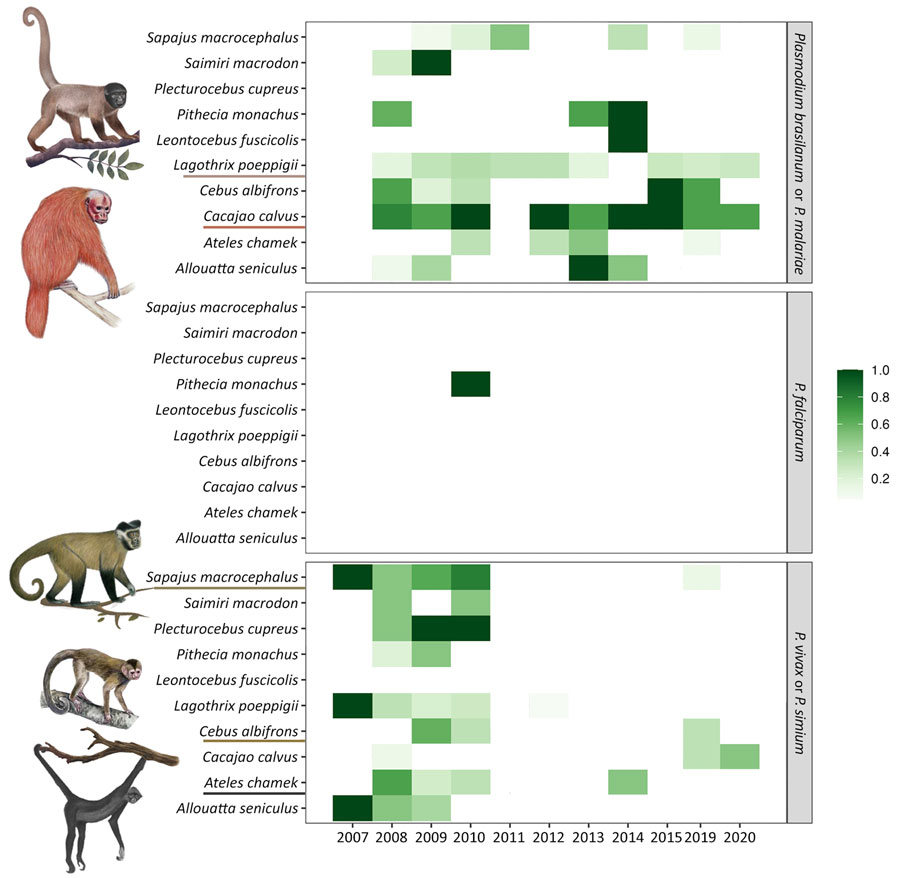
Figure 3. Annual prevalence of Plasmodium spp. infections in wild nonhuman primate species detected in study of zoonotic and anthroponotic Plasmodium spp. circulation between wild primates and Indigenous community, Peruvian Amazon, 2007–2020. Prevalence of cytochrome oxidase b nested PCR–detected infections are shown for 10 nonhuman primate species sampled during 2007–2015, 2019, and 2020 in the Yavarí-Mirín River basin, Loreto region, Peru. Each tile indicates the proportion of infected persons for a given host–parasite pair, by year (shading intensity reflects prevalence). Illustrations and underlining highlight taxa with more stable or recurrent infection patterns.
Page created: March 17, 2026
Page updated: May 06, 2026
Page reviewed: May 06, 2026
The conclusions, findings, and opinions expressed by authors contributing to this journal do not necessarily reflect the official position of the U.S. Department of Health and Human Services, the Public Health Service, the Centers for Disease Control and Prevention, or the authors' affiliated institutions. Use of trade names is for identification only and does not imply endorsement by any of the groups named above.