Volume 32, Number 5—May 2026
Research
Zoonotic and Anthroponotic Plasmodium spp. Circulation between Wild Primates and Indigenous Community, Peruvian Amazon, 2007–2020
Gabriela M. Ulloa , Alex D. Greenwood, Omar E. Cornejo, Henar Alonso, Meddly L. Santolalla Robles, Stephanie Montero, Andres G. Lescano, and Pedro Mayor
, Alex D. Greenwood, Omar E. Cornejo, Henar Alonso, Meddly L. Santolalla Robles, Stephanie Montero, Andres G. Lescano, and Pedro Mayor
Figure 4
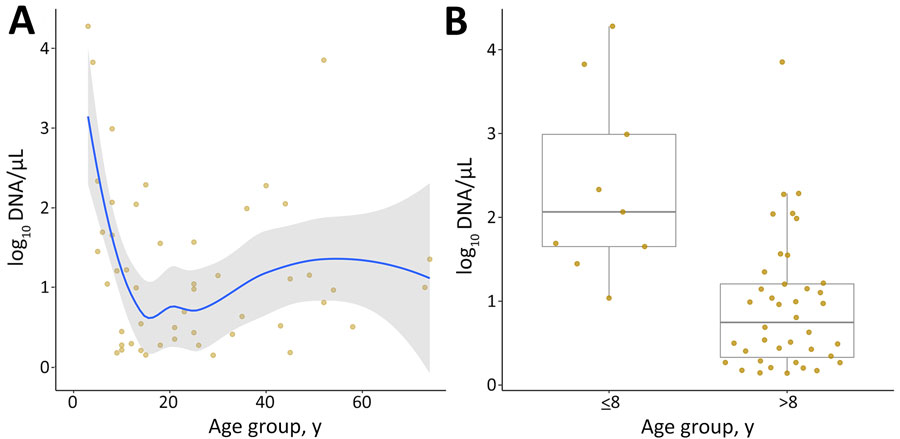
Figure 4. Age-specific parasite load in humans based on quantitative PCR targeting for Plasmodium spp. 18S rRNA genes in study of zoonotic and anthroponotic Plasmodium spp. circulation between wild primates and Indigenous community, Peruvian Amazon, 2007–2020. A) Smoothed regression of log-transformed parasite DNA concentration, by age, in 49 persons. B) Boxplot comparing parasite loads between children <8 years and older persons. Higher parasite loads occurred in younger age groups. Horizontal lines within boxes indicate medians; box tops and bottoms indicate interquartile range (25th–75th percentiles); error bars indicate 1.5 × interquartile range.
Page created: March 17, 2026
Page updated: May 06, 2026
Page reviewed: May 06, 2026
The conclusions, findings, and opinions expressed by authors contributing to this journal do not necessarily reflect the official position of the U.S. Department of Health and Human Services, the Public Health Service, the Centers for Disease Control and Prevention, or the authors' affiliated institutions. Use of trade names is for identification only and does not imply endorsement by any of the groups named above.