Volume 32, Number 5—May 2026
Research
Zoonotic and Anthroponotic Plasmodium spp. Circulation between Wild Primates and Indigenous Community, Peruvian Amazon, 2007–2020
Gabriela M. Ulloa , Alex D. Greenwood, Omar E. Cornejo, Henar Alonso, Meddly L. Santolalla Robles, Stephanie Montero, Andres G. Lescano, and Pedro Mayor
, Alex D. Greenwood, Omar E. Cornejo, Henar Alonso, Meddly L. Santolalla Robles, Stephanie Montero, Andres G. Lescano, and Pedro Mayor
Figure 2
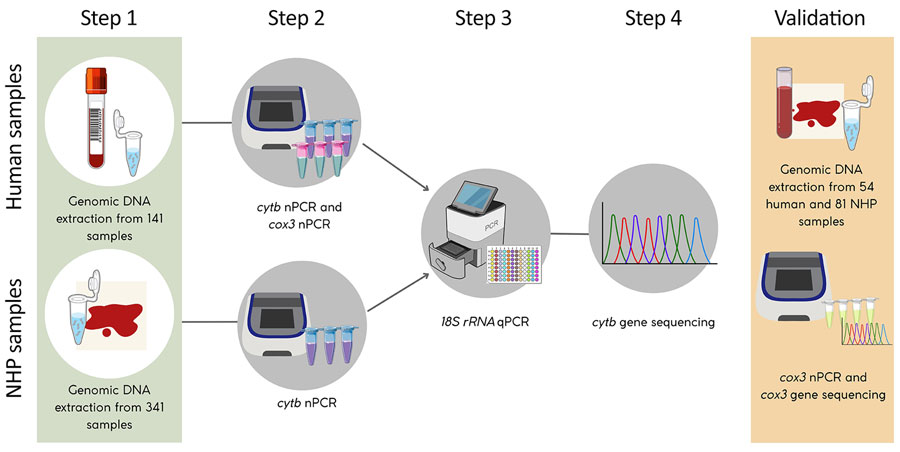
Figure 2. Workflow for molecular detection and validation of Plasmodium spp. infections in study of zoonotic and anthroponotic Plasmodium spp. circulation between wild primates and Indigenous community, Peruvian Amazon, 2007–2020. Schematic of laboratory procedures show DNA extraction and detection of Plasmodium spp. in human and NHP blood samples using qPCR (targeting 18S rRNA gene) and nPCR targeting mitochondrial genes (cytb and cox3). Selected samples underwent sequencing for species confirmation and external validation. cytb, cytochrome oxidase b; cox3, cytochrome c oxidase III; NHP, nonhuman primate; nPCR, nested PCR; qPCR, quantitative PCR.
Page created: March 17, 2026
Page updated: May 06, 2026
Page reviewed: May 06, 2026
The conclusions, findings, and opinions expressed by authors contributing to this journal do not necessarily reflect the official position of the U.S. Department of Health and Human Services, the Public Health Service, the Centers for Disease Control and Prevention, or the authors' affiliated institutions. Use of trade names is for identification only and does not imply endorsement by any of the groups named above.