Volume 32, Number 5—May 2026
Research
Zoonotic and Anthroponotic Plasmodium spp. Circulation between Wild Primates and Indigenous Community, Peruvian Amazon, 2007–2020
Gabriela M. Ulloa , Alex D. Greenwood, Omar E. Cornejo, Henar Alonso, Meddly L. Santolalla Robles, Stephanie Montero, Andres G. Lescano, and Pedro Mayor
, Alex D. Greenwood, Omar E. Cornejo, Henar Alonso, Meddly L. Santolalla Robles, Stephanie Montero, Andres G. Lescano, and Pedro Mayor
Figure 1
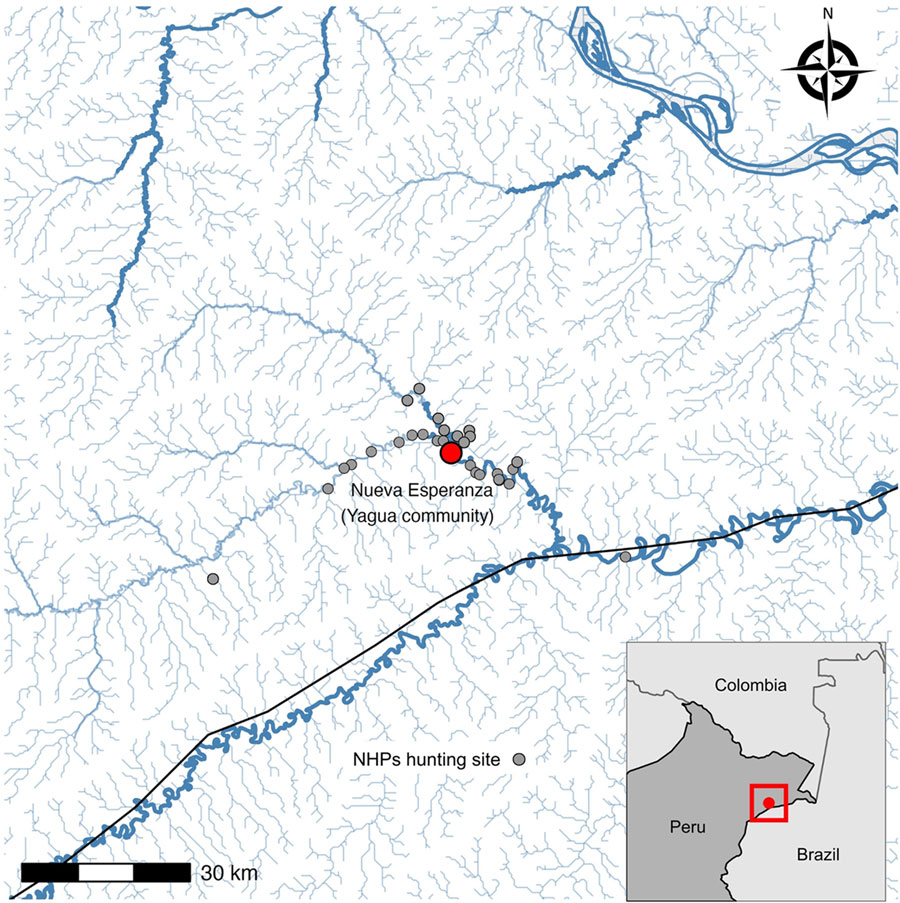
Figure 1. Geographic location of study of zoonotic and anthroponotic Plasmodium spp. circulation between wild primates and Indigenous community, Peruvian Amazon, 2007–2020. Red dot indicates Yagua Indigenous community of Nueva Esperanza, located along the Yavarí-Mirín River near the Peru–Brazil border. Gray dots represent locations of legally hunted nonhuman primates sampled during 2007–2020. Inset map indicates location of community (indicated by red dot in red square) at Peru–Brazil border.
Page created: March 17, 2026
Page updated: May 06, 2026
Page reviewed: May 06, 2026
The conclusions, findings, and opinions expressed by authors contributing to this journal do not necessarily reflect the official position of the U.S. Department of Health and Human Services, the Public Health Service, the Centers for Disease Control and Prevention, or the authors' affiliated institutions. Use of trade names is for identification only and does not imply endorsement by any of the groups named above.