Zoonotic and Anthroponotic Plasmodium spp. Circulation between Wild Primates and Indigenous Community, Peruvian Amazon, 2007–2020
Gabriela M. Ulloa

, Alex D. Greenwood, Omar E. Cornejo, Henar Alonso, Meddly L. Santolalla Robles, Stephanie Montero, Andres G. Lescano, and Pedro Mayor
Author affiliation: Universidade Federal Rural da Amazônia, Belém-Pará, Brazil (G.M. Ulloa); Universidad Científica del Sur, Lima, Peru (G.M. Ulloa); Leibniz-Institute for Zoo and Wildlife Research, Berlin, Germany (A.D. Greenwood); Freie Universität Berlin, Berlin (A.D. Greenwood); University of California Santa Cruz, Santa Cruz, California, USA (O.E. Cornejo); University of Zaragoza, Zaragoza, Spain (H. Alonso); Universidad Peruana Cayetano Heredia, Lima (M.L. Santolalla Robles, S. Montero, A.G. Lescano); Universidad Peruana de Ciencias Aplicadas, Lima (S. Montero); Universitat Autònoma de Barcelona, Bellaterra-Barcelona, Spain (P. Mayor); Comunidad de Manejo de Fauna Silvestre en la Amazonía y en Latinoamérica, Iquitos, Peru (P. Mayor); Museo de Culturas Indígenas Amazónicas, Iquitos (P. Mayor)
Main Article
Figure 6
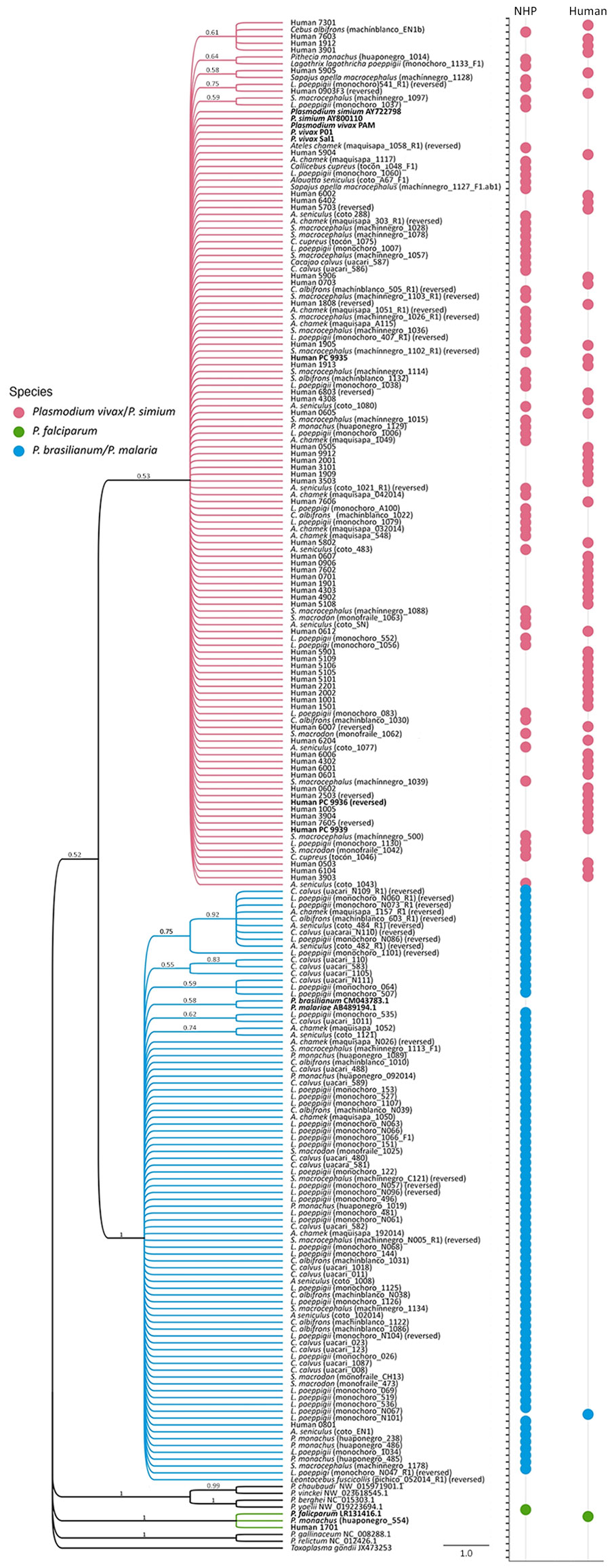
Figure 6. Bayesian phylogeny of Plasmodium spp. from humans and nonhuman primates in study of zoonotic and anthroponotic Plasmodium spp. circulation between wild primates and Indigenous community, Peruvian Amazon, 2007–2020. Phylogenetic tree shows cytochrome oxidase b gene sequences (≈776 bp) obtained from 60 humans and 146 wild nonhuman primates sampled in the Yavarí-Mirín River basin, Loreto region, Peru. Tree reconstructed by using Bayesian inference (209 sequences). Tip symbols denote host origin (human or nonhuman primates) and are color-coded by species: pink, P. vivax or P. simium; blue, P. brasilianum or P. malariae; and green, P. falciparum; black, reference sequences. Bold type indicates sequences from fieldworkers with confirmed P. vivax infection.
Main Article
Page created: March 17, 2026
Page updated: May 06, 2026
Page reviewed: May 06, 2026
The conclusions, findings, and opinions expressed by authors contributing to this journal do not necessarily reflect the official position of the U.S. Department of Health and Human Services, the Public Health Service, the Centers for Disease Control and Prevention, or the authors' affiliated institutions. Use of trade names is for identification only and does not imply endorsement by any of the groups named above.