Volume 32, Number 5—May 2026
Dispatch
Development and Validation of Real-Time PCR for Detecting Anaplasma bovis–Like Agent in Dermacentor spp. Ticks
Rachel C. Smith , Daniel F. Barrantes Murillo, Aryanna Carr, Kathryn T. Duncan, and Lindsay A. Starkey
, Daniel F. Barrantes Murillo, Aryanna Carr, Kathryn T. Duncan, and Lindsay A. Starkey
Figure 1
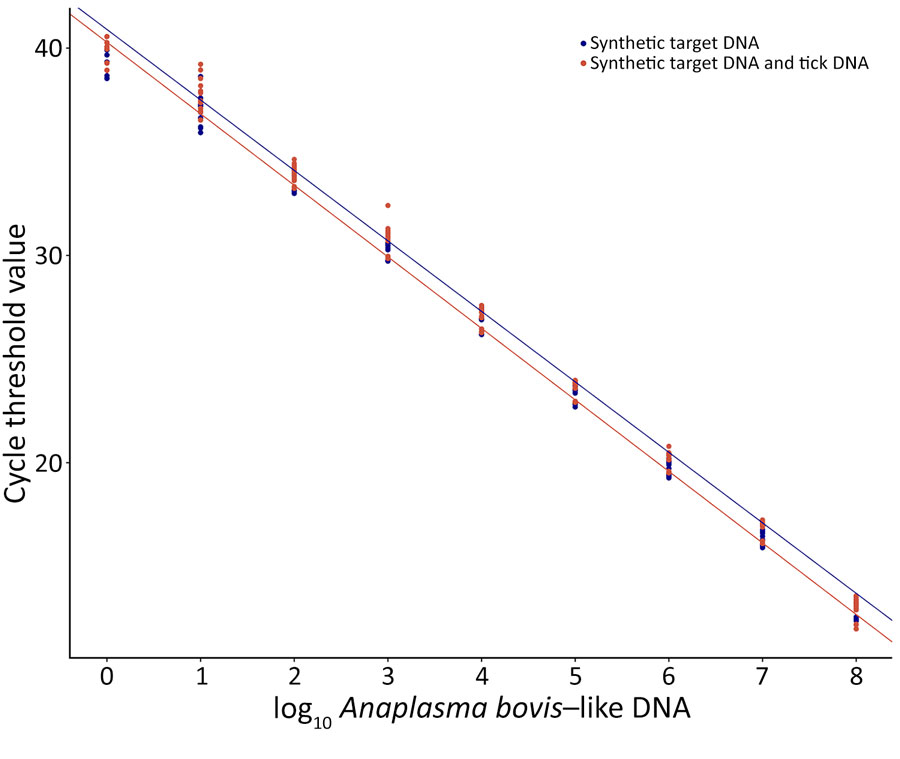
Figure 1. Results of the standard curve analyses, correlation, and amplification efficiency of real-time PCR for detecting Anaplasma bovis–like agent in Dermacentor spp. ticks, United States. We conducted standard curve analyses to evaluate assay efficiency and sensitivity by using 2 sets of samples: a 10-fold dilution series containing synthetic A. bovis–like DNA only and the same dilution series with ≈54 ng of noninfected D. variabilis tick DNA added per reaction. We used tick samples to assess assay performance in the tick DNA matrix. Graph shows standard curve lines for each sample set, with cycle threshold value graphed as a function of target copy number.
Page created: April 28, 2026
Page updated: May 07, 2026
Page reviewed: May 07, 2026
The conclusions, findings, and opinions expressed by authors contributing to this journal do not necessarily reflect the official position of the U.S. Department of Health and Human Services, the Public Health Service, the Centers for Disease Control and Prevention, or the authors' affiliated institutions. Use of trade names is for identification only and does not imply endorsement by any of the groups named above.