Volume 32, Number 6—June 2026
Dispatch
Repeated Extraneous Introductions of Cholera, Thailand, 2007–2025
 , Amonrattana Roobthaisong, Warawan Wongboot, Pawinee Doung-ngern, Wichan Bhunyakitikorn, Pilailuk A. Okada, Thanee Wongchai, Witaya Swaddiwudhipong, Tetsuya Iida, and Shigeyuki Hamada
Figure 1
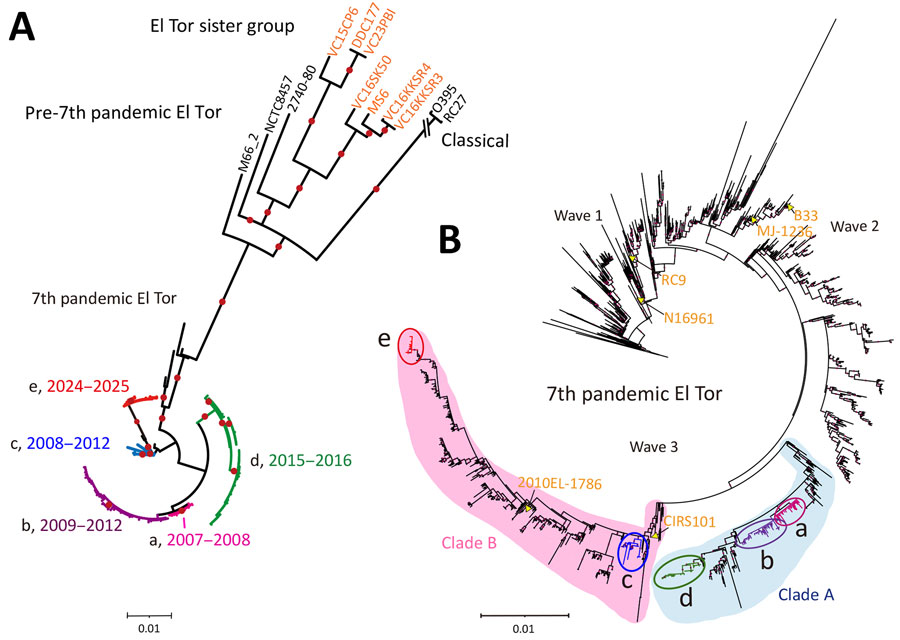
Figure 1. Maximum-likelihood phylogenetic trees of Vibrio cholerae O1 isolates reconstructed for study of repeated extraneous introductions of cholera, Thailand, 2007–2025. A) Phylogenetic relationships of 157 Thailand isolates and 11 representative O1 reference strains. Seven Thailand isolates (orange) belong to the El Tor Sister group lineage. The 7th pandemic El Tor lineage is divided into 5 distinct clusters (a–e), color-coded by isolation period: red-purple (cluster a, 2007–2008), blue-purple (cluster b, 2009–2010), blue (cluster c, 2011–2012), green (cluster d, 2015–2016), and red (cluster e, 2024–2025). B) Detailed phylogeny of the 7th pandemic El Tor lineage incorporating 150 Thailand isolates and 1,425 global genomes. Yellow labels explicitly identify the global reference strains (e.g., N16961, CIRS101) used in the analysis to provide genomic context for the Thailand clades. Light blue shaded region highlights clade A; light pink shaded region highlights clade B. Both were selected for molecular clock analysis. Outbreak-associated Thailand clades (TH1–TH4) are nested within these broader genomic groups. Both trees were reconstructed using maximum-likelihood estimation based on high-quality core genome single-nucleotide polymorphisms and visualized using Interactive Tree of Life (https://itol.embl.de). Dots on the branches indicate bootstrap values >80%.