Skip directly to site content Skip directly to page options Skip directly to A-Z link Skip directly to A-Z link Skip directly to A-Z link

Disclaimer: Early release articles are not considered as final versions. Any changes will be reflected in the online version in the month the article is officially released.

Volume 32, Number 6—June 2026

Dispatch

Repeated Extraneous Introductions of Cholera, Thailand, 2007–2025

Kazuhisa OkadaComments to Author , Amonrattana Roobthaisong, Warawan Wongboot, Pawinee Doung-ngern, Wichan Bhunyakitikorn, Pilailuk A. Okada, Thanee Wongchai, Witaya Swaddiwudhipong, Tetsuya Iida, and Shigeyuki Hamada
Author affiliation: The University of Osaka Thailand–Japan Research Collaboration Center on Emerging and Re-emerging Infections, Mueang, Thailand (K. Okada, A. Roobthaisong); The University of Osaka Research Institute for Microbial Diseases, Suita, Japan (K. Okada, T. Iida, S. Hamada); Ministry of Public Health, Muang (W. Wongboot, P. Doung-ngern, W. Bhunyakitikorn, P.A. Okada); Maesot General Hospital, Maesot, Thailand (T. Wongchai, W. Swaddiwudhipong)

Main Article

Figure 2

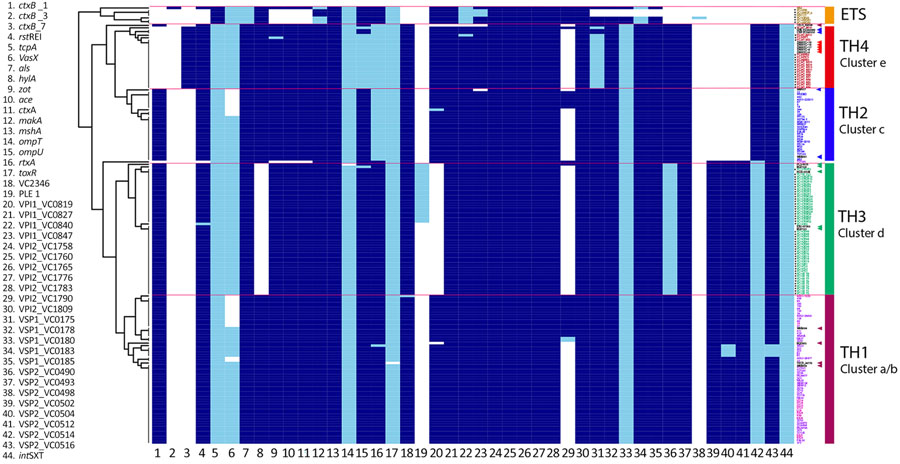
Phylogenetic relationships, genomic features, and outbreak cluster associations of Vibrio cholerae isolates from study of repeated extraneous introductions of cholera, Thailand, 2007–2025. Black dots indicate newly sequenced Thailand isolates in this study (n = 72) to distinguish them from reference strains. Virulence genes, integrative conjugative elements, and mobile genetic elements identified using CholeraeFinder (Center for Genomic Epidemiology, https://www.genomicepidemiology.org) in BLASTN mode (minimum coverage and identity 90%) (Appendix 2, Table 1). The blue cells in the heatmap represent the presence of genes, light blue cells indicate mutated genes, and blank cells signify the absence of genes. Phylogenetic relationships analyzed using a RAxML tree (https://cme.h-its.org/exelixis/web/software/raxml); genomic features are numerically coded (gene present = 1, gene absent = 0, mutated gene = 0.5). Thailand clades (TH1, TH2, TH3, and TH4) defined based on phylogenetic clustering and characteristic genomic features: TH1 (clusters a and b), TH2 (cluster c), TH3 (cluster d), and TH4 (cluster e). Arrowheads highlight the 5 closest non-Thailand isolates associated with each outbreak cluster, identified by pairwise single-nucleotide polymorphism comparisons. ETS, El Tor sister V. cholerae isolates.

Figure 2. Phylogenetic relationships, genomic features, and outbreak cluster associations of Vibrio cholerae isolates from study of repeated extraneous introductions of cholera, Thailand, 2007–2025. Black dots indicate newly sequenced Thailand isolates in this study (n = 72) to distinguish them from reference strains. Virulence genes, integrative conjugative elements, and mobile genetic elements identified using CholeraeFinder (Center for Genomic Epidemiology, https://www.genomicepidemiology.org) in BLASTN mode (minimum coverage and identity 90%) (Appendix 2, Table 1). The blue cells in the heatmap represent the presence of genes, light blue cells indicate mutated genes, and blank cells signify the absence of genes. Phylogenetic relationships analyzed using a RAxML tree (https://cme.h-its.org/exelixis/web/software/raxml); genomic features are numerically coded (gene present = 1, gene absent = 0, mutated gene = 0.5). Thailand clades (TH1, TH2, TH3, and TH4) defined based on phylogenetic clustering and characteristic genomic features: TH1 (clusters a and b), TH2 (cluster c), TH3 (cluster d), and TH4 (cluster e). Arrowheads highlight the 5 closest non-Thailand isolates associated with each outbreak cluster, identified by pairwise single-nucleotide polymorphism comparisons. ETS, El Tor sister V. cholerae isolates.

Main Article

Page created: May 06, 2026
Page updated: May 20, 2026
Page reviewed: May 20, 2026
The conclusions, findings, and opinions expressed by authors contributing to this journal do not necessarily reflect the official position of the U.S. Department of Health and Human Services, the Public Health Service, the Centers for Disease Control and Prevention, or the authors' affiliated institutions. Use of trade names is for identification only and does not imply endorsement by any of the groups named above.
file_external