Skip directly to site content Skip directly to page options Skip directly to A-Z link Skip directly to A-Z link Skip directly to A-Z link

Disclaimer: Early release articles are not considered as final versions. Any changes will be reflected in the online version in the month the article is officially released.

Volume 32, Number 6—June 2026

Dispatch

Repeated Extraneous Introductions of Cholera, Thailand, 2007–2025

Kazuhisa OkadaComments to Author , Amonrattana Roobthaisong, Warawan Wongboot, Pawinee Doung-ngern, Wichan Bhunyakitikorn, Pilailuk A. Okada, Thanee Wongchai, Witaya Swaddiwudhipong, Tetsuya Iida, and Shigeyuki Hamada
Author affiliation: The University of Osaka Thailand–Japan Research Collaboration Center on Emerging and Re-emerging Infections, Mueang, Thailand (K. Okada, A. Roobthaisong); The University of Osaka Research Institute for Microbial Diseases, Suita, Japan (K. Okada, T. Iida, S. Hamada); Ministry of Public Health, Muang (W. Wongboot, P. Doung-ngern, W. Bhunyakitikorn, P.A. Okada); Maesot General Hospital, Maesot, Thailand (T. Wongchai, W. Swaddiwudhipong)

Main Article

Figure 3

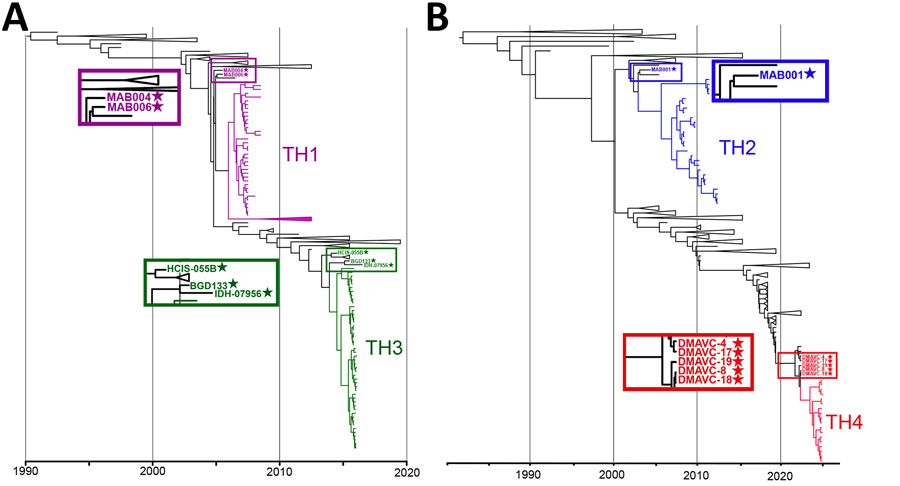
Temporal signal and divergence dating of Thailand Vibrio cholerae O1 isolates during the seventh pandemic from study of repeated extraneous introductions of cholera, Thailand, 2007–2025. Maximum clade credibility trees for clade A (panel A) and clade B (panel B) were reconstructed using a relaxed molecular clock (log-normal distribution) and a coalescent exponential population model. For clade A (n = 254; DRR189295 excluded), sampling years covered 1992–2019; for clade B (n = 417; ERR2265665 and DRR189283 excluded), sampling years covered 1992–2025. Both clades demonstrated strong temporal signals, confirmed by root-to-tip regression analysis (R2 > 0.91) (Appendix 2, Figure 2) and showed strong statistical support with effective sample size values >200. Temporal estimates suggest interregional transmission during the pandemic and highlight the preservation of specific genetic traits within Thailand populations, supporting the inferred lineage connections. Different colors indicate distinct clades, and stars indicate strains with characteristic genomic features.

Figure 3. Temporal signal and divergence dating of Thailand Vibrio cholerae O1 isolates during the seventh pandemic from study of repeated extraneous introductions of cholera, Thailand, 2007–2025. Maximum clade credibility trees for clade A (panel A) and clade B (panel B) were reconstructed using a relaxed molecular clock (log-normal distribution) and a coalescent exponential population model. For clade A (n = 254; DRR189295 excluded), sampling years covered 1992–2019; for clade B (n = 417; ERR2265665 and DRR189283 excluded), sampling years covered 1992–2025. Both clades demonstrated strong temporal signals, confirmed by root-to-tip regression analysis (R2 > 0.91) (Appendix 2, Figure 2) and showed strong statistical support with effective sample size values >200. Temporal estimates suggest interregional transmission during the pandemic and highlight the preservation of specific genetic traits within Thailand populations, supporting the inferred lineage connections. Different colors indicate distinct clades, and stars indicate strains with characteristic genomic features.

Main Article

Page created: May 06, 2026
Page updated: May 20, 2026
Page reviewed: May 20, 2026
The conclusions, findings, and opinions expressed by authors contributing to this journal do not necessarily reflect the official position of the U.S. Department of Health and Human Services, the Public Health Service, the Centers for Disease Control and Prevention, or the authors' affiliated institutions. Use of trade names is for identification only and does not imply endorsement by any of the groups named above.
file_external