Skip directly to site content Skip directly to page options Skip directly to A-Z link Skip directly to A-Z link Skip directly to A-Z link

Disclaimer: Early release articles are not considered as final versions. Any changes will be reflected in the online version in the month the article is officially released.

Volume 32, Number 7—July 2026

Research

Clinical Predictors of Fatal Outcomes from Human Leptospirosis, Thailand, 2015–2024

Umaporn Limothai, Nathan E. Stone, Sasipha Tachaboon, Janejira Dinhuzen, Jason W. Sahl, Theerapon Sukmark, Chayomon Dokpong, David M. Wagner, David A Haake, and Nattachai SrisawatComments to Author 
Author affiliation: Chulalongkorn University Faculty of Medicine, Center of Excellence in Critical Care Nephrology, Bangkok, Thailand (U. Limothai, S. Tachaboon, J. Dinhuzen, N. Srisawat); King Chulalongkorn Memorial Hospital–Thai Red Cross Society, Excellence Center for Critical Care Nephrology, Bangkok (U. Limothai, S. Tachaboon, J. Dinhuzen, N. Srisawat); Northern Arizona University Pathogen and Microbiome Institute, Flagstaff, Arizona, USA (N.E. Stone, J.W. Sahl, D.M. Wagner); Thungsong Hospital, Nakhon Si Thammarat, Thailand (T. Sukmark); Khukhan Hospital, Sisaket, Thailand (C. Dokpong); Veterans Affairs Greater Los Angeles Healthcare System, Los Angeles, California, USA (D.A. Haake); University of California David Geffen School of Medicine, Los Angeles (D.A. Haake); University of Pittsburgh School of Medicine, Pittsburgh, Pennsylvania, USA (N. Srisawat); Royal Society of Thailand Academy of Science Bangkok (N. Srisawat)

Main Article

Figure 1

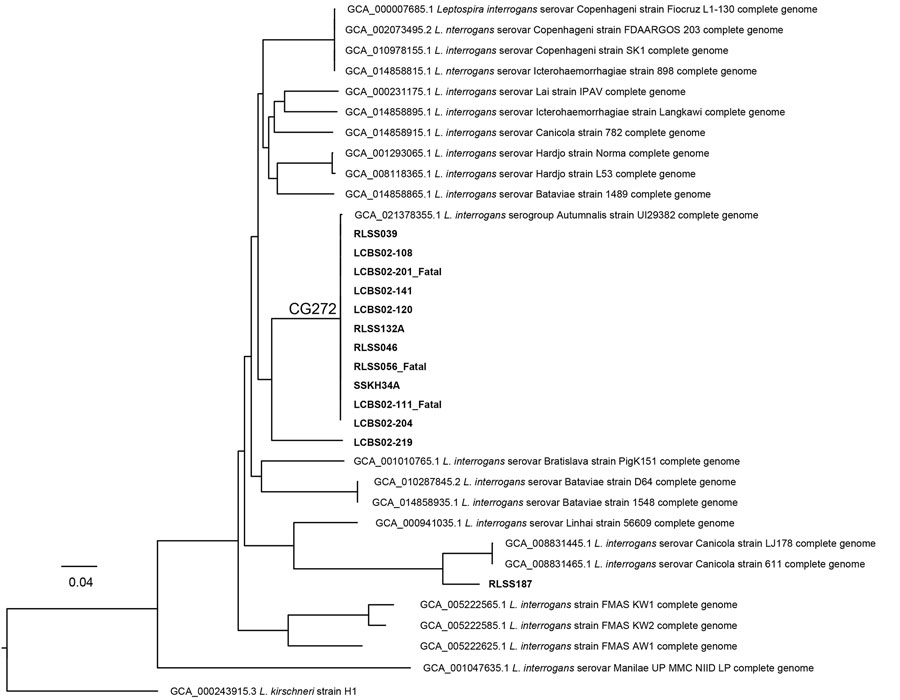
Whole-genome phylogeny of Leptospira interrogans isolates, Thailand, 2015–2024. Maximum-likelihood phylogenetic tree was generated by using 102,654 variable sites across a 3.9-Mb core genome of 13 L. interrogans isolates from this study (in bold font) plus 21 publicly available L. interrogans reference genomes. The tree was rooted with L. kirschneri. Eleven of the 13 isolates clustered within CG272, including 3 from patients with fatal cases. The remaining 2 isolates grouped outside CG272, indicating the presence of additional L. interrogans lineages in the region. Scale bar represents nucleotide substitutions per site. CG272, clonal group 272.

Figure 1. Whole-genome phylogeny of Leptospira interrogans isolates, Thailand, 2015–2024. Maximum-likelihood phylogenetic tree was generated by using 102,654 variable sites across a 3.9-Mb core genome of 13 L. interrogans isolates from this study (in bold font) plus 21 publicly available L. interrogans reference genomes. The tree was rooted with L. kirschneri. Eleven of the 13 isolates clustered within CG272, including 3 from patients with fatal cases. The remaining 2 isolates grouped outside CG272, indicating the presence of additional L. interrogans lineages in the region. Scale bar represents nucleotide substitutions per site. CG272, clonal group 272.

Main Article

Page created: April 27, 2026
Page updated: June 05, 2026
Page reviewed: June 05, 2026
The conclusions, findings, and opinions expressed by authors contributing to this journal do not necessarily reflect the official position of the U.S. Department of Health and Human Services, the Public Health Service, the Centers for Disease Control and Prevention, or the authors' affiliated institutions. Use of trade names is for identification only and does not imply endorsement by any of the groups named above.
file_external