Volume 32, Number 7—July 2026
Research
Clinical Predictors of Fatal Outcomes from Human Leptospirosis, Thailand, 2015–2024

Figure 2
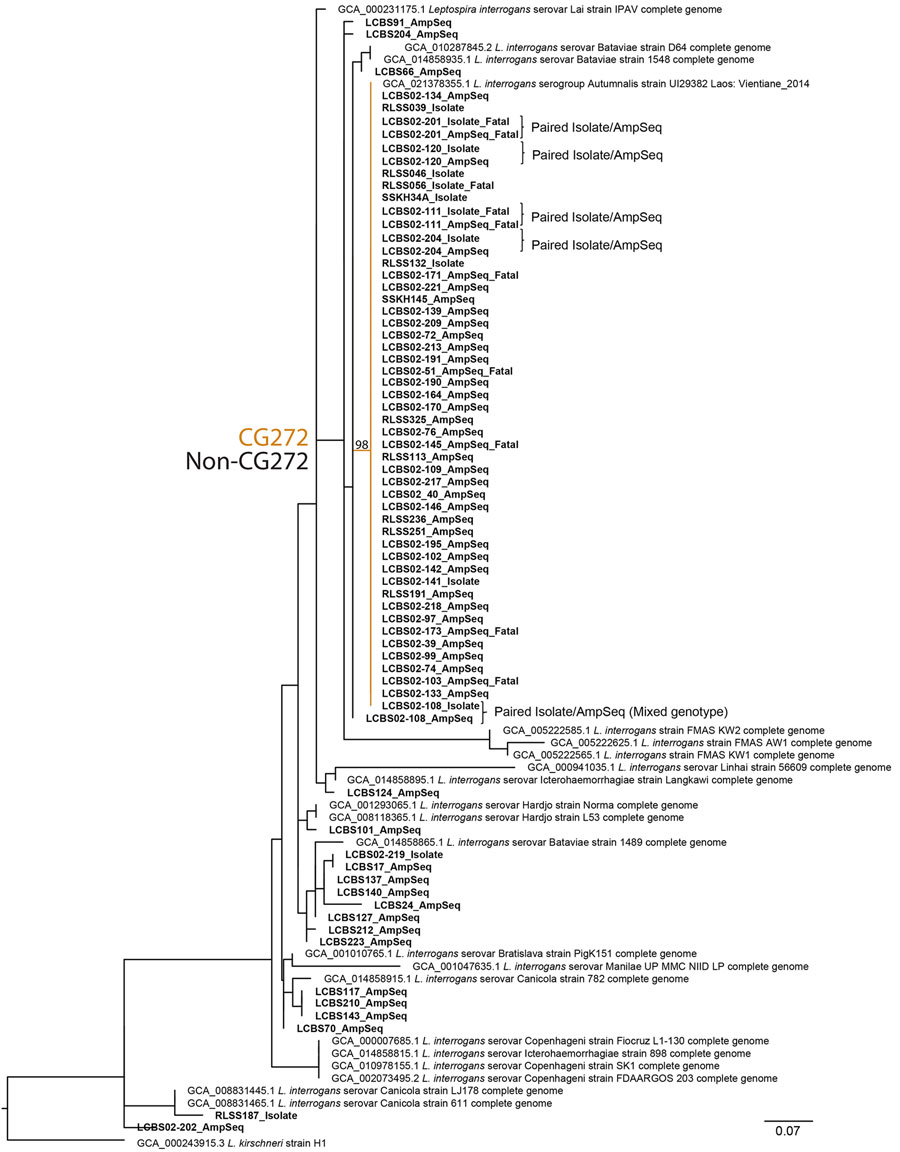
Figure 2. Phylogenetic analysis of Leptospira interrogans from AmpSeq (27) and isolate genome data, Thailand, 2015–2024. Maximum-likelihood phylogenetic tree was generated for high breadth of coverage AmpSeq samples (>25 loci amplified with >10× coverage) by using 59 variable sites across a 1,813-nt core genome of 57 L. interrogans AmpSeq samples, 13 L. interrogans isolates, and 21 publicly available L. interrogans reference genomes. The tree was rooted with L. kirschneri. Five isolate or AmpSeq pairs demonstrate the phylogenetic concordance between methods. A major clade corresponding to CG272 contained most of the clinical samples, including those from several patients with fatal cases, whereas the remaining samples fell into other non-CG272 lineages. A bootstrap value of 98 supports placement in the CG272 clade. CG272 and non-CG272 lineages are color-coded in gold and black. Bold font indicates sequences generated during this study. Scale bar represents nucleotide substitutions per site. AmpSeq, amplicon sequencing; CG272, clonal group 272.
References
- Costa F, Hagan JE, Calcagno J, Kane M, Torgerson P, Martinez-Silveira MS, et al. Global morbidity and mortality of leptospirosis: a systematic review. PLoS Negl Trop Dis. 2015;9:
e0003898 . DOIPubMedGoogle Scholar - Haake DA, Levett PN. Leptospirosis in humans. Curr Top Microbiol Immunol. 2015;387:65–97. DOIPubMedGoogle Scholar
- Picardeau M. Virulence of the zoonotic agent of leptospirosis: still terra incognita? Nat Rev Microbiol. 2017;15:297–307. DOIPubMedGoogle Scholar
- Baharom M, Ahmad N, Hod R, Ja’afar MH, Arsad FS, Tangang F, et al. Environmental and occupational factors associated with leptospirosis: a systematic review. Heliyon. 2023;10:
e23473 .PubMedGoogle Scholar - Muñoz-Zanzi C, Dreyfus A, Limothai U, Foley W, Srisawat N, Picardeau M, et al. Leptospirosis—improving healthcare outcomes for a neglected tropical disease. Open Forum Infect Dis. 2025;12:
ofaf035 . DOIPubMedGoogle Scholar - Narkkul U, Thaipadungpanit J, Srisawat N, Rudge JW, Thongdee M, Pawarana R, et al. Human, animal, water source interactions and leptospirosis in Thailand. Sci Rep. 2021;11:3215. DOIPubMedGoogle Scholar
- Sawangpol C, Aimyong N, Phosri A. Epidemiological changes in the incidence of human leptospirosis in Thailand: findings from the National Disease Surveillance System from 2013 to 2022. Infect Dis Now. 2025;55:
105108 . DOIPubMedGoogle Scholar - Limothai U, Lumlertgul N, Sirivongrangson P, Kulvichit W, Tachaboon S, Dinhuzen J, et al. The role of leptospiremia and specific immune response in severe leptospirosis. Sci Rep. 2021;11:14630. DOIPubMedGoogle Scholar
- Spichler AS, Vilaça PJ, Athanazio DA, Albuquerque JO, Buzzar M, Castro B, et al. Predictors of lethality in severe leptospirosis in urban Brazil. Am J Trop Med Hyg. 2008;79:911–4. DOIPubMedGoogle Scholar
- Petakh P, Rostoka L, Isevych V, Kamyshnyi A. Identifying risk factors and disease severity in leptospirosis: a meta-analysis of clinical predictors. Trop Doct. 2023;53:464–9. DOIPubMedGoogle Scholar
- Daher EF, Soares DS, Galdino GS, Macedo ÊS, Gomes PEAC, Pires Neto RDJ, et al. Leptospirosis in the elderly: the role of age as a predictor of poor outcomes in hospitalized patients. Pathog Glob Health. 2019;113:117–23. DOIPubMedGoogle Scholar
- Dupont H, Dupont-Perdrizet D, Perie JL, Zehner-Hansen S, Jarrige B, Daijardin JB. Leptospirosis: prognostic factors associated with mortality. Clin Infect Dis. 1997;25:720–4. DOIPubMedGoogle Scholar
- Galdino GS, de Sandes-Freitas TV, de Andrade LGM, Adamian CMC, Meneses GC, da Silva GB Junior, et al. Development and validation of a simple machine learning tool to predict mortality in leptospirosis. Sci Rep. 2023;13:4506. DOIPubMedGoogle Scholar
- Tubiana S, Mikulski M, Becam J, Lacassin F, Lefèvre P, Gourinat AC, et al. Risk factors and predictors of severe leptospirosis in New Caledonia. PLoS Negl Trop Dis. 2013;7:
e1991 . DOIPubMedGoogle Scholar - Abgueguen P, Delbos V, Blanvillain J, Chennebault JM, Cottin J, Fanello S, et al. Clinical aspects and prognostic factors of leptospirosis in adults. Retrospective study in France. J Infect. 2008;57:171–8. DOIPubMedGoogle Scholar
- Reis EA, Hagan JE, Ribeiro GS, Teixeira-Carvalho A, Martins-Filho OA, Montgomery RR, et al. Cytokine response signatures in disease progression and development of severe clinical outcomes for leptospirosis. PLoS Negl Trop Dis. 2013;7:
e2457 . DOIPubMedGoogle Scholar - Senavirathna I, Rathish D, Agampodi S. Cytokine response in human leptospirosis with different clinical outcomes: a systematic review. BMC Infect Dis. 2020;20:268. DOIPubMedGoogle Scholar
- Boonsilp S, Thaipadungpanit J, Amornchai P, Wuthiekanun V, Bailey MS, Holden MT, et al. A single multilocus sequence typing (MLST) scheme for seven pathogenic Leptospira species. PLoS Negl Trop Dis. 2013;7:
e1954 . DOIPubMedGoogle Scholar - Thaipadungpanit J, Wuthiekanun V, Chierakul W, Smythe LD, Petkanchanapong W, Limpaiboon R, et al. A dominant clone of Leptospira interrogans associated with an outbreak of human leptospirosis in Thailand. PLoS Negl Trop Dis. 2007;1:
e56 . DOIPubMedGoogle Scholar - Jolley KA, Bray JE, Maiden MCJ. Open-access bacterial population genomics: BIGSdb software, the PubMLST.org website and their applications. Wellcome Open Res. 2018;3:124. DOIPubMedGoogle Scholar
- Grillová L, Robinson MT, Chanthongthip A, Vincent AT, Nieves C, Oppelt J, et al. Genetic diversity of Leptospira isolates in Lao PDR and genome analysis of an outbreak strain. PLoS Negl Trop Dis. 2021;15:
e0010076 . DOIPubMedGoogle Scholar - World Health Organization (WHO). Human leptospirosis: guidance for diagnosis, surveillance and control. 2003 [cited 2026 Jan 5]. https://www.who.int/publications/i/item/human-leptospirosis-guidance-for-diagnosis-surveillance-and-control
- Moreno R, Rhodes A, Piquilloud L, Hernandez G, Takala J, Gershengorn HB, et al. The Sequential Organ Failure Assessment (SOFA) score: has the time come for an update? Crit Care. 2023;27:15. DOIPubMedGoogle Scholar
- Singer M, Deutschman CS, Seymour CW, Shankar-Hari M, Annane D, Bauer M, et al. The Third International Consensus Definitions for Sepsis and Septic Shock (Sepsis-3). JAMA. 2016;315:801–10. DOIPubMedGoogle Scholar
- Vincent JL, Moreno R, Takala J, Willatts S, De Mendonça A, Bruining H, et al. The SOFA (Sepsis-related Organ Failure Assessment) score to describe organ dysfunction/failure. Intensive Care Med. 1996;22:707–10. DOIPubMedGoogle Scholar
- Stoddard RA, Gee JE, Wilkins PP, McCaustland K, Hoffmaster AR. Detection of pathogenic Leptospira spp. through TaqMan polymerase chain reaction targeting the LipL32 gene. Diagn Microbiol Infect Dis. 2009;64:247–55. DOIPubMedGoogle Scholar
- Stone NE, Hamond C, Clegg JR, McDonough RF, Bourgeois RM, Ballard R, et al. Host population dynamics influence Leptospira spp. transmission patterns among Rattus norvegicus in Boston, Massachusetts, US. PLoS Negl Trop Dis. 2025;19:
e0012966 . DOIPubMedGoogle Scholar - Giraud-Gatineau A, Nieves C, Harrison LB, Benaroudj N, Veyrier FJ, Picardeau M. Evolutionary insights into the emergence of virulent Leptospira spirochetes. PLoS Pathog. 2024;20:
e1012161 . DOIPubMedGoogle Scholar - Al Hariri YK, Sulaiman SAS, Khan AH, Adnan AS, Al-Ebrahem SQ. Determinants of prolonged hospitalization and mortality among leptospirosis patients attending tertiary care hospitals in northeastern state in peninsular Malaysia: a cross sectional retrospective analysis. Front Med (Lausanne). 2022;9:
887292 . DOIPubMedGoogle Scholar - Gancheva GI. Leptospirosis in elderly patients. Braz J Infect Dis. 2013;17:592–5. DOIPubMedGoogle Scholar
- Mikulski M, Boisier P, Lacassin F, Soupé-Gilbert ME, Mauron C, Bruyere-Ostells L, et al. Severity markers in severe leptospirosis: a cohort study. Eur J Clin Microbiol Infect Dis. 2015;34:687–95. DOIPubMedGoogle Scholar
- Petakh P, Nykyforuk A. Predictors of lethality in severe leptospirosis in Transcarpathian region of Ukraine. Infez Med. 2022;30:272–6.PubMedGoogle Scholar
- Agampodi SB, Matthias MA, Moreno AC, Vinetz JM. Utility of quantitative polymerase chain reaction in leptospirosis diagnosis: association of level of leptospiremia and clinical manifestations in Sri Lanka. Clin Infect Dis. 2012;54:1249–55. DOIPubMedGoogle Scholar
- Tubiana S, Mikulski M, Becam J, Lacassin F, Lefèvre P, Gourinat A-C, et al. Risk factors and predictors of severe leptospirosis in New Caledonia. PLoS Negl Trop Dis. 2013;7:
e1991 . DOIPubMedGoogle Scholar - Hochedez P, Theodose R, Olive C, Bourhy P, Hurtrel G, Vignier N, et al. Factors associated with severe leptospirosis, Martinique, 2010–2013. Emerg Infect Dis. 2015;21:2221–4. DOIPubMedGoogle Scholar
- Philip N, Bahtiar Affendy N, Ramli SNA, Arif M, Raja P, Nagandran E, et al. Leptospira interrogans and Leptospira kirschneri are the dominant Leptospira species causing human leptospirosis in Central Malaysia. PLoS Negl Trop Dis. 2020;14:
e0008197 . DOIPubMedGoogle Scholar - Ravindranathan AT, Mukundan A, Puthanpurayil SNT, Kavuthodi B, Karunakaran S, John R. Molecular and genomic characterization of Leptospira isolates in humans and its relation to disease severity. Indian J Med Microbiol. 2025;56:
100910 . DOIPubMedGoogle Scholar