Volume 32, Number 8—August 2026
Research
Occupationally Exposed and General Population Antibody Profiles to Influenza A Viruses Circulating in Swine as Indication of Zoonotic Risk
Celeste A. Snyder, Garrett M. Janzen, Giovana Ciacci Zanella, Daniel C.A. Moraes, Gustavo S. Silva, Jefferson J.S. Santos, Elizabeth M. Drapeau, Scott E. Hensley, Tavis K. Anderson, Phillip C. Gauger, and Amy L. Baker
Figure 1
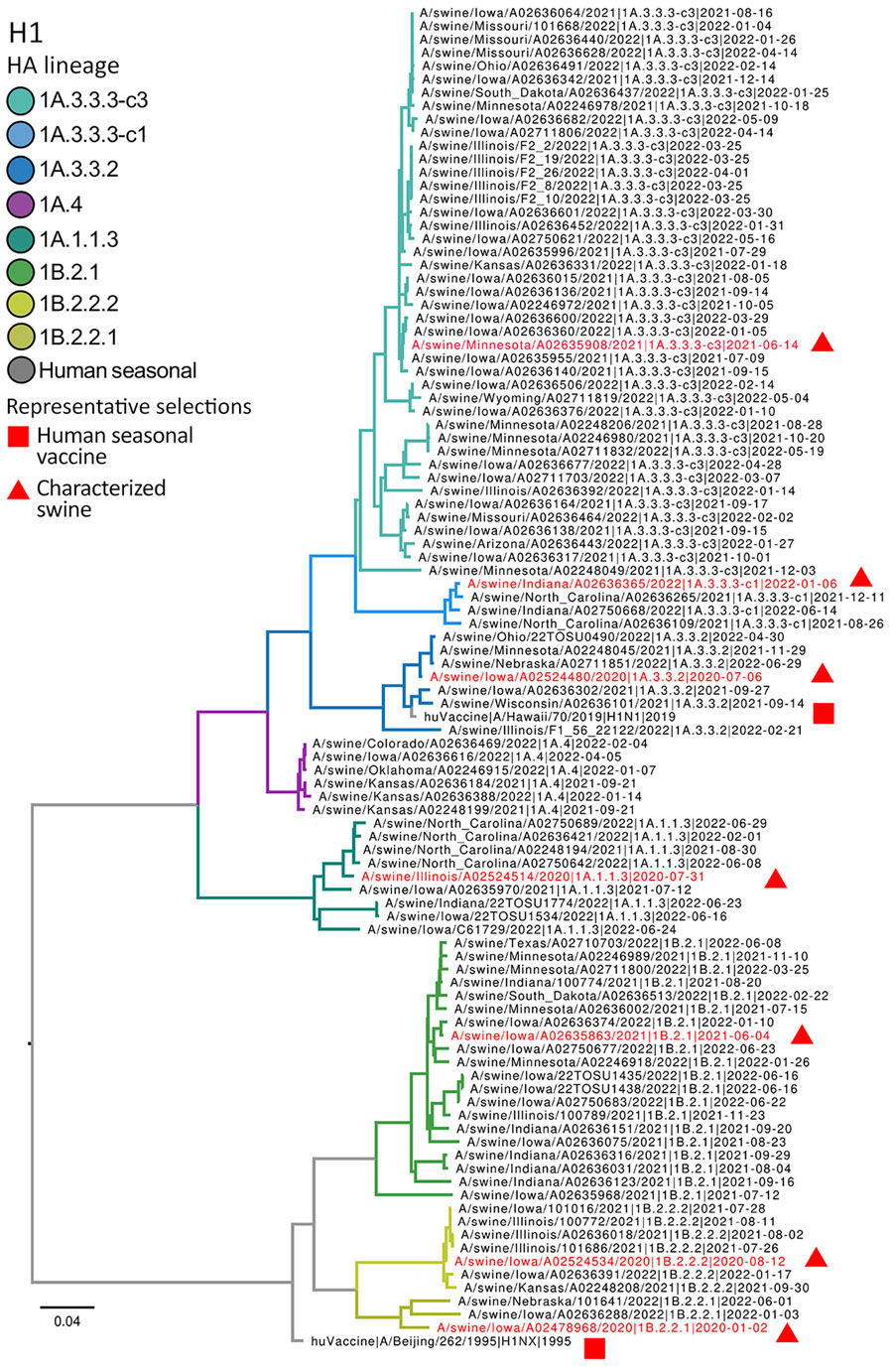
Figure 1. Maximum-likelihood phylogeny of swine and human influenza H1 HA genes from study of occupationally exposed and general population antibody profiles to influenza A viruses circulating in swine as indication of zoonotic risk. Two major H1 HA lineages in US swine resulted from independent introductions of H1N1 and H1N2 viruses from humans to swine and are grouped by the 1A and 1B lineage designations. Each lineage is divided and colored by statistically supported clades: 1A.1.1.3, 1A.3.3.2, 1A.3.3.3-c1, 1A.3.3.3-c3, 1A.4; and 1B.2.1, 1B.2.2.1, and 1B.2.2.2. Triangles and squares annotate selected reference and test antigens. HA, hemagglutinin.
Page created: June 25, 2026
Page updated: July 26, 2026
Page reviewed: July 26, 2026
The conclusions, findings, and opinions expressed by authors contributing to this journal do not necessarily reflect the official position of the U.S. Department of Health and Human Services, the Public Health Service, the Centers for Disease Control and Prevention, or the authors' affiliated institutions. Use of trade names is for identification only and does not imply endorsement by any of the groups named above.