Skip directly to site content Skip directly to page options Skip directly to A-Z link Skip directly to A-Z link Skip directly to A-Z link

Disclaimer: Early release articles are not considered as final versions. Any changes will be reflected in the online version in the month the article is officially released.

Volume 32, Number 8—August 2026

Research

Occupationally Exposed and General Population Antibody Profiles to Influenza A Viruses Circulating in Swine as Indication of Zoonotic Risk

Celeste A. Snyder, Garrett M. Janzen, Giovana Ciacci Zanella, Daniel C.A. Moraes, Gustavo S. Silva, Jefferson J.S. Santos, Elizabeth M. Drapeau, Scott E. Hensley, Tavis K. Anderson, Phillip C. Gauger, and Amy L. BakerComments to Author 
Author affiliation: National Animal Disease Center, US Department of Agriculture Agricultural Research Service, Ames, Iowa, USA (C.A. Snyder, G.M. Janzen, G. Ciacci Zanella, T.K. Anderson, A.L. Baker); Iowa State University College of Veterinary Medicine, Ames (C.A. Snyder, G. Ciacci Zanella, D.C.A. Moraes, G.S. Silva, P.C. Gauger); University of Pennsylvania Perelman School of Medicine, Philadelphia, Pennsylvania, USA (J.J.S. Santos, E.M. Drapeau, S.E. Hensley)

Main Article

Figure 5

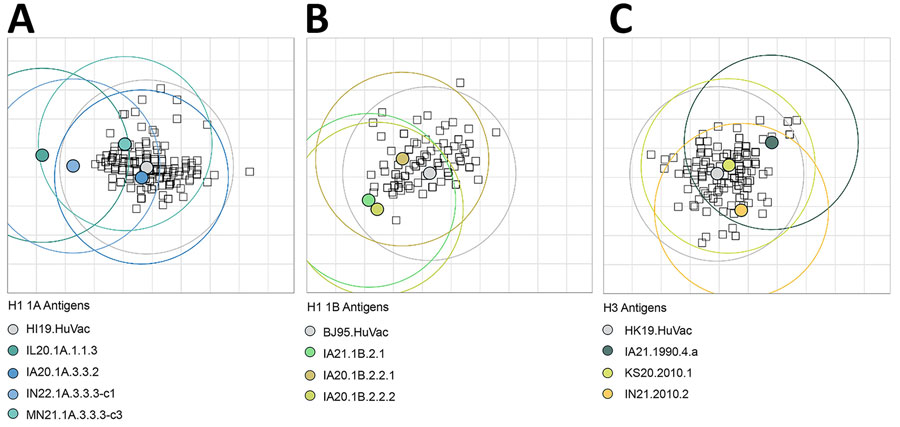
Antigenic map showing the relationships between human antibody immunity and selected strains of influenza A virus (IAV) in swine and human seasonal vaccines in study of occupationally exposed and general population antibody profiles to IAVs circulating in swine as indication of zoonotic risk. Each sphere on the map represents an antigen; squares represent individual participant serum samples from the combined veterinarian, farm, Philadelphia, and Hong Kong cohorts. A) H1 1A classical swine lineage derived from the 1918 human influenza pandemic; B) H1 1B human seasonal lineage derived from introductions of pre-2009 human seasonal H1 IAV; C) H3 lineages derived from decadal introductions of human seasonal H3N2 viruses into swine. Rings around each strain display 3 antigenic units or 8-fold change in titer from the associated antigen. Persons outside the ring are predicted to have significant loss in cross-protection.

Figure 5. Antigenic map showing the relationships between human antibody immunity and selected strains of influenza A virus (IAV) in swine and human seasonal vaccines in study of occupationally exposed and general population antibody profiles to IAVs circulating in swine as indication of zoonotic risk. Each sphere on the map represents an antigen; squares represent individual participant serum samples from the combined veterinarian, farm, Philadelphia, and Hong Kong cohorts. A) H1 1A classical swine lineage derived from the 1918 human influenza pandemic; B) H1 1B human seasonal lineage derived from introductions of pre-2009 human seasonal H1 IAV; C) H3 lineages derived from decadal introductions of human seasonal H3N2 viruses into swine. Rings around each strain display 3 antigenic units or 8-fold change in titer from the associated antigen. Persons outside the ring are predicted to have significant loss in cross-protection.

Main Article

Page created: June 25, 2026
Page updated: July 15, 2026
Page reviewed: July 15, 2026
The conclusions, findings, and opinions expressed by authors contributing to this journal do not necessarily reflect the official position of the U.S. Department of Health and Human Services, the Public Health Service, the Centers for Disease Control and Prevention, or the authors' affiliated institutions. Use of trade names is for identification only and does not imply endorsement by any of the groups named above.
file_external