Volume 32, Number 8—August 2026
Research
Occupationally Exposed and General Population Antibody Profiles to Influenza A Viruses Circulating in Swine as Indication of Zoonotic Risk
Celeste A. Snyder, Garrett M. Janzen, Giovana Ciacci Zanella, Daniel C.A. Moraes, Gustavo S. Silva, Jefferson J.S. Santos, Elizabeth M. Drapeau, Scott E. Hensley, Tavis K. Anderson, Phillip C. Gauger, and Amy L. Baker
Figure 2
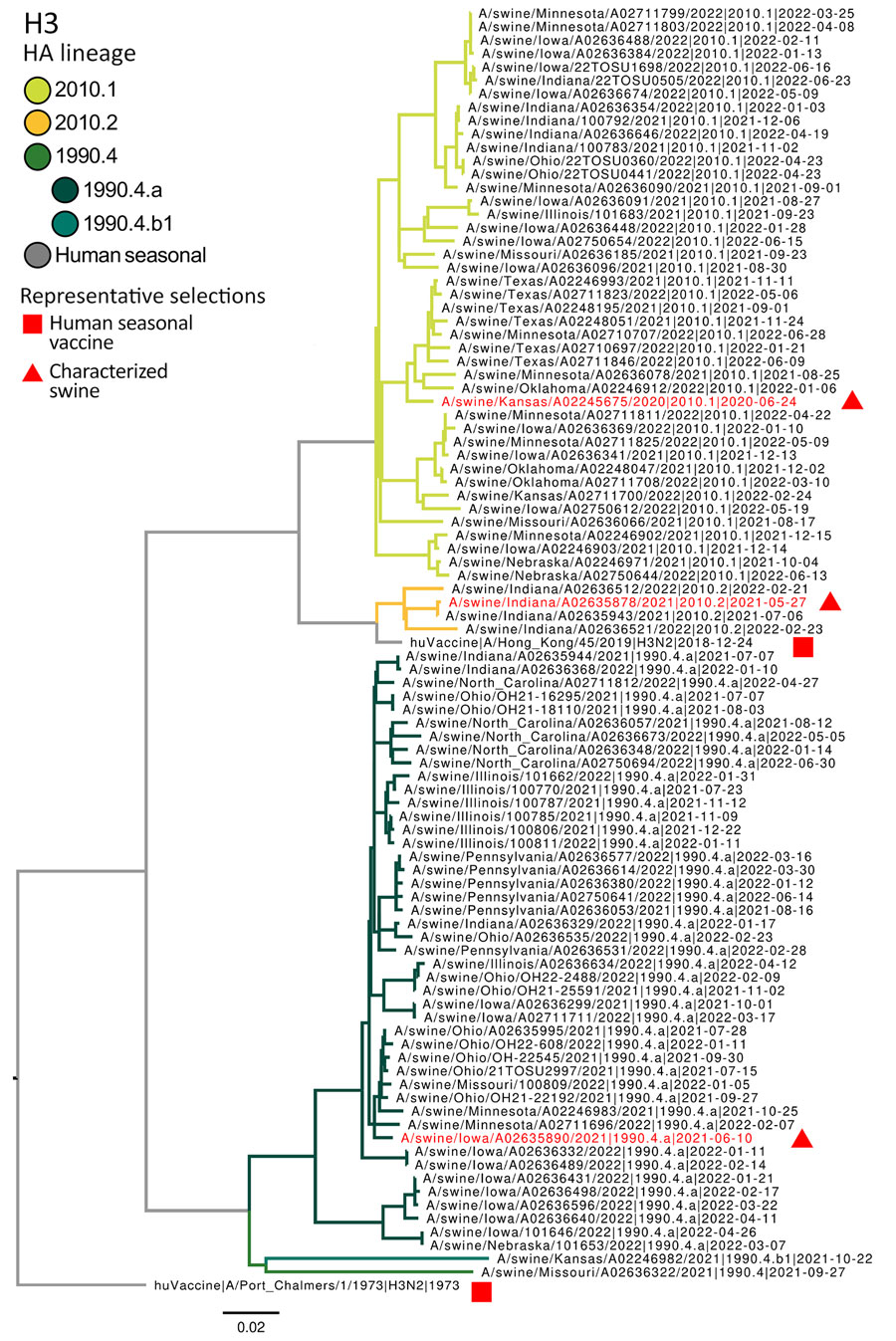
Figure 2. Maximum-likelihood phylogeny of swine and human influenza H3 HA genes from study of occupationally exposed and general population antibody profiles to influenza A viruses circulating in swine as indication of zoonotic risk. Three major H3 HA lineages in US swine were derived from interspecies transmission in the 1990s (1990.4.x) and 2010s (2010.1 and 2010.2). Each lineage is divided and colored by statistically supported clades. The H3 tree was rooted on the human seasonal HA gene A/Port Chalmers/1/1973 (H3N2). Branch lengths were drawn to scale. Scale bar indicates number of nucleotide substitutions per site. The phylogeny with tip labels included is available at https://github.com/flu-crew/datasets. HA, hemagglutinin.
Page created: June 25, 2026
Page updated: July 26, 2026
Page reviewed: July 26, 2026
The conclusions, findings, and opinions expressed by authors contributing to this journal do not necessarily reflect the official position of the U.S. Department of Health and Human Services, the Public Health Service, the Centers for Disease Control and Prevention, or the authors' affiliated institutions. Use of trade names is for identification only and does not imply endorsement by any of the groups named above.