Projected Effects of Changing Global Tuberculosis Epidemiology on Mycobacterium tuberculosis Immunoreactivity Prevalence, 2024–2050
Michelle Machado, Aria Ed Jordan, Alvaro Schwalb, Rein M.G.J. Houben, Peter J. Dodd, Katie Dale, Kevin Schwartzman, and Jonathon R. Campbell

Author affiliation: McGill University, Montreal, Quebec, Canada (M. Machado, K. Schwartzman, J.R. Campbell); University of Minnesota Foundation, Minneapolis, Minnesota, USA (A.E. Jordan); Instituto de Medicina Tropical Alexander von Humboldt, Universidad Peruana Cayetano Heredia, Lima, Peru (A. Schwalb); TB Modelling Group, TB Centre, London School of Hygiene and Tropical Medicine, London, UK (A. Schwalb, R.M.G.J. Houben); Sheffield Centre for Health and Related Research, School of Medicine and Population Health, University of Sheffield, Sheffield, UK (P.J. Dodd); Victorian Tuberculosis Program, Royal Melbourne Hospital, at the Peter Doherty Institute for Infection and Immunity, Melbourne, Victoria, Australia (K. Dale); The University of Melbourne, at the Peter Doherty Institute for Infection and Immunity, Melbourne (K. Dale); McGill International TB Centre, Montreal (K. Schwartzman, J.R. Campbell); Centre for Outcomes Research and Evaluation, Research Institute of the McGill University Health Centre, Montreal (K. Schwartzman, J.R. Campbell)
Main Article
Figure 4
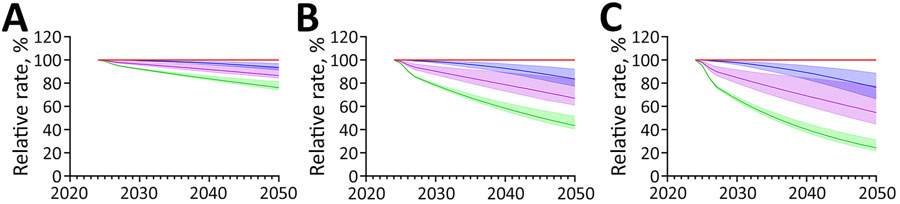
Figure 4. Projected effects on tuberculosis (TB) incidence and Mycobacterium tuberculosis immunoreactivity in study of effects of global tuberculosis epidemiology on M. tuberculosis immunoreactivity prevalence, 2024–2050. Graphs show effects over time among immigrants from the Philippines under 3 scenarios for reduction in annual risk for infection: A) 1% additional reduction; B) 3% additional reduction; C) 5% additional reduction. Solid lines represent median estimates; shaded areas indicate 95% uncertainty intervals. Red line indicates status quo scenario (i.e., no change in percent immunoreactivity or TB incidence); blue indicates overall M. tuberculosis immunoreactivity; green indicates recent (<2 years) M. tuberculosis immunoreactivity; and purple indicates TB disease risk in the year of immigration to low-incidence country.
Main Article
Page created: February 09, 2026
Page updated: March 25, 2026
Page reviewed: March 25, 2026
The conclusions, findings, and opinions expressed by authors contributing to this journal do not necessarily reflect the official position of the U.S. Department of Health and Human Services, the Public Health Service, the Centers for Disease Control and Prevention, or the authors' affiliated institutions. Use of trade names is for identification only and does not imply endorsement by any of the groups named above.