Volume 32, Supplement –Summer 2026
SUPPLEMENT ISSUE
Supplement
Evaluation of Detection Methods for Wastewater Surveillance of Antimicrobial-Resistant Bacteria from Healthcare Facilities

Figure 3
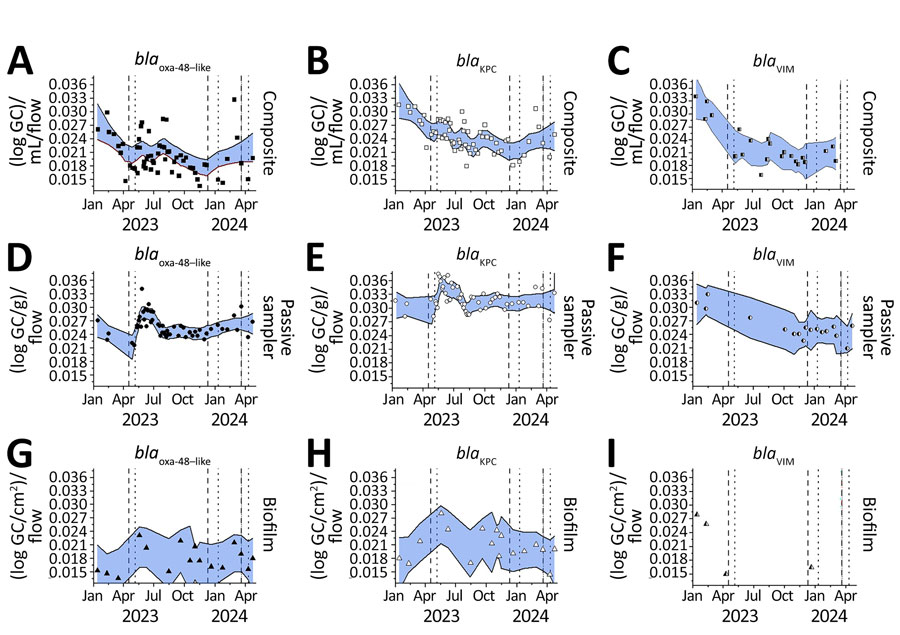
Figure 3. GC of blaOXA-48-like, blaKPC, and blaVIM in wastewater collected by autosamplers, passive samplers, or swabs of sewer biofilm in study of detection methods for wastewater surveillance of antimicrobial-resistant bacteria from healthcare facilities, January 2023–April 2024. A–C) Composite samples for blaOXA-48-like, blaKPC, and blaVIM. D–F) Passive sampler results for blaOXA-48-like, blaKPC, and blaVIM. G–I) Biofilm samples for blaOXA-48-like, blaKPC, and blaVIM. Values are normalized by recovery control and water usage. Nonparametric regression smoothing factors range from 0.1 to 0.25. Dashed lines (admit date) and dotted lines (discharge date) indicate periods when patients infected with carbapenem-resistant Enterobacterales (CRE) or carbapenem-resistant Pseudomonas aeruginosa were in the facility. Infections consisted of Klebsiella aerogenes, Enterobacter cloacae, and Pseudomonas aeruginosa in period 1 (April 2023); P. aeruginosa in period 2 (December 2023); and Escherichia coli and Citrobacter freundii in period 3 (March 2024). The CRE infections in April 2023 were not carbapenemase-producing organisms, based on PCR. The CRE infection in March 2024 was not tested for carbapenemase genes by PCR. None of the carbapenem-resistant Pseudomonas aeruginosa were tested for carbapenemase genes.