Volume 32, Number 9—September 2026
Research
Clustering and Source Association of Clinical and Nonclinical Listeria monocytogenes Isolates, New York, USA, 2000–20211

Figure 1
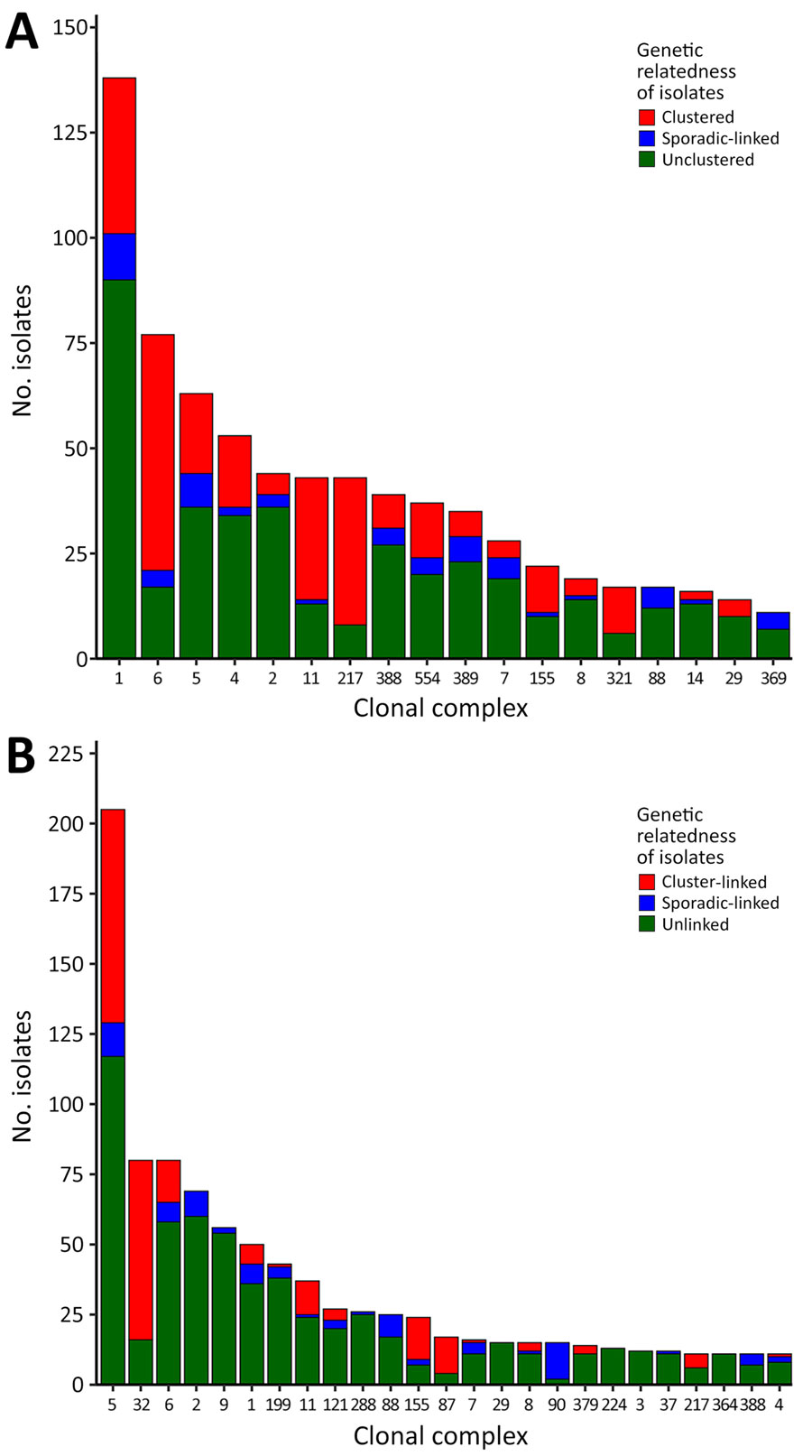
Figure 1. Distribution of Listeria monocytogenes CCs by grouping status in terms of genetical relatedness by single-nucleotide polymorphism (SNP) distances in study of clustering and source association of clinical and nonclinical L. monocytogenes isolates, New York, USA, 2000–2021. Distribution is shown for clinical (A) and nonclinical (B) isolates. Clinical isolates were considered clustered if they clustered with >1 other clinical isolate by <20 SNPs and nonclinical isolates were considered cluster-linked if they were linked with >1 clustered clinical isolate by <50 SNPs; both clinical and nonclinical isolates were considered sporadic-linked if the clinical isolate was not clustered with any other clinical isolate by <20 SNPs but linked with >1 nonclinical isolate by <50 SNPs. The terms clustered, cluster-linked, and sporadic-linked refer only to genetic relatedness based on SNP thresholds, without interpretation of epidemiologic data. Clinical isolates not meeting those criteria were considered unclustered, while nonclinical isolates were considered unlinked. CCs representing <1% of total isolates within each isolate type were grouped as other and excluded from this figure. CC, clonal complex.
1Preliminary results from this study were presented at the 2025 International Association for Food Protection Conference; July 27–30, 2025; Cleveland, Ohio, USA.