Skip directly to site content Skip directly to page options Skip directly to A-Z link Skip directly to A-Z link Skip directly to A-Z link

Disclaimer: Early release articles are not considered as final versions. Any changes will be reflected in the online version in the month the article is officially released.

Volume 32, Number 9—September 2026

Research

Clustering and Source Association of Clinical and Nonclinical Listeria monocytogenes Isolates, New York, USA, 2000–20211

Hilal Samut, Damaris V. Mendez-Vallellanes, Hannah Hoyt, Samantha E. Wirth, Lisa Mingle, Brian D. Sauders, Gregory A. Deiulio, Alyssa W. Dickey, Maria L. Ishida, William J. Wolfgang, Kimberlee A. Musser, Martin Wiedmann, and Renato H. OrsiComments to Author 
Author affiliation: Cornell University, Ithaca, New York, USA (H. Samut, M. Wiedmann, R.H. Orsi); New York State Department of Health, Wadsworth Center, Albany, New York, USA (D.V. Mendez-Vallellanes, H. Hoyt, S.E. Wirth, L. Mingle, W.J. Wolfgang, K.A. Musser); New York State Department of Agriculture and Markets, Albany (B.D. Sauders, G.A. Deiulio, A.W. Dickey, M.L. Ishida)

Main Article

Figure 3

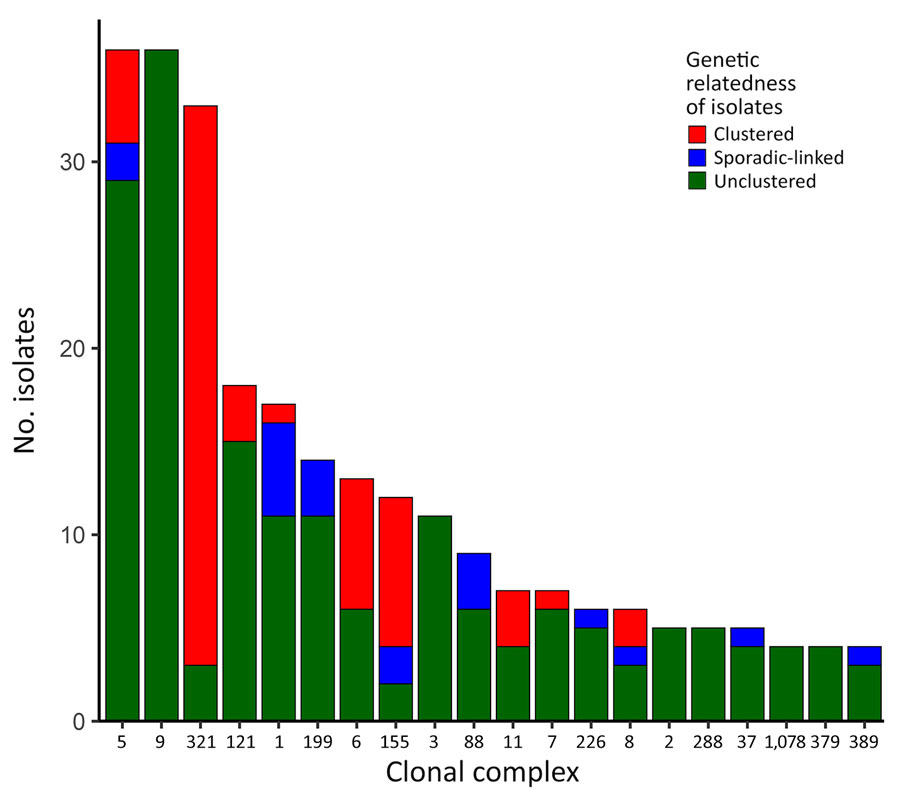
Distribution of Listeria monocytogenes CCs by grouping status in terms of genetical relatedness by single-nucleotide polymorphism (SNP) distances among food isolates in study of clustering and source association of clinical and nonclinical L. monocytogenes isolates, New York, USA, 2000–2021. Nonclinical isolates were considered cluster-linked if they were linked with >1 clustered clinical isolate by <50 SNPs, and nonclinical isolates were considered sporadic-linked if a clinical isolate was not clustered with any other clinical isolate by <20 SNPs but linked with >1 non-clinical isolate by <50 SNPs. Nonclinical isolates not meeting those criteria were considered unlinked. CCs representing <1% of total isolates within each isolate type were grouped as other and excluded from this figure.

Figure 3. Distribution of Listeria monocytogenes CCs by grouping status in terms of genetical relatedness by single-nucleotide polymorphism (SNP) distances among food isolates in study of clustering and source association of clinical and nonclinical L. monocytogenes isolates, New York, USA, 2000–2021. Nonclinical isolates were considered cluster-linked if they were linked with >1 clustered clinical isolate by <50 SNPs, and nonclinical isolates were considered sporadic-linked if a clinical isolate was not clustered with any other clinical isolate by <20 SNPs but linked with >1 non-clinical isolate by <50 SNPs. Nonclinical isolates not meeting those criteria were considered unlinked. CCs representing <1% of total isolates within each isolate type were grouped as other and excluded from this figure.

Main Article

1Preliminary results from this study were presented at the 2025 International Association for Food Protection Conference; July 27–30, 2025; Cleveland, Ohio, USA.

Page created: July 30, 2026
Page updated: August 17, 2026
Page reviewed: August 17, 2026
The conclusions, findings, and opinions expressed by authors contributing to this journal do not necessarily reflect the official position of the U.S. Department of Health and Human Services, the Public Health Service, the Centers for Disease Control and Prevention, or the authors' affiliated institutions. Use of trade names is for identification only and does not imply endorsement by any of the groups named above.
file_external