Volume 32, Number 8—August 2026
Research
Virulence of Burkholderia pseudomallei Strains from Western Hemisphere and Africa in Mice
Christopher P. Klimko, J. Matthew Meinig, Kevin D. Mlynek, Nathaniel O. Rill, Sergei S. Biryukov, Jennifer L. Dankmeyer, Annette M. Gray, Jennifer Chua, Stephanie A. Halasohoris, Michael L. Davies, Brian A. Smith, Carlos I. Rodriguez-Negron, Christopher T. Braun, Elsie E. Martinez, Jade L. Spencer, David N. Dyer, Ondraya M. Frick, Marjorie E. Torres, Mindy G. Elrod, Jay E. Gee, Christopher A. Gulvik, Zachary P. Weiner, Ju Qiu, Joel A. Bozue, David DeShazer, and Christopher K. Cote
Figure 1
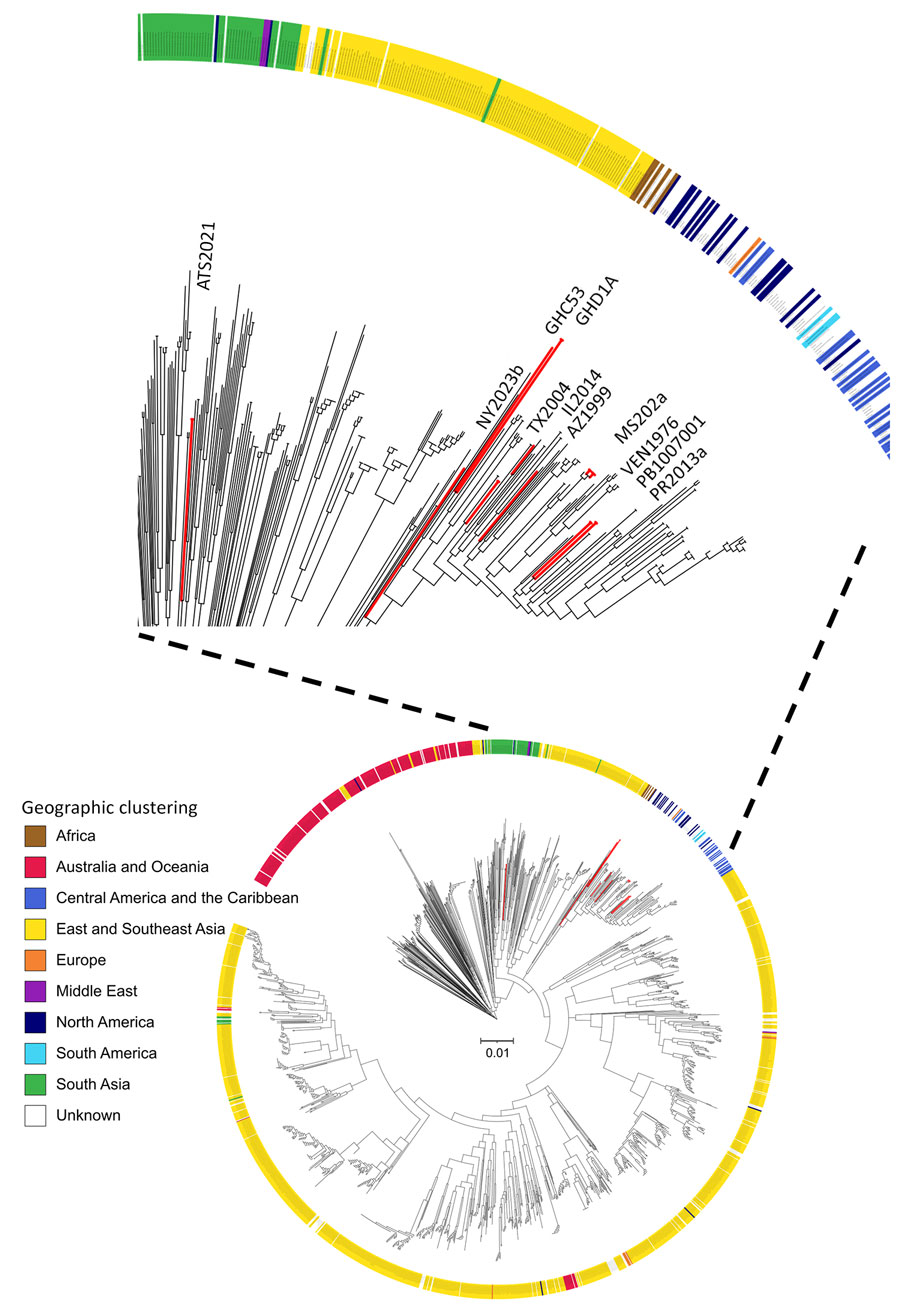
Figure 1. Maximum-likelihood core-genome phylogenetic tree of all Burkholderia pseudomallei genomes (n = 1,956) from the National Center for Biotechnology Information RefSeq (https://www.ncbi.nlm.nih.gov/refseq) database used in study of B. pseudomallei virulence in mouse models. Red bars highlight the 10 isolates used in this study (inset); ring color denotes geographic origin. Scale bar represents nucleotide substitutions per site.
Page created: June 09, 2026
Page updated: July 28, 2026
Page reviewed: July 28, 2026
The conclusions, findings, and opinions expressed by authors contributing to this journal do not necessarily reflect the official position of the U.S. Department of Health and Human Services, the Public Health Service, the Centers for Disease Control and Prevention, or the authors' affiliated institutions. Use of trade names is for identification only and does not imply endorsement by any of the groups named above.