Virulence of Burkholderia pseudomallei Strains from Western Hemisphere and Africa in Mice
Christopher P. Klimko, J. Matthew Meinig, Kevin D. Mlynek, Nathaniel O. Rill, Sergei S. Biryukov, Jennifer L. Dankmeyer, Annette M. Gray, Jennifer Chua, Stephanie A. Halasohoris, Michael L. Davies, Brian A. Smith, Carlos I. Rodriguez-Negron, Christopher T. Braun, Elsie E. Martinez, Jade L. Spencer, David N. Dyer, Ondraya M. Frick, Marjorie E. Torres, Mindy G. Elrod, Jay E. Gee, Christopher A. Gulvik, Zachary P. Weiner, Ju Qiu, Joel A. Bozue, David DeShazer, and Christopher K. Cote

Author affiliation: US Army Medical Research Institute of Infectious Diseases, Frederick, Maryland, USA (C.P. Klimko, J.M. Meinig, K.D. Mlynek, N.O. Rill, S.S. Biryukov, J.L. Dankmeyer, A.M. Gray, J. Chua, S.A. Halasohoris, M.L. Davies, B.A. Smith, C.I. Rodriguez-Negron, C.T. Braun, E.E. Martinez, J.L. Spencer, D.N. Dyer, O.M. Frick, M.E. Torres, J. Qiu, J.A. Bozue, D. DeShazer, C.K. Cote); Centers for Disease Control and Prevention, Atlanta, Georgia, USA (M.G. Elrod, J.E. Gee, C.A. Gulvik, Z.P. Weiner)
Main Article
Figure 3
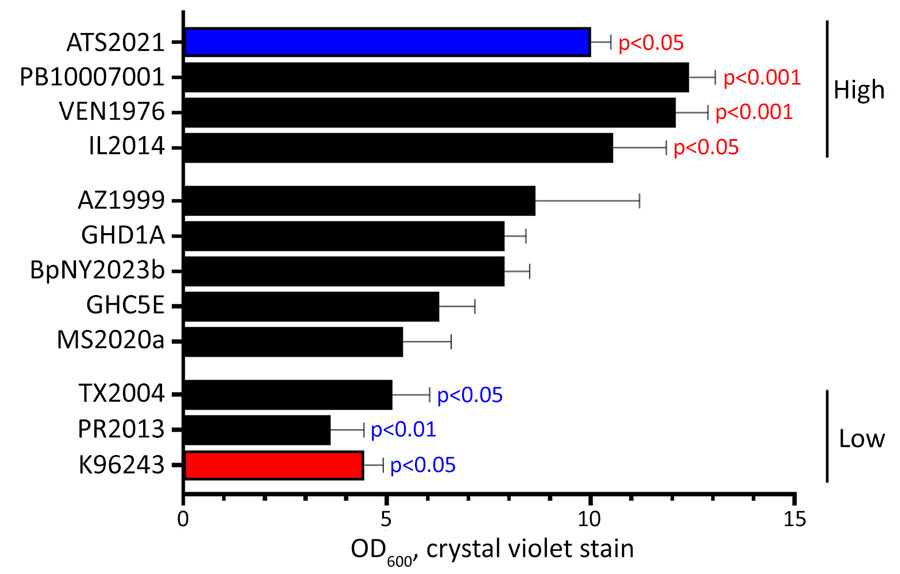
Figure 3. Observations of biofilm formation in a study of Burkholderia pseudomallei virulence in mouse models. Burkholderia pseudomallei isolates were inoculated into Luria broth with 4% glycerol and incubated statically at 37°C for 24 hours. We removed planktonic growth and stained the remaining biofilm by using crystal violet staining then quantified by using 600 nm optical density. We compared the test panel (represented by black bars) with a hyper-biofilm producing strain (strain ATS2021, represented by blue bar) and a common strain used in the laboratory with low biofilm formation (strain K96243, represented by red bar). Data displayed are the averaged results of >3 biologic replicates with error bars representing the standard error of the mean. Red p values indicate statistical significance relative to strain K96243. Blue p values indicate significance relative to strain ATS202. OD600, optical density at 600 nm.
Main Article
Page created: June 09, 2026
Page updated: July 28, 2026
Page reviewed: July 28, 2026
The conclusions, findings, and opinions expressed by authors contributing to this journal do not necessarily reflect the official position of the U.S. Department of Health and Human Services, the Public Health Service, the Centers for Disease Control and Prevention, or the authors' affiliated institutions. Use of trade names is for identification only and does not imply endorsement by any of the groups named above.