Ebola Bundibugyo Virus Disease in the Democratic Republic of the Congo and Uganda
Key points
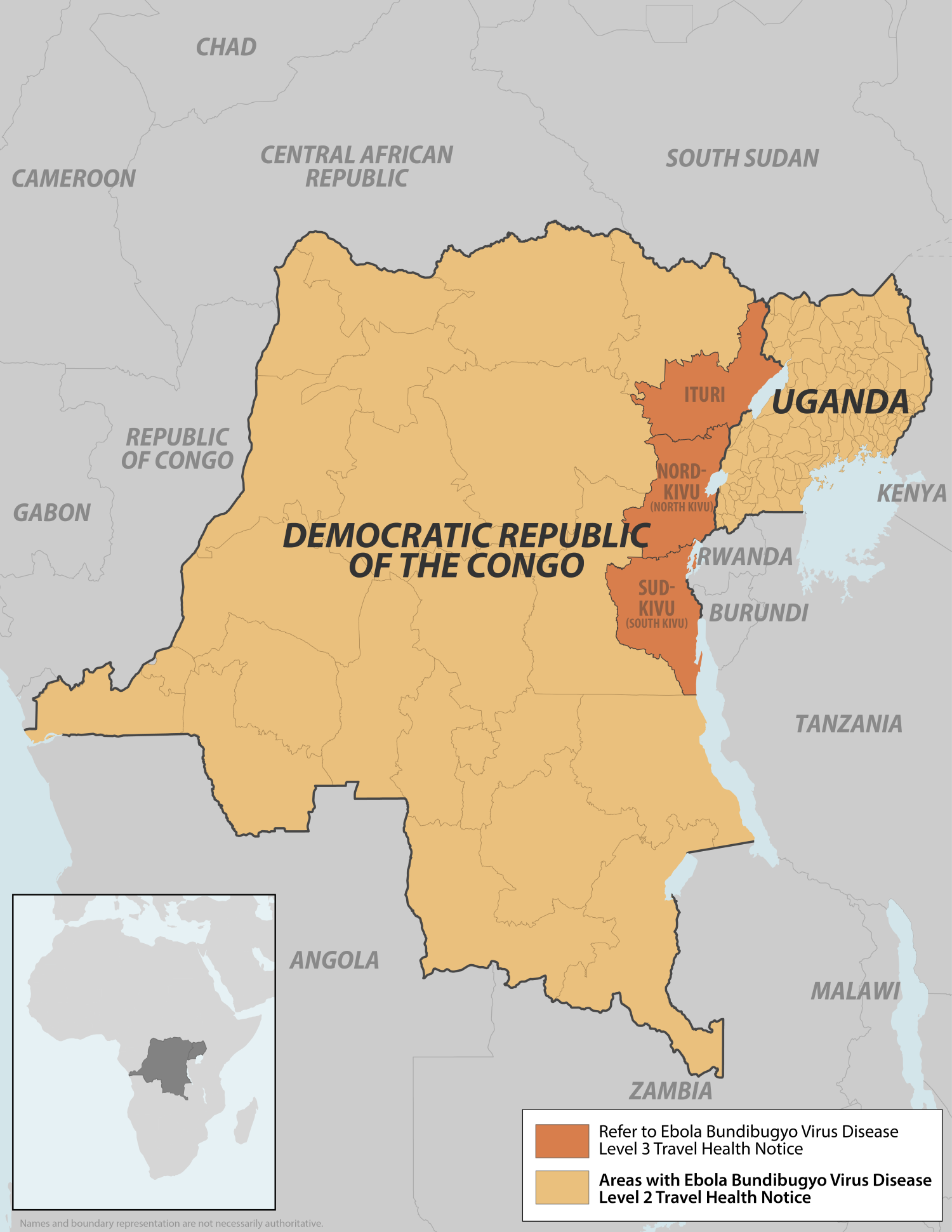
- CDC recommends practicing enhanced precautions for travel to Uganda or to provinces in the Democratic Republic of the Congo (DRC) not affected by the current Bundibugyo virus disease (BVD) outbreak (see map).
- CDC recommends avoiding all travel to Ituri and Nord-Kivu (North-Kivu) provinces in the DRC unless traveling for humanitarian aid or emergency response.
- CDC recommends avoiding nonessential travel to Haut-Uélé and Tshopo provinces in the DRC.
- To reduce the risk of Ebola importation into the United States, U.S. entry for travelers who were recently in the Democratic Republic of Congo (DRC) is temporarily restricted. Travelers, including Americans, who have been in the DRC within 21 days of their flight will not be allowed to board commercial flights with U.S. destinations. All U.S. citizens and U.S. nationals who have been in the DRC should plan to remain outside the DRC for 21 days before entering the United States.
- U.S. citizens and U.S. nationals who have been present in Uganda or South Sudan (and not present in DRC) within 21 days of arrival in the United States must only enter through designated airports for enhanced screening. Please review the CDC’s information on what travelers need to know about returning to the United States from DRC, Uganda, and South Sudan for the list of designated airports and for health information about Ebola. Americans who need consular assistance can visit Additional Consular Information for Americans Regarding the Ebola Outbreak, or call the Department of State:
- From the U.S. and Canada: +1-888-407-4747
- From all other locations: +1-202-501-4444
For travelers who have been outside of the Democratic Republic of the Congo, Uganda, or South Sudan for more than 21 days and need assistance with a public health travel restriction, please contact Ebola-Travel-HELP@hq.dhs.gov.
If you are traveling to the DRC or to Uganda, you should:
- Review CDC Health Information for Travelers to the Democratic Republic of the Congo and Uganda to find out about routine precautions travelers should take when traveling to the DRC and Uganda.
- Consider getting travel insurance before you travel, including health and medical evacuation insurance, to cover yourself in case delays, injuries, or illnesses occur on your trip.
- Avoid contact with people who have symptoms such as fever, muscle pain, and rash.
- Avoid contact with blood and other body fluids or objects that are contaminated with them.
- Avoid visiting healthcare facilities for non-urgent medical care or for non-medical reasons.
- Avoid traditional healers.
- Avoid contact with dead bodies or items that have been in contact with dead bodies.
- Avoid participating in funeral or burial practices that involve touching the body of someone who died.
- Avoid exposure to semen from men who have recovered from BVD until testing shows that the virus is no longer in the semen.
- Avoid contact with bats, forest antelopes, nonhuman primates (e.g., monkeys, chimpanzees, gorillas), and blood, fluids, or raw meat from these or unknown animals.
- Avoid going into areas where bats live, such as mines or caves.
- Monitor yourself for symptoms of BVD while in the country and for 21 days after leaving. If you develop fever, headache, muscle pain, weakness, diarrhea, vomiting, stomach pain, or unexplained bleeding or bruising (a late stage of illness):
- Separate yourself from others (isolate) immediately.
- Do not travel.
- Contact the local health authorities or a healthcare facility for advice. Calling ahead before going to a healthcare facility helps the facility prepare for your arrival, including contacting health authorities and taking any precautions needed to protect staff and other patients.
Traveler Information
- Health Information for Travelers to the Democratic Republic of the Congo
- Health Information for Travelers to Uganda
- CDC Ebola Website
- Travel Health and Medical Evacuation Insurance
- Register with the U.S. Department of State
- Information for Travelers Returning from Ebola-Affected Areas
Clinician Information
- Post-Travel Evaluation to Rule Out Viral Special Pathogen Infection in the CDC Yellow Book: Health Information for International Travel
- Clinical Screening and Diagnosis for VHFs | Viral Hemorrhagic Fevers (VHFs) | CDC
- Viral Hemorrhagic Fevers (VHFs) for Healthcare Providers
Information for Organizations
Bundibugyo virus disease (BVD) Bundibugyo virus disease (BVD) is a rare and potentially deadly type of viral hemorrhagic fever. BVD is caused by Bundibugyo virus, a type of Ebola virus. BVD has caused two previous outbreaks, one in Uganda in 2007 and one in DRC in 2012.
BVD disease is spread by contact with the blood or bodily fluids of a person who is infected with or has died from BVD. It is also spread by contact with contaminated objects (such as clothing, bedding, needles, and medical equipment), or by contact with animals, such as bats and nonhuman primates, that are infected with BVD.
Symptoms include fever, headache, muscle pain, weakness, diarrhea, vomiting, stomach pain, and unexplained bleeding or bruising (a late stage of illness).
There are no vaccines or specific treatments approved to prevent or treat BVD. Early supportive care improves the chance of survival.